
When “NFL RedZone” launched in 2009, host Scott Hanson welcomed Week 1 viewers by saying, “You’re watching the first moments of the channel that we hope will change the way you watch football — forever.”
Today, Hanson is a cult hero to millions of football fans, and “RedZone” has so revolutionized how the sport is consumed that the recent introduction of four 15-second ads interrupting the show’s seven hours of live games incited revolt. With Hanson at the helm, “RedZone” flies viewers around the world of football on Sunday afternoons during the NFL regular season, often with several games on screen at once, showing every touchdown from every game and more. It’s must-see TV for diehards like Jim Serratore.
Serratore, a senior producer at MLB Network, leads the team that puts together “Big Inning,” a scaled-down baseball equivalent to “RedZone,” each day during the MLB regular season. For baseball fans seeking the firehose viewing experience “RedZone” has brought to football, “Big Inning” is a tantalizing option — if you know where to find it (more on that later) and when it airs (more on that, too). But “Big Inning” has not yet captured viewers in the way “RedZone” has, and the show’s very premise begs the question: Is baseball built for this? Even if “Big Inning” executed its approach flawlessly, can a slow-paced sport still command viewer interest when the closest corollary to a red zone is a runner on third base?
Serratore is certain it can. He is glued to “RedZone” on Sundays as a fan and an apprentice, taking note of how the show brings order to chaos.
“The fact that my brain could even conceptualize a show like this is thanks to ‘RedZone’ existing for 16 years,” Serratore said. “It showed sports fans there’s a different way to watch games. It doesn’t have to be one at a time.”
Before “Big Inning” evolved into its current format in 2023, showing four games simultaneously, the show was exactly that: one game at a time for a few batters, then on to the next game. “You can tell how bored I am telling you that,” Serratore said, “because that’s how boring it was to watch compared to what we’re doing now.” Producers curate which broadcasts are seen (and heard) in the quadbox, and a host segues and interjects context.
There are frenzied moments in each “Big Inning” broadcast that illustrate its potential: a no-hit bid in one quadrant of the screen, a back-and-forth battle brewing in another, a third in walk-off territory. Even if the action amounts to pitchers and catchers playing catch, the viewer has four chances to see a big play break out. A trained eye knows instinctively where to look. Baseball, like football, has pauses between plays. And because games are shot with the batter and pitcher in a tight frame, “it works perfectly for showing more than one thing at once,” said Kevin Cooper, a senior manager for MLB Network’s “Overdrive” who orchestrated the visual evolution of “Big Inning”.
In some ways, “Big Inning” still feels like a concept in its nascence, figuring out how best to fit baseball into a template perfected by “RedZone.” Yet it’s such a mesmerizing way to watch ball — a screen full of games with no blackouts or (on MLB.TV) commercial breaks — that it’s fair to wonder why the show doesn’t already have a wider audience. It has scant web presence or publicity. Most discover it by accident. The show lives primarily as a streaming product on MLB.TV, but also airs weekdays on Apple TV+ and intermittently on MLB Network.
Remaining Big Inning schedule
DayDateTime (ET)Channel
Thursday
Sept. 25
7-9:30 p.m.
MLB.TV, Apple TV+
Friday
Sept. 26
8:30-11:30 p.m.
MLB.TV, Apple TV+
Saturday
Sept. 27
8-10:30 p.m.
MLB.TV, MLB Network
Sunday
Sept. 28
3-6 p.m.
MLB.TV
Once, when MLB Network analyst Mark DeRosa made the “Big Inning”-“RedZone” comparison to Matt Yallof, one of two “Big Inning” hosts, Yallof replied, “The difference is this: It’s seven days a week.”
That’s the allure of “Big Inning,” and also what makes it a logistical morass. “RedZone” runs 18 Sundays each year. “Big Inning” aired about 185 times this season. But because the show runs for just 2 1/2 to 3 hours daily, it stops short of being a one-stop shop for the baseball sickos seeking one place to watch all the action in a baseball game day, from start to finish.
Could it eventually become that — truly a “RedZone” for baseball?
“The short answer is yes, this could be an all-inclusive night in the future,” Serratore said. “I’ve wanted that for a couple years, since we kind of proved that this works. The natural next question is: Why don’t we stay on longer?”
Timing is the most frequent complaint about “Big Inning” — both its inconsistent start time and the hard out at its scheduled conclusion. For the final week of the MLB regular season, the show has six different start times in seven days. The reasoning behind it is reasonable (the “Big Inning” staff is trying to select the window of games with the best action), but the schedule is hard for viewers to track. Most nights, the show begins midway through the 7 p.m. ET slate of games. There are runs on the board everywhere, and often no recapping of how they got there.
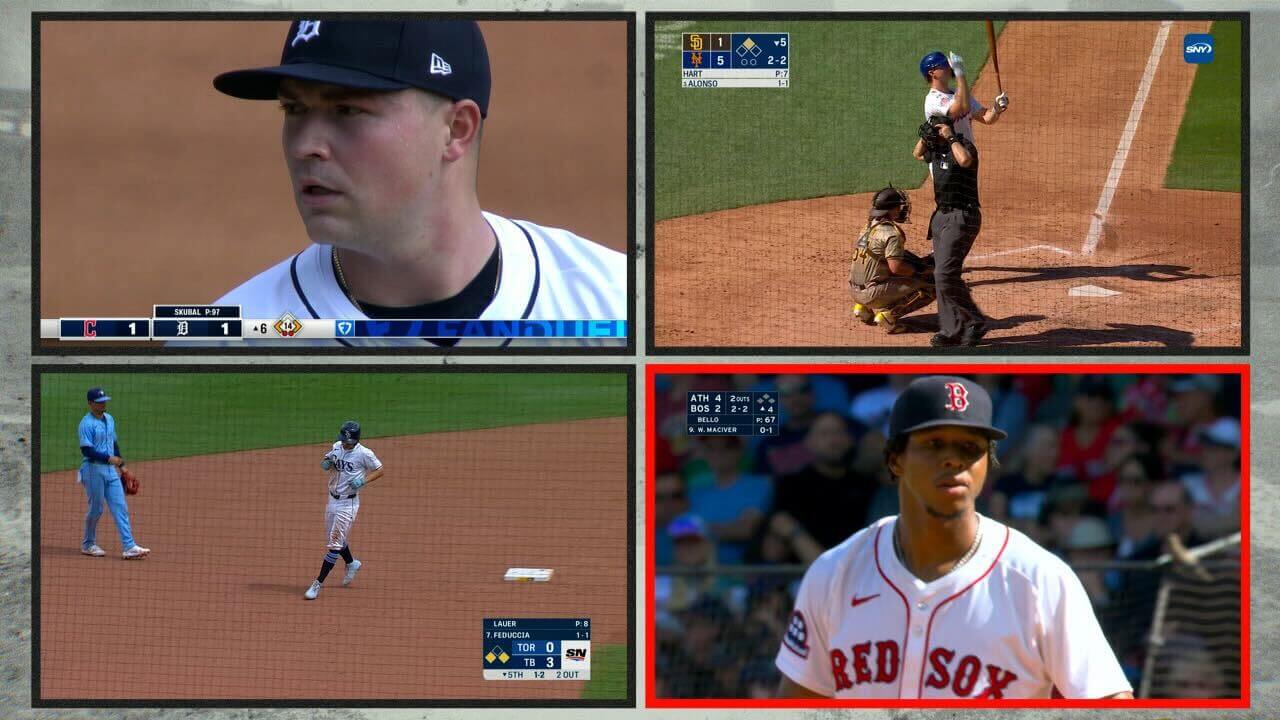
“Big Inning,” much like the NFL’s “RedZone,” features a quadbox of action from the day’s games. (Courtesy of MLB Network)
The MLB schedule fluctuates so much — start times stretching from before noon to after 10 p.m.; fewer games on Mondays and Thursdays; earlier games on weekends — that “Big Inning” could never cover every game, every day, even if it expanded its hours. But it would benefit from not leaving viewers hanging with an abrupt ending. When Yallof signed off at 10:30 p.m. on Sept. 16, the New York Yankees were holding off a furious Minnesota Twins comeback in the ninth inning, Toronto Blue Jays closer Jeff Hoffman was on the mound in Tampa, Seattle Mariners outfielder Dominic Canzone was about to hit his third homer of the night, and Shohei Ohtani was on the mound in the first inning facing the Philadelphia Phillies.
Serratore and Cooper said they understand viewer frustration about timing, and largely agree with it.
“It’s great criticism to have,” Cooper said. “Obviously, there’s an appetite.”
“Is there a world where maybe ‘Big Inning’ covers 7 p.m. to 1 a.m. in the future? I wouldn’t say no to that,” Serratore said. “Coop and I would welcome a world like that. But those are all decisions that haven’t been made yet.”
Another area in which “Big Inning” has continued to iterate in recent years is how to best deploy its hosts, Yallof and Gregg Caserta. That’s the show’s second-most common criticism. Hanson has set a high bar. Ideally, the host serves as a point guard, guiding the viewer from box to box, game to game, in a couple of sentences — dropping a quick fact or cueing up an approaching Aaron Judge at-bat — and then getting out of the way. But some moments are enhanced by further involvement; when Detroit Tigers ace Tarik Skubal’s injury was the story of the night, Yallof pulled in updates from social media and aired Skubal’s postgame interview.
“How do we add to the presentation with the host microphone and not overtake it?” Serratore said. “But also not say so little that we’re not involved? That’s an evolution we’re still working on perfecting.”
What makes the host role especially challenging is that “Big Inning” is almost always showing live action. When Seattle slugger Cal Raleigh smacked a homer to surpass a record Mickey Mantle had held since 1961, Yallof was describing a different game. The audio didn’t switch to the Mariners broadcast until Raleigh crossed home plate, catching only the tail end of the home-run call: “Move over, Mick, Cal Raleigh is the new switch-hitting home run king! A player and season baseball has never seen before.”
It’s easier for a host to tee up a replay than to try sussing out where action will arise. Even “RedZone” typically zooms in on a primary game, then pulls in replays from others just after they happen — an approach that “Big Inning” has not experimented with much, but may in the future.
“The way we’re doing it, the trade-off is we’re maximizing the moments live that you’re going to see live,” Serratore said, “and it minimizes the feeling of: Here’s a lot of stuff that already happened.”
At MLB Network, “Big Inning” is considered a complement to “MLB Tonight,” the network’s signature show, in which in-studio analysts provide commentary during live look-ins around the league. Taped in the same Secaucus, N.J., facility as “Big Inning,” “MLB Tonight” has all the polish of an award-winning show that’s been running for 16 years. There’s expert insight from veteran hosts, players and broadcasters, news-of-the-day discussion and on-field demonstrations. It’s smart, instructive, funny. A downright responsible way to consume a night of baseball games.
Comparatively, “Big Inning” is an all-you-can-eat baseball buffet. All action, all the time. Whether there’s a widespread appetite for that, beyond fantasy baseball owners and bettors, will determine the show’s ceiling. As it has gotten more airtime on MLB Network this season, “Big Inning” viewership on the channel is up 17 percent from 2024, according to Nielsen. The show is up 28 percent in minutes watched on MLB.TV this year.
For “Big Inning” to become that “all-inclusive night” of baseball for future seasons would require more resources, marketing and airtime. Longer shows would mean more manpower on the production end, though the broadcast would still only need one on-air talent. If MLB Network makes growing the show a priority, perhaps all of that support will come.
At a time when network execs everywhere are seeking creative, cost-effective solutions to attract viewers and baseball’s stakeholders are fixated on increasing on-field action, “Big Inning” would seem to serve both purposes. It packages almost all the game’s activity together. It rarely feels slow. Even the sight of the Los Angeles Dodgers lineup turning over is appointment viewing. Shohei Ohtani, Mookie Betts and Freddie Freeman “might all pop up,” Serratore said, “but it still feels like a moment. It’s the equivalent of a red-zone drive that ends in a field goal. You’re still captivated because of who they are.”
Serratore will have his hands full Sunday, the last day of the MLB regular season and thus the last “Big Inning” of the year, but in a couple weeks, he’ll be back on the couch watching an afternoon of football on “RedZone.” While he hasn’t sought out anyone on the show for advice, Serratore said he views “RedZone” as “a friend that is showing us the way.”
“It’s obviously apples to oranges with the sports,” he added. “We take everything we can from what they’re doing, and appreciate them, then we want to do the best job we can to serve baseball in our unique way.”
No one is telling viewers “Big Inning” will change the way they watch baseball — forever. But, for some, maybe it will.
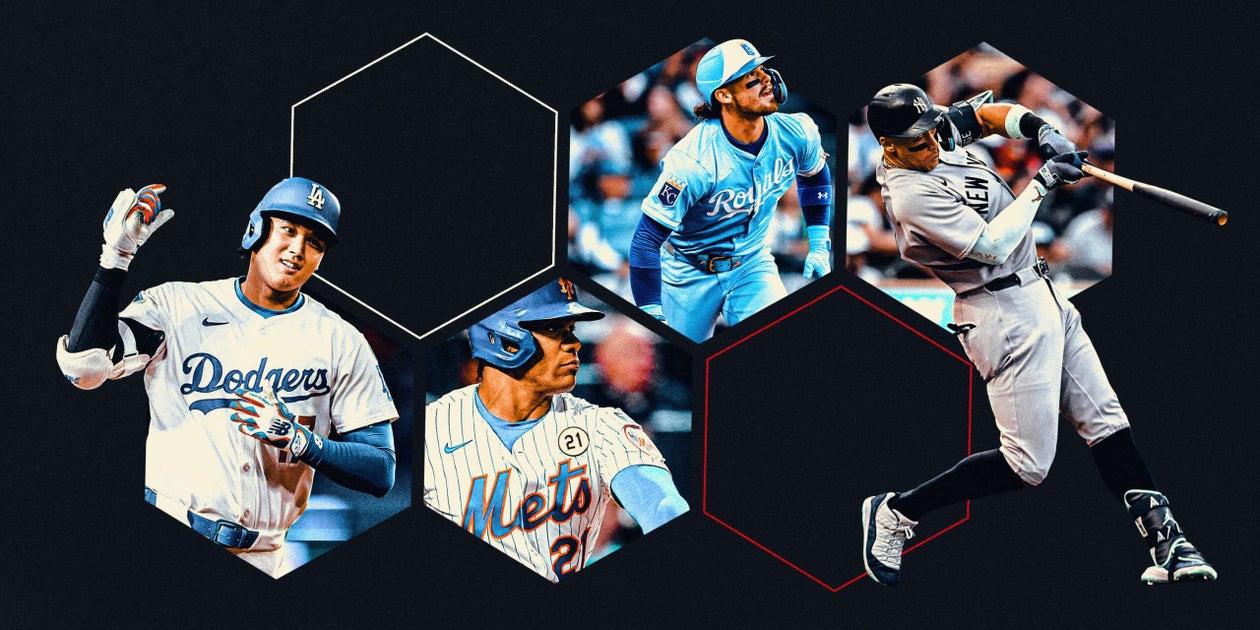
(Illustration: Kelsea Petersen / The Athletic; Ric Tapia / Getty Images, Stephen Maturen / Getty Images, Mary DiCicco / Getty Images, Lauren Bacho / Getty Images)