
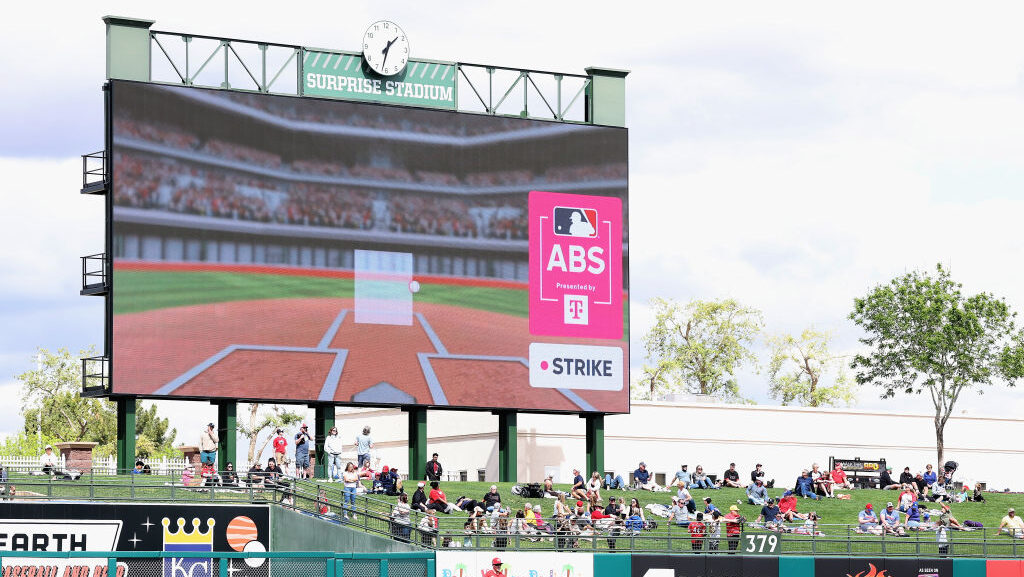
PHOENIX — It didn’t come as a surprise for anyone in the Arizona Diamondbacks’ clubhouse that the automated balls and strikes (ABS) challenge system will be added to Major League Baseball games next year.
Zac Gallen is on the Competition Committee (comprised of six owners, four players and one umpire) and heard first-hand on a call Tuesday morning that baseball is moving forward with another significant change.
“I think whether you were in favor of it or opposed, it was coming anyway,” Gallen said, explaining he leaned no but was largely indifferent. “Just the structure of the vote between the players and the owners. We had like two-thirds of the clubhouses were in favor of it.”
USA Today’s Bob Nightengale reported that 23 of 30 clubs voted in favor of the change, along with all six owners. Gallen said based on the results, the players submitted three yes votes and one no. The umpire voted against the measure.
ABS has gone through trials in the minor leagues, spring training and the 2025 All-Star Game.
The basics are that each team will have two challenges each game and keep them if they win.
Only the batter, pitcher or catcher can challenge a pitch by tapping their head, and it has to be quick. There is no appealing to the dugout like challenging a play at first base.
If someone challenges a ball or strike, using the Hawk-Eye view of the pitch, an animation is transmitted to the video board in the stadium and to the TV broadcast, showing the pitch location and whether the challenge was successful or not. All of this happens within a few seconds, it is not like other challenges than takes minutes at a time.
Here’s what it looked like in a critical moment of a minor league game last year:
Upon further review… @GoStripers win it!@Braves prospect Hayden Harris records all of his outs via strikeout to earn the save — with the final one coming on an ABS challenge: pic.twitter.com/dlnBOvUoOs
— Minor League Baseball (@MiLB) September 18, 2024
This solution is a middle ground between fully automated balls and strikes (robo umps) and the status quo.
“I think the fans are gonna love it,” utility player Tim Tawa, who has experience using ABS in Triple-A, told Arizona Sports. “I think it’s gonna add a new dimension to the game that fans really get into, just because there’s tension and excitement when someone challenges and you see it on the board.”
Manager Torey Lovullo made the point that replay challenges in games were big changes that feel routine now, and he imagines this will fall under that umbrella. MLB has implemented a pitch clock, disengagement limits for pitchers, mound visit limits and the three-batter rule for pitchers within the past decade.
Diamondbacks to plan strategies for challenges
Missed balls and strikes calls happen all the time, but when to fire off a challenge will be an added element of strategy in baseball games moving forward. Blowing a challenge in the first inning would be a detriment, for example.
Gallen joked during spring training that he told catcher Gabriel Moreno to handle all the challenges since he would tap on his hat too often.
Lovullo said pitchers may not be the most trustworthy with handling the responsibility.
“We’re gonna put some protocols in place,” Lovullo said. “I don’t know what those are, but from the small experience we had during spring training, the pitchers were a little bit more emotional and I think they were the ones that were missing those calls. The catchers and the hitters were usually pretty tight on the zone, so we’re gonna definitely give it to the catchers.”
There is going to be a balancing act for catchers.
The art of pitch framing and strike stealing is a significant element of a catcher’s role defensively. That’s still going to be valuable, but Moreno noted that catchers will have to be more intuned with where the ball crosses the plate now to decide whether a challenge is warranted, as opposed to be hyper focused on bringing it into the strike zone.
Tawa said from experience that ideally you would have one saved for a critical point late in the ballgame. In Triple-A, teams had three challenges to work with last year, so knocking that down to two also has its adjustments.
“I’ve been one of those people where early I thought there was a ball and it’d be right on the line,” Tawa said. “I did it when there were three challenges. I guess you could really try one early. But with two this year, there were a couple times where we would use one in the first or second inning and it wasn’t right. And then you have to be really careful with it.”
Any concerns with the ABS system?
There were some concerns brought up amongst veterans regarding the strike zone consistency.
The plate is 17 inches wide. The top of the zone is 53.5% of the player’s height. The bottom is at 27% of player heights.
Players will have their heights measured in spring training in a standardized manner.
“I was just curious what the shape of the strike zone was gonna look like from a digital standpoint,” Gallen said. “I just wanna make sure that the heights of the players are strictly enforced. I know in Triple-A, not all the heights were necessarily exact. And I get that like Triple-A you’re operating on a lower budget or whatever it is, but the last thing you want is for hitters to be 6-foot-2 and it says they’re 6-foot.”
Reactions pour in from around the Diamondbacks’ clubhouse to being able to challenge balls and strikes next season.
The Automated Ball/Strike (ABS) System is coming. pic.twitter.com/6iDWQeYvHS
— Arizona Sports (@AZSports) September 24, 2025
Catcher James McCann added: “What worries me is the ABS zone varying from stadium to stadium. I guess that leads to a little bit of home field advantage, knowing that the strike zone plays a little higher, a little lower, a little more of the first base side, the third base side, whatever it may be. Hopefully those kinks are worked out because I know that was one of the things they’ve talked about among minor league players is from stadium to stadium they felt like the zones played a little bit differently. But all in all, I’m for it.”
Jalen Beeks, a veteran reliever who has minimal experience with ABS, said he’s heard the strike zone is a bit tighter. According to MLB.com, umpire-called zones are typically more favorable to pitchers with a strike zone of 55.6% up top and 24.2% at the bottom.
Beeks’ curiosity is whether hitters become more stubborn, holding off on swinging the bat as much, but he assured that pitchers will adjust.
Gallen joked the strike zone always feels too tight anway.
Owen Caissie with that 80-grade vision 😉
The red-hot @Cubs prospect wins an ABS challenge to draw a walk in the Futures Game ⭐️
Watch what’s next LIVE: https://t.co/4VErWf6Pit pic.twitter.com/YFGlPv4EhN
— Minor League Baseball (@MiLB) July 12, 2025
Will there be dozens of challenges every game?
According to Baseball America, there were 4.2 ABS challenges per game. So while technically teams can challenge every pitch if an umpire is having a poor day, the reality is that baseball is still baseball and only a handful of pitches each game will be up for review.
“Guys aren’t just gonna be challenging left and right,” McCann said. “There’s some gamesmanship to it. Early in the game, two outs, nobody on, challenging a borderline pitch and getting it wrong costs your team a valuable challenge down the road. I think that’s gonna be interesting to see how different teams operate.”
