

By now, the radical improvement in bat speed and hard-hit rate for Brice Turang this year is a well-known phenomenon. The changes Turang has made to unlock his power production, at long last, are front-page news, because he’s been the engine of one of the league’s best offenses—especially since the start of August.
Much of the change lies in Turang’s intention—his approach at the plate. He’s learned how opposing pitchers will attack him, and this year, he set out to better attack them, rather than taking a defensive mindset into the batter’s box. We’ve seen a major change in Turang’s bat speed, but it’s not a matter of entirely overhauling his swing; he just decided to cut it loose much more often. He was never a hitter who couldn’t swing fast. He had just chosen not to, and he’s now making a different set of choices at the plate.
That said, there are more changes afoot than a simple acceleration of his swing. He’s swinging faster, and swinging fast more often, but he’s also getting much more value out of his fast swings than he did last year—and more out of his slower swings, too. Here’s a chart showing the distribution of his swing speed for 2024, colored by run value per 100 pitches.
.jpeg.a6aeebf9fd237e90c70de0880d2a99ed.jpeg)
Here’s the same chart for 2025.
.jpeg.641e947fa0a19594f4f5344e21b63d05.jpeg)
As you can see by the more vibrant red at the right edge of the second chart, Turang has produced about twice as much value on a rate basis when swinging fast this year, in addition to swinging fast more often in the first place. To understand why, you just need to see the change in his batted-ball distribution. Here, side-by-side, are the charts of Turang’s batted balls by launch angle and exit velocity for each of the last two years. The closer to the edge of the chart a given point is, the harder that ball was hit. To highlight the big changes from last season to this one, I’ve added three outlines to each chart.
.png.1811a5a3565c75d33db80b27b814e971.png)
The three bins created by those outlines are: very high fly balls (basically, pop-ups, or lazy flies); hard-hit line drives; and medium- to hard-hit balls at a sharply negative launch angle. Turang has hit many fewer of the high flies and the choppers, and many more of the hard liners and low flies. That all three shifts are good news goes without saying.
But how, exactly, is Turang concentrating more of his well-struck balls in a highly productive launch angle band? For that answer, we can’t look to bat speed, because swinging faster usually makes one’s barrel less accurate, not more so. Most guys who gain bat speed do it partially by flattening their swing, so less of the force they put into the stroke is going into the process of getting the bat moving uphill and more of it is going into the horizontal rush of the rotation. Flat swings tend to mean more contact per swing, but more balls hit at very high or low launch angles; errors in timing or pitch recognition are more likely to produce mishit batted balls.
Turang, however, has gone the other way. From last year to this year, and even within this season, his swing has gotten steeper—that is, he’s tilted the barrel down more as he brings the bat toward the hitting zone.
.jpeg.adfd1a10351772463244c6941694005f.jpeg)
That increasingly steep stroke gives him more of a range within which he can produce a batted ball between, say, 0° and 30° of launch angle. When he guesses right and he’s perfectly on time, he can hit a 430-foot home run, but even when he’s wrong or he’s slightly late, he has a good chance to split a gap or shoot a one-hopper through the infield.
Swinging faster and steeper is a neat trick. It’s why he’s more productive even before you account for the uptick in bat speed, and it’s why he’s been both more likely to hit balls in that productive launch-angle band and more successful when he does. Here’s the distribution of his batted balls by launch angle for 2024, colored by run value per 100 batted balls. I’ve overlaid his 2025 distribution, to show the places where he’s seen a big change in the frequency and/or the value of hits.
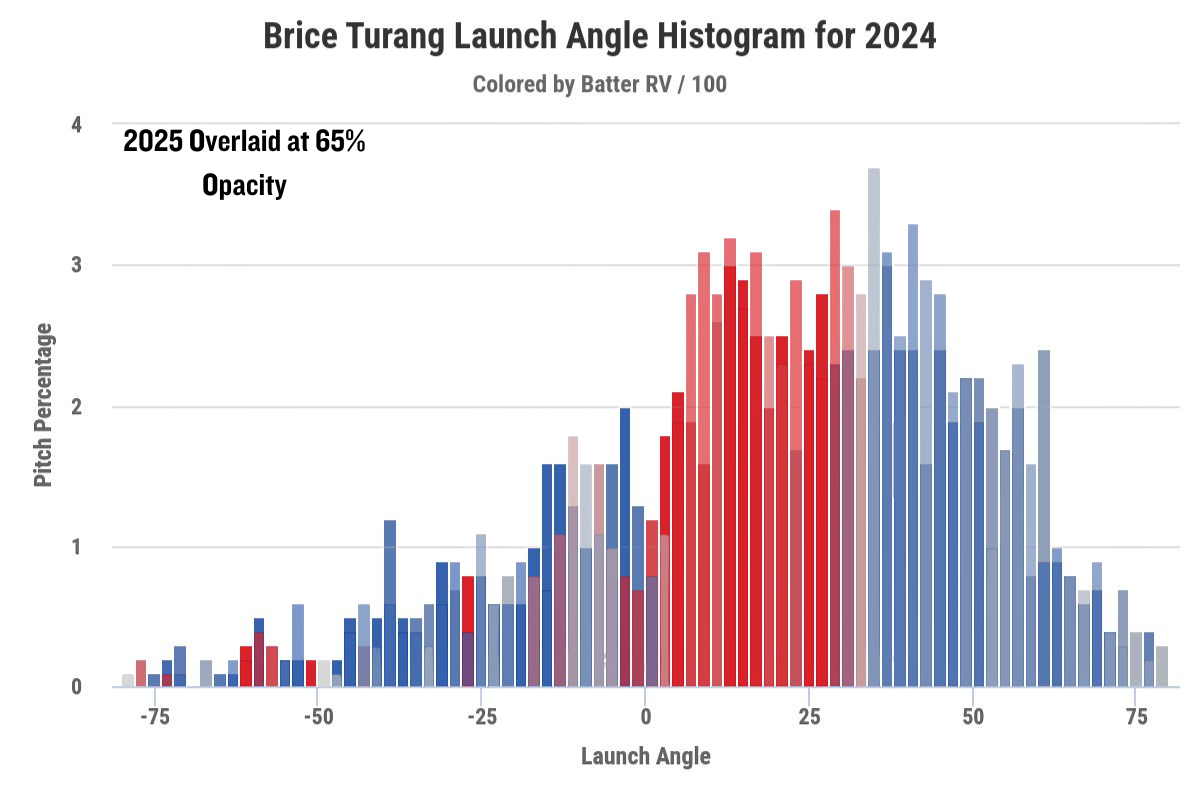
He’s hit a higher share of his balls in each of these (small) buckets from about 6° upward, but especially from 6° to around 40°. He was highly productive in the lower half of that range even last year, but look at the high 20s and low 30s. That’s where he’s not only hitting the ball more often, but has turned from not getting much out of it (his slower swing didn’t power those fly balls far enough to produce the power they promise) to getting a ton out of it. That’s the magic of blending increased tilt and increased swing speed.
As he’s made that shift, he’s become better able to cover the whole plate. Even through July, with his better bat speed and better outcomes across the board, he was largely playing defense on the outer third of the plate. Pitchers could work him there without much fear, knowing that he might poke a single to left field fairly often, but he wasn’t going to turn on the ball or split a gap very often. Here’s a look at his weighted on-base average by pitch location through the end of July.
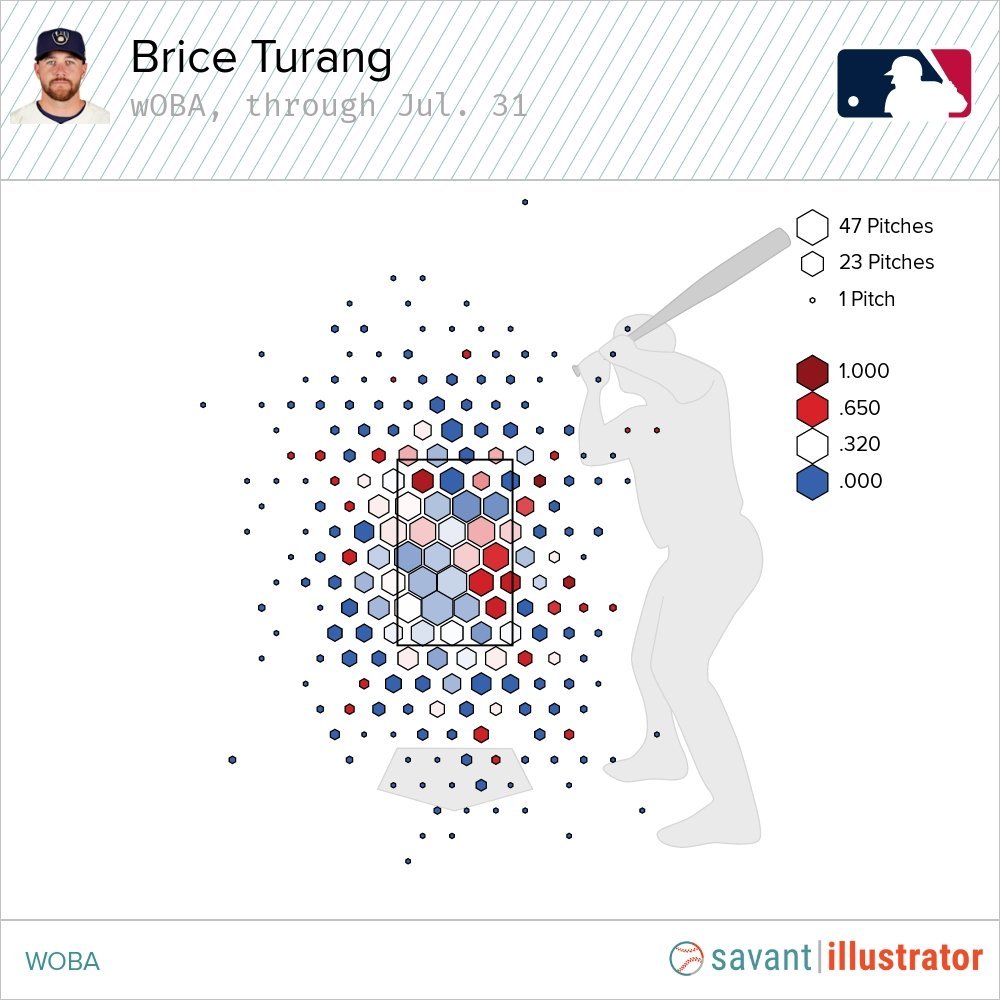
With the increase in his tilt, though, Turang has become more adept at lifting the ball, and he can even pull pitches on the outer half—or line a ball out on the edge right into center field, as he did on his go-ahead hit against the Padres Wednesday. As a result, he’s more dangerous throughout the zone—but especially in the lower half of it. As you’d guess, the steeper a swing is, the better it plays from the belt downward, and the more trouble a hitter tends to have with pitches above the navel.
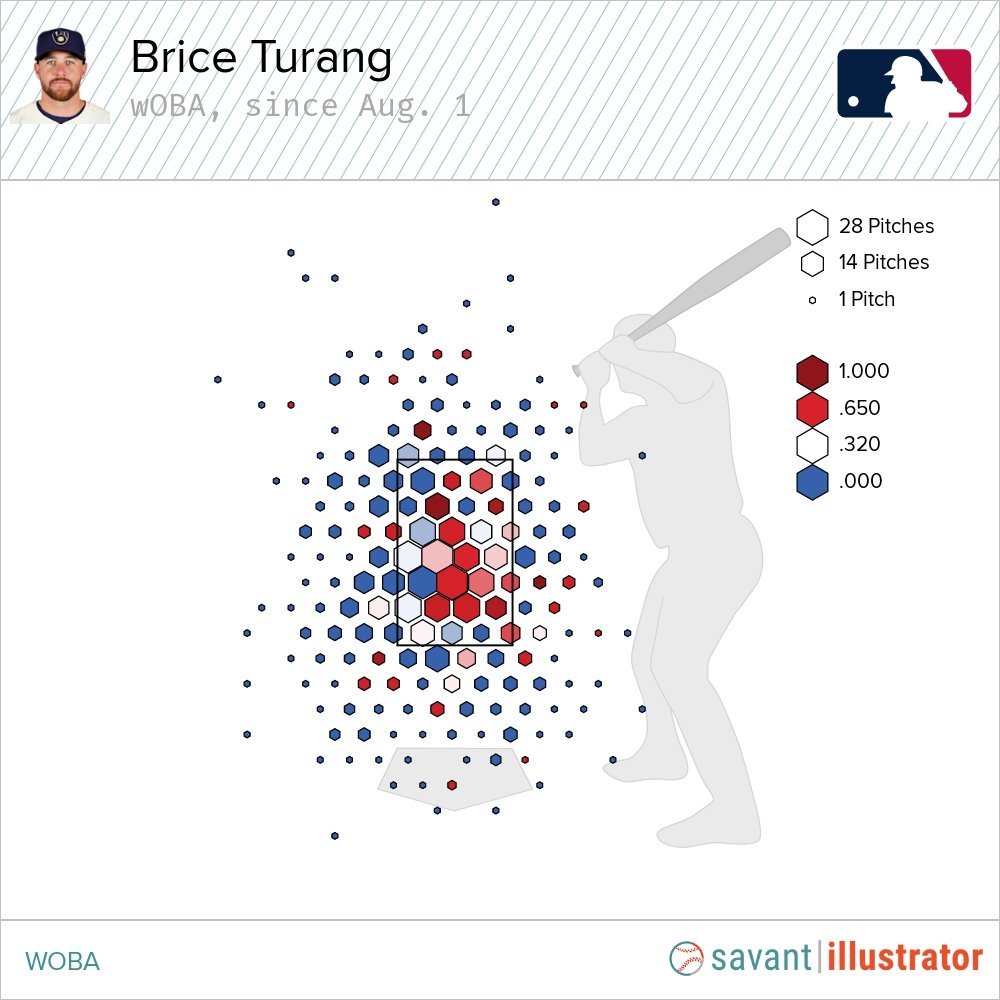
Turang still has a very adaptable swing, and he can sometimes sit on a location up in the zone and attack it with a flatter approach. By and large, though, he’s a steeper swinger now, so he should be looking to swing at more pitches down and fewer up. Here’s a heat map of his swings through the end of July.
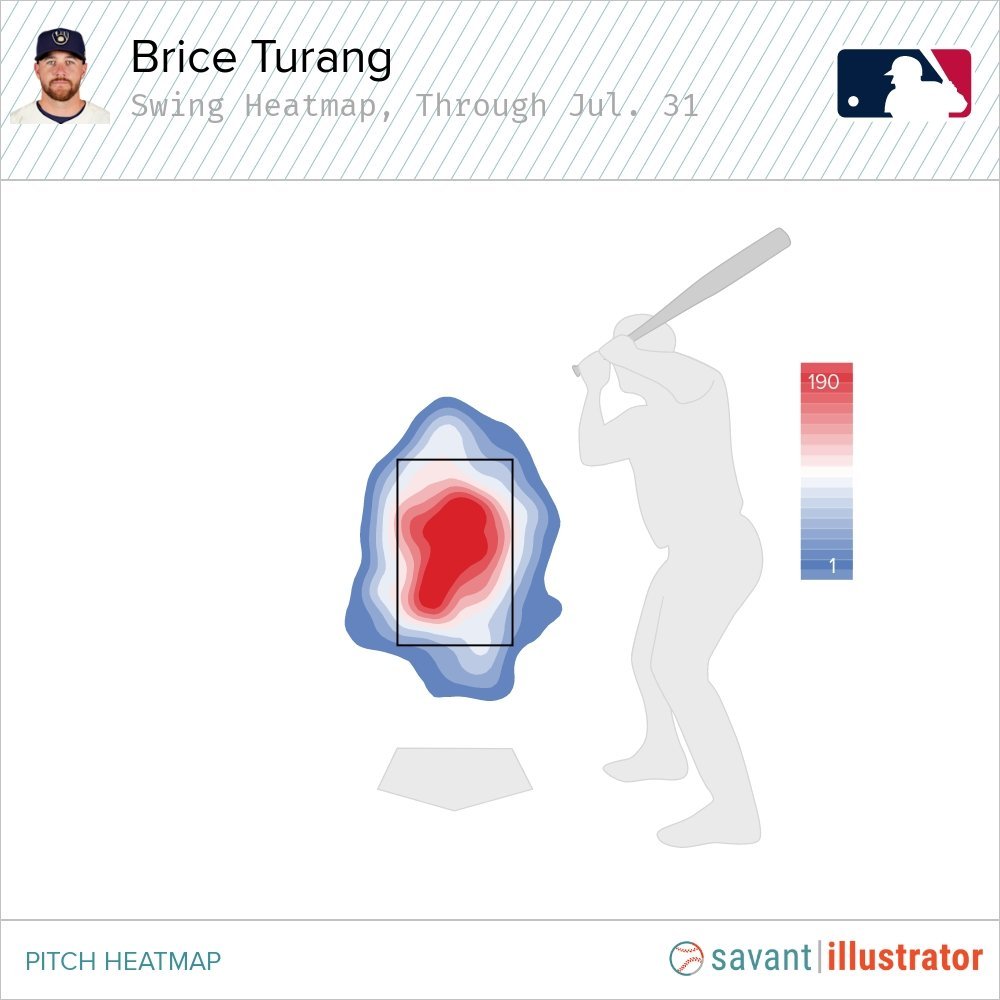
And here’s the same for the last two months.

There you have it. Turang has sped up his swing this year, but as it’s progressed, he’s also tapped into more of the loft of which he’s capable. To do so, he’s needed to adjust his approach, but that, too, has come fairly easily to him. By no means is Turang one of the Brewers’ most cerebral players. He’s a cage rat, though, and without thinking about all of this in quite the way we’ve just walked through it, he’s found his way to an ever-improving best version of himself. Locked into one of the top five spots in the batting order on a daily basis, Turang will be a key cog in the Milwaukee Speed Machine this postseason. His power is in full bloom, but he’s sold out very little for it. This is a mature swing, and a mature approach, from a player who has used every rep he’s gotten in professional baseball to hone his craft.