
TORONTO — Red Sox chief baseball officer Craig Breslow made a bold statement the day after he traded slugger Rafael Devers to the Giants.
“I do think that there is a real chance that at the end of the season we’re looking back and we’ve won more games than we otherwise would’ve,” Breslow said.
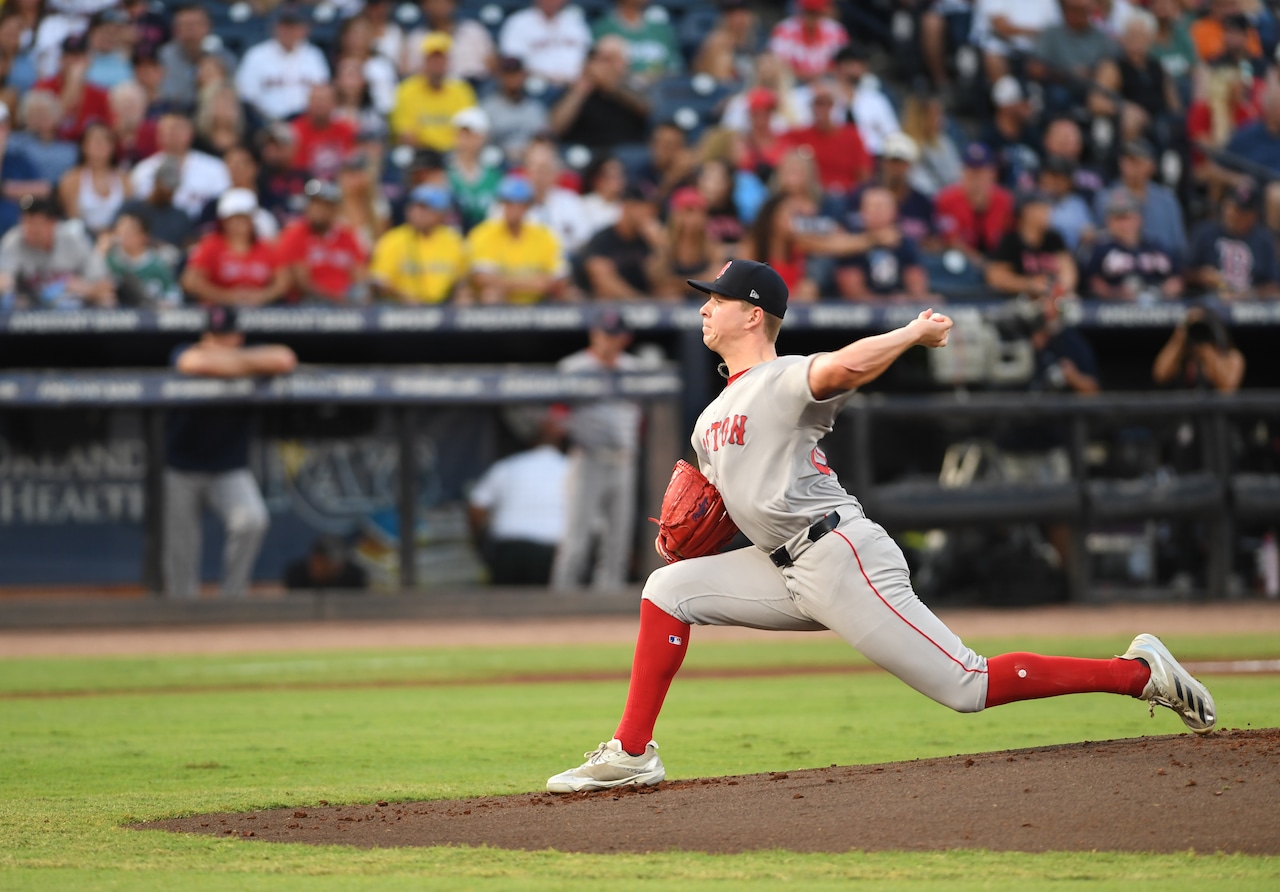
The Red Sox were 37-36 back then. They have gone 50-36 without Devers and have a chance to clinch a postseason berth Friday at Fenway Park with Kyle Harrison, the highest upside piece from the Devers trade, starting on the mound.
Harrison is excited he’s finally contributing after almost three months at Triple-A Worcester where he reworked his pitch mix.
“I just wanted to get here and help the team,” Harrison said. “Took me a little while, but I’m glad they gave me that time to learn those pitches, just use them on hitters down there. Because who knows what would have happened if I just came over here and started throwing new stuff. So it was all a process and a learning experience, but I’m just happy to be here.”
The 24-year-old is one of four players whom the Red Sox acquired from the Giants.
Boston traded James Tibbs III, the top prospect from the blockbuster deal, to the Dodgers for right-hander Dustin May. Reliever Jordan Hicks has struggled (8.20 ERA in 21 relief outings). Jose Bello, the other player acquired in the trade, is years away from potentially helping as a 20-year-old who has yet to pitch above Low-A ball.
As of now, Harrison looks like the best piece Boston received. He has allowed one run in nine innings since the Red Sox promoted him from Worcester on Sept. 10. Meanwhile, Harrison has not been tracking Devers’ performance for the Giants.
“No, not at all,” Harrison said. “Not at all. I was trying to figure out how to learn a cutter and throw a new kick changeup and all that, man. So I’m just being where my feet are. And that’s all I can do.”
It all starts with the fastball for Harrison. Director of pitching Justin Willard has called it Harrison’s “bread and butter.”
Harrison has only slightly above-average fastball velocity, ranking in the 58th percentile among major league pitchers (94.8 mph) in that category. But opponents are just 12-for-78 (.154) with a .269 slugging percentage against the pitch.
“I think it’s honestly just the location,” Harrison said at Rogers Centre on Wednesday. “Location, first and foremost. I like to throw it top of the zone. … Then the thing that a lot of people don’t know is the vertical approach angle. It’s basically the angle of my arm coming into the zone. So it could appear that it’s a little lower than it should be.”
His extension (6.7) — which is in the 72nd percentile — is another reason the heater plays so well.
“My extension’s been a little less this year, but that’s something that’s played pretty well,” he said.
The Red Sox had him focus on his secondary pitches with Worcester.
“With the Giants, I used the heater a lot,” Harrison said. “I used it probably over 60%. That’s why when I got over here, they wanted to add the cutter, sinker, changeup — to protect the fastball.”
The cutter is brand new. He’s thrown it 20 times in his two outings for Boston so far, all to right-handed hitters. He said he’s “starting to love it.”
“Just giving hitters a different look — looking like a fastball, and it’s staying on that line. But it’s just basically cutting across, not even that much, maybe one inch,” he said. “But just the visual effect of it when you’re playing the angles of the heater, expecting it to go up and away. And then you’ve got the cutter to come in, and it protects it. You can’t dive out on a heater.”
Harrison pointed out that Red Sox rookie Connelly Early’s fastball plays so well in part because he has above-average secondary pitches. This is what Harrison hopes to achieve.
“I think he’s honestly got some more vert on his fastball than me,” Harrison said about Early. “His breaking stuff’s unbelievable. His changeup’s great. So it’s like, all we need to be able to do is spot that heater up in the zone, spot one down. Just mix it up.”
Early agreed, saying that he doesn’t think “there’s anything too crazy about” his fastball.
“I think it’s just that I like to throw a lot of other pitches,” Early said. “So throwing my changeup, throwing my curveball, throwing the cutter — if I’m able to land all those pitches, then if they’re not on go for the fastball, then it looks a lot harder than it really is. So just trying to keep the hitters off balance, and if they’re guessing on a certain pitch, hopefully the fastball is going to play up.”
Harrison said it’s tough to add new pitches during the season and he will put a heavy focus on his cutter during the offseason.
“I’m happy how I worked through it there (in Worcester) and just added it to my arsenal,” Harrison said. “Now we’re competing.”
If you purchase a product or register for an account through a link on our site, we may receive compensation. By using this site, you consent to our User Agreement and agree that your clicks, interactions, and personal information may be collected, recorded, and/or stored by us and social media and other third-party partners in accordance with our Privacy Policy.