
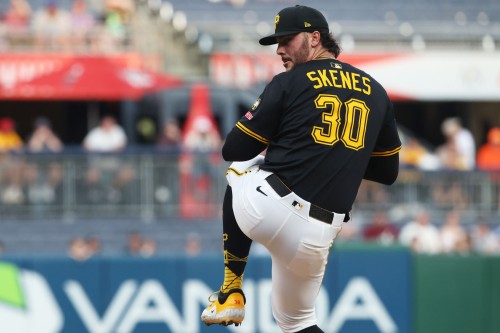
Paul Skenes’ 2025 campaign is now in the books, and in case you’ve been living under a rock – it proved to be another gem of a season. The 23-year-old clocked a 1.97 ERA, 0.948 WHIP, and 216 strikeouts across 187 innings through 32 starts for the Pirates. The numbers reflect an almost identical outlook to his 2024 rookie campaign (1.96 ERA, 0.947 WHIP).
As we head toward the offseason, with 4 years of team-control remaining for Skenes in Pittsburgh, much attention will be given to both his outlook with the last-place organization, and potential landing spots/subsequent contract extension numbers in the future.
We’ll address the latter here, with a much-too-early (but still relevant) look at the market valuation and potential contract extension breakdown for starting pitcher Paul Skenes.
Remaining Pre-Arbitration (2026)
Skenes hits the 2025 winter as the odds-on favorite to secure his first NL Cy Young, despite the fact that the Pirates will finish the season with a worse overall record than they did in 2024. So much for getting behind your star young ace and attempting to quickly build a contender. Skenes earned $875,000 in base salary this season, a figure that will soon be escalated thanks to the Pre-Arbitration Bonus pool (which paid him an additional $2.15M last season). As the likely Cy Young winner this season, Skenes will add a $2.5M bonus to his 2025 compensation. There’s likely another $1M or so available from the standard bonus pool allocation, raising Skenes’ likely 2025 output up to $4.3M (exactly double what he earned in 2024).
With that said, it’s hard to imagine a more lucrative pre-arbitation season than the one Skenes is about to see out, so keeping him at or around the $4M mark for 2026 seems judicious.
Spotrac Predicts
2026 (age 24): $1M salary, $4M signing bonus
Upcoming Arbitration (2027-2029)
From here we begin to evaluate Skenes as a looming free agent, running him through our true market value algorithm, with specific percentage points built in to allocate the various years of arbitration. Skenes is slated for Arbitration 1 in 2027, and based on our math, should be in line to double his final year of pre-arbitration (estimated $4M). Prime performance should dictate an Arbitration 2 salary that doubles the previous one, while the 3rd and final go-around generally comes with a little more back and forth. The last time a starting pitcher earned $20M+ in arbitration was never – so we’re walking into uncharted territory here, but rightfully so thus far.
The following arbitration projection for Paul Skenes stands to pay him out over $46M across the 3-year span. When combining this figure with the previous $4M allocation for 2026, we’re projecting a $50M payout for Skenes over the next 4 seasons.
Spotrac Predicts
2027 (age 25): $7.8M
2028 (age 26): $15.6M
2029 (age 27): $23.1M
Free Agent Years (2030-2032)
Skenes is eligible for free agency in the Winter of 2029, just prior to his age-28 season, and as of today, projects toward an average salary of $39M. This figure ranks him 2nd only to Zach Wheeler’s small extension in Philadelphia in terms of overall starters, but it blows away the rest of the young pitchers who have given up free agent seasons in exchange for an early pre-arbitration extension.
Spencer Strider (ATL): 2 yrs @ $22M per year
Hunter Greene (CIN): 2 yrs @ $18.5M per year
Brayan Bello (BOS) 2 yrs @ $17.5M per year
Cristopher Sanchez (PHI): 2 yrs @ $17M per year
Spotrac Predicts
2030 (age 28): $40M
2031 (age 29): $40M
2032 (age 30): $40M
Is Paul Skenes really worth double these players on the open market? For measure, I ran a market value comparison between Skenes and these 4 recently extended players. The percent difference in production? 40%. This gets us to at least $30M per year without trying very hard.
But here’s the real reason overpaying for Skenes through his late-20s makes some semblance of sense. All of the numbers we’ve projected before this are simply the “going-rate” or “fair market value”. We haven’t inflated the numbers in any way shape or form, essentially laying out a floor plan that guarantees him the money he is already on pace to be making throughout the final 4 years of his team control.
If he does in fact stay healthy, and remains an at or below 2 ERA pitcher through the 2029 season, there will be little room for argument that a near $40M per year APY going forward is not just warranted – but potentially containing value.
Final Thoughts
Is this a timely conversation? For a few reasons – absolutely not.
First off, Paul Skenes is wasting historic young seasons on one of the worst teams in MLB. This just also happens to be one of the lowest annual payrolled teams in the league. Pittsburgh’s all-time largest contract was given to OF Bryan Reynolds (8 years, $106.75M in 2023.) The largest pitching contract in team history belongs to Mitch Keller (5 years, $77M in 2024). The likelihood that both the Pirates would be willing to go this big on a contract AND that Paul Skenes and his representation would agree to it seems unfathomable.
Secondly, the league is heading toward a potentially messing CBA negotiation, that many believe could lead to a lockout from the player’s association. Changes to the luxury tax system, spending limits/requirements, and the notion of a salary cap have all been floated by the people in power. Some of these entities could eventually reduce player contract values, while others (such as a spending floor) could lead to more extensions across the league.
There’s an argument to be made that players should be looking to lock in contract extensions before the expiration of the CBA, to protect themselves from potential losses or season(s) missed. But Skenes has likely produced himself out of concern here, and more into a “unicorn” status when it comes to an eventual payday.
But despite the poor timing, it feels right to give Paul Skenes his valuation due after two sensational seasons.
Spotrac Predicts
7 years, $171.5M ($24.5M APY)
2026: $5M ($4M bonus)
2027: $7.8M
2028: $15.6M
2029: $23.1M
2030: $40M
2031: $40M
2032: $40M