
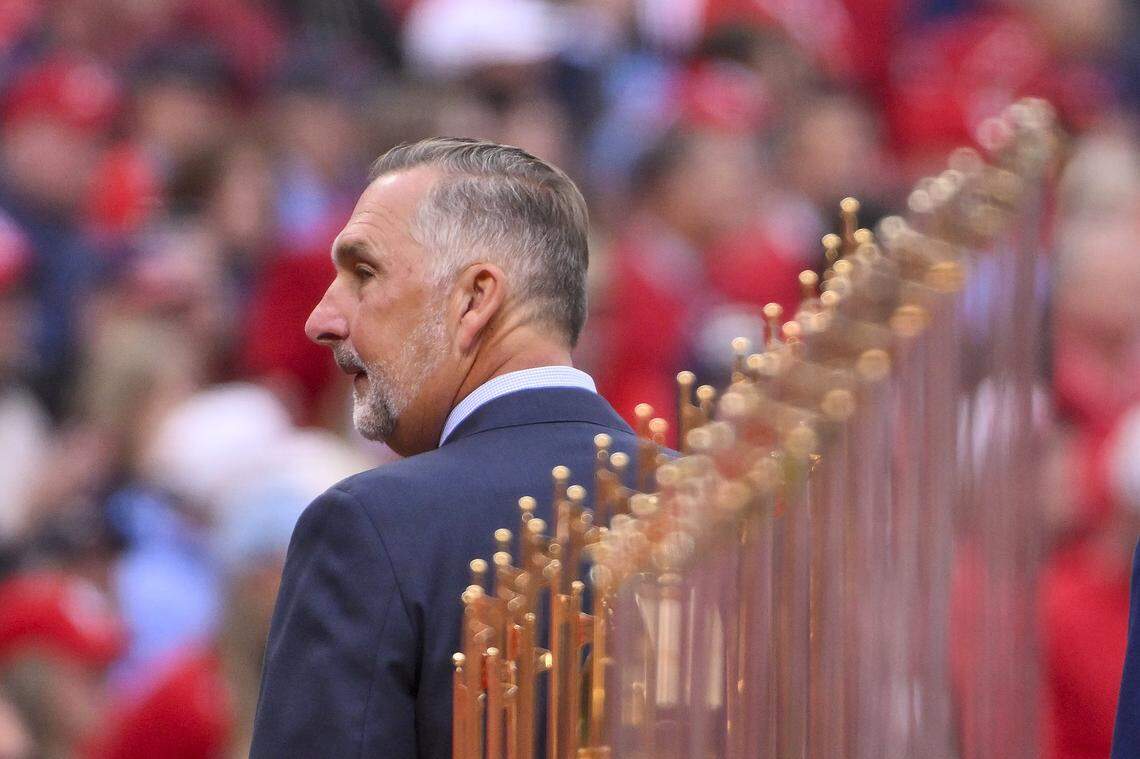
John Mozeliak said that he has “nothing” planned to do tomorrow, a sharp departure from his 18 years in charge of the St. Louis Cardinals’ baseball operations department and an opening for an obvious punch line for those inclined to levy criticism of the team’s recent offseasons.
However this one unfolds will be shaped by and large by other people, and Monday’s ceremonial baton passing was as much an opportunity for him to offer thanks and receive plaudits as it was a reflection on the organization’s recent history and a guide to its unfolding path.
Advertisement
“I’ve personally enjoyed working closely with Mo over these many years, and I will miss that day-to-day interaction,” said Cardinals chairman Bill DeWitt, Jr. “We wish him all the best in his next chapter, and I can assure you he will always be welcome at Busch Stadium.”
“The drum beat was getting louder – candidly, real loud – for a new voice, and I heard it,” Mozeliak acknowledged. “I do believe [change] can be a good thing. Having a fresh voice, a different perspective, new ideas will be healthy for the St. Louis Cardinals.”
After a year of planned obsolescence, and despite a contract which runs through midnight on Oct. 31, Tuesday will mark the handing off of responsibilities from Mozeliak to Chaim Bloom, closing an era which began on Halloween in 2007 when Mozeliak had the “interim” removed from his title and was named the full-time general manager. A further bump in title came with his being named president of baseball operations a decade later, but for nearly two full decades, the buck has stopped on his desk (when it was not kicked up to DeWitt’s).
Advertisement
Indeed, the buck was seemingly at the front of Mozeliak’s mind as he gave his farewell remarks. On the rare occasions he split away from gratitude and appreciation, he went out of his way to point out what he views as the growing economic disparities in the game, taking pains to describe St. Louis as among the sport’s disadvantaged smaller markets.
“The economic landscape of baseball has continued to shift over the past decade,” he said. “How you build rosters looks completely different based on your market size. The ability for a small market team to be successful will require the following traits: innovation, never lose sight of your core principles, and remain nimble and flexible in the ever-fluid environment.”
The creeping business school vocabulary which has colored so much of the communication strategy from the front office in recent years poses an interesting contrast with the history of data explosion throughout the game. At roughly the same time Billy Beane was building his legend through Michael Lewis’ Moneyball, DeWitt was being introduced to Jeff Luhnow by his son in law, removing one of the most significant barriers to entry to the consultant class which now dominates front offices.
Advertisement
Luhnow, after all, was in the running for Mozeliak’s job when first he was elevated to it, and would eventually seize the same position in Houston. From that burn-it-down-and-rebuild-it operation sprang numerous other heads of baseball departments throughout the game, including Baltimore’s Mike Elias, who worked under Luhnow in St. Louis before following him to Houston.
The Cardinals, then, are every bit as much at the nexus of baseball’s desire to innovate and streamline, and that will be perhaps the most enduring part of Mozeliak’s legacy outside of St. Louis.
“I definitely think my experience and what I was exposed to added to a more modern game of baseball as far as decision making,” he acknowledged. “But I think as far as the haves and have nots, no, we’ve always tried to figure out a way to just keep up. That’s always been the challenge, and it’ll be challenges in the future as well.”
Advertisement
Throughout Monday’s dialogue, Mozeliak took pains to stay away from any assessments of the future of players and where the organization is headed. In the midst of his introduction, he thanked assistant general managers Randy Flores and Moises Rodríguez by name, as well as retired assistant GM and former farm director Gary LaRocque.
Rob Cerfolio, who also currently holds an assistant GM title, was lumped in further down the line with Bloom, treated as an agent of the future. The Cardinals do plan to hire a general manager under Bloom in much the same way Michael Girsch operated under Mozeliak for seven seasons; Cerfolio is a strong candidate for that position after a year spent working to revitalize a lagging player development system.
Staffing decisions and bold pronouncements will be the purpose of Tuesday’s introductory gathering for Bloom, and it’s at that meeting that Cardinals fans should be prepared to hear about a longer path back to contention than many may desire. Mozeliak even nodded in that direction in his own remarks, offering his relief that he was never put in a position to undergo a full rebuild, but adding, “the words you hear tomorrow might be different.”
Advertisement
Those words coming from a fresh voice will soften whatever difficult blow may otherwise accompany them, but they won’t change the standards or expectations. Cardinals baseball under this ownership group carries a championship pedigree, and that is the standard against which they will be measured.
Whether they measure up will simply no longer be Mozeliak’s problem. He said Monday that he has no future plans to take up a similar position in another organization, though he would like to “have some connection to the game at some point.” He added that he doesn’t expect to stay on to oversee any ongoing projects, such as the renovation of the team’s facility in Jupiter, Fla.
In the offing is a clean break, and a fresh new era in which the Cardinals will take pains to re-energize a fan base worn thin by a stretch of half measures which left the decision makers speaking of runway and opportunity rather than playoffs and championships.
Whether that lands is up to someone else.