

Editor’s Note: Though not one of our traditional, Red Sox-centric articles, Maddie put in a huge amount of work to share this experience with you, our readers. We hope you to take the time to enjoy and share in her adventure in Japan, one of the international hubs currently expanding the baseball scene. Please enjoy.
I’ve always tried to incorporate baseball games into my travel plans whenever possible. Sports embody culture. A stadium’s architecture mirrors a cultural aesthetics and the relationship between the building’s design, its fans, and the surrounding area. Pregame, in-game, and postgame ceremonies and rituals allow communities to express their cultural identity through music, dancing, and rituals. Food is another cultural identity marker, reflecting local ingredients, social customs, and traditions.
Last May, I attended the London Series between the New York Mets and the Philadelphia Phillies. While I love traveling to Europe, there isn’t a strong baseball culture present. Although I’ve lived in Pennsylvania for most of my life, I couldn’t care less about the Phillies’ record. I was primarily attending for the 1) food and 2) the vibes, like Jazz Chisholm during the Home Run Derby this year, and 3) the chance to see London Stadium, the home of West Ham F.C., converted to a baseball field. While the London Series resembled (and smelled like) a home game for the Phillies at Citizens Bank Park, the fans brought their energy, enthusiasm, and jeering, which was mostly reserved for the Mets, although they booed Whit Merrifield after he struck out.
The atmosphere at the London Series reminded me that baseball is more than a sport – it’s a unifying force, bringing people together from different backgrounds and countries to share the experience of watching a baseball game. I left London feeling inspired and brimming with curiosity. I wanted to continue exploring how different cultures engage with my favorite sport. This newfound curiosity eventually led my sister and me to Japan.
Since the Red Sox signed Masataka Yoshida, a former Orix Buffaloes player, I’ve adopted them as my favorite Nippon Professional Baseball (NPB) team. The Buffaloes have produced several players who made their mark in MLB, including Hideo Nomo, Yoshinobu Yamamoto, and newly-inducted Hall of Famer, Ichiro Suzuki. Their home is the Kyocera Dome in Osaka.
NPB teams are owned by corporations that brand their teams with their company name. The Buffaloes’ owner is Orix, a financial services conglomerate. Other NPB team owners run more exciting businesses. For example, the Hiroshima Toyo Carp’s primary owner is the Matsuda family, related to the founder of Mazda Motor Corporation. Their stadium is rightfully named the Mazda Zoom-Zoom Stadium. The Yomiuri Giants, who are often referred to as “the New Yankees of Japan,” are owned by Yomiuri Shimbun Holdings, the largest media conglomerate in Japan. The Yomiuri Shimbun newspaper and the Nippon Television Network fall under their umbrella. The Giants play at the elusive Tokyo Dome. Read more about the Nippon Professional Baseball Organization structure here.
From what I had read online, the Kyocera Dome isn’t at the top of must-see NPB stadiums for tourists. Some seasoned fans recommend avoiding the stadium altogether. Nonetheless, I wasn’t planning this trip solely around NPB games. It was just one piece of the puzzle, and I didn’t want to overwhelm the rest of my travel plans (and bore my sister) with baseball games. I wanted to immerse myself in the Japanese baseball scene, and the Orix Buffaloes’ schedule aligned perfectly with our itinerary. The game we attended was on July 8th, 2025, the second-to-last day of our trip.
On the day of the game, I woke up exhausted at 4:00 am in Kyoto. Jet lag played a part, but I set my alarm early to shoot photos in Gion, Kyoto’s famous historic district, before the throngs of tourists arrived. The temperature was already at 84°F, and like the rest of Japan, it was humid. As I walked around the quiet streets lined with traditional wooden machiya buildings, I realized that I’d have to be at the baseball game in 12 hours. Later in the morning, we took a train to Osaka Station from Kyoto Station, which took about 20 minutes.
Exiting Osaka station armed with our 40-pound suitcases, we were tired, sweaty, and dehydrated after 12 days of non-stop travel and sightseeing. According to our phones, we averaged 30,000 steps and climbed up 50 flights of stairs per day. I’m usually good with directions, but the Japanese train stations really tested me. While we were attempting to navigate to the pickup location for our hotel shuttle bus, a camera crew suddenly appeared, offering to guide us. It turned out they were filming two famous Japanese Rozan comedians, Hirofumi Suga (菅 広文) and Fuminori Ujihara (宇治原 史規) for a weekly directions segment on the MBS channel. Hirofumi spoke some English and asked us questions, with Fuminori translating. The conversation turned to baseball, and we discussed Seiya Suzuki‘s MLB success. We spoke for about 10 minutes before they “dropped” us at the shuttle bus location.
Yet, we still couldn’t find the shuttle and probably missed it due to the filming. Confused, we walked around and avoided the crew near the station’s south exit. This probably led us in the wrong direction. We ultimately took a taxi to the hotel. After dropping off our bags, we grabbed lunch at Kuromon Market before heading back to rest before the game. We’d planned to take the subway to the stadium, but exhaustion set in, so we ended up calling an Uber instead.
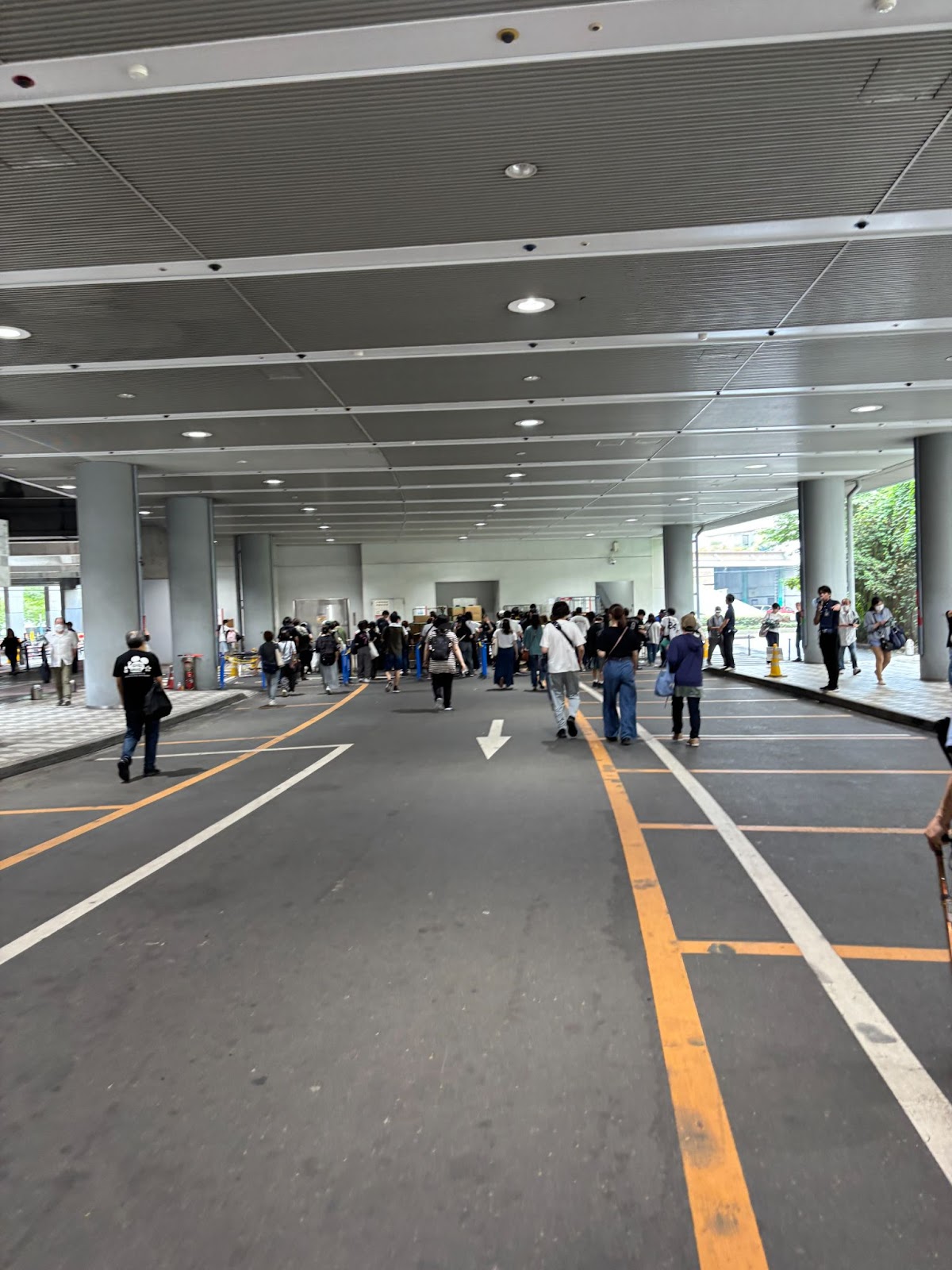
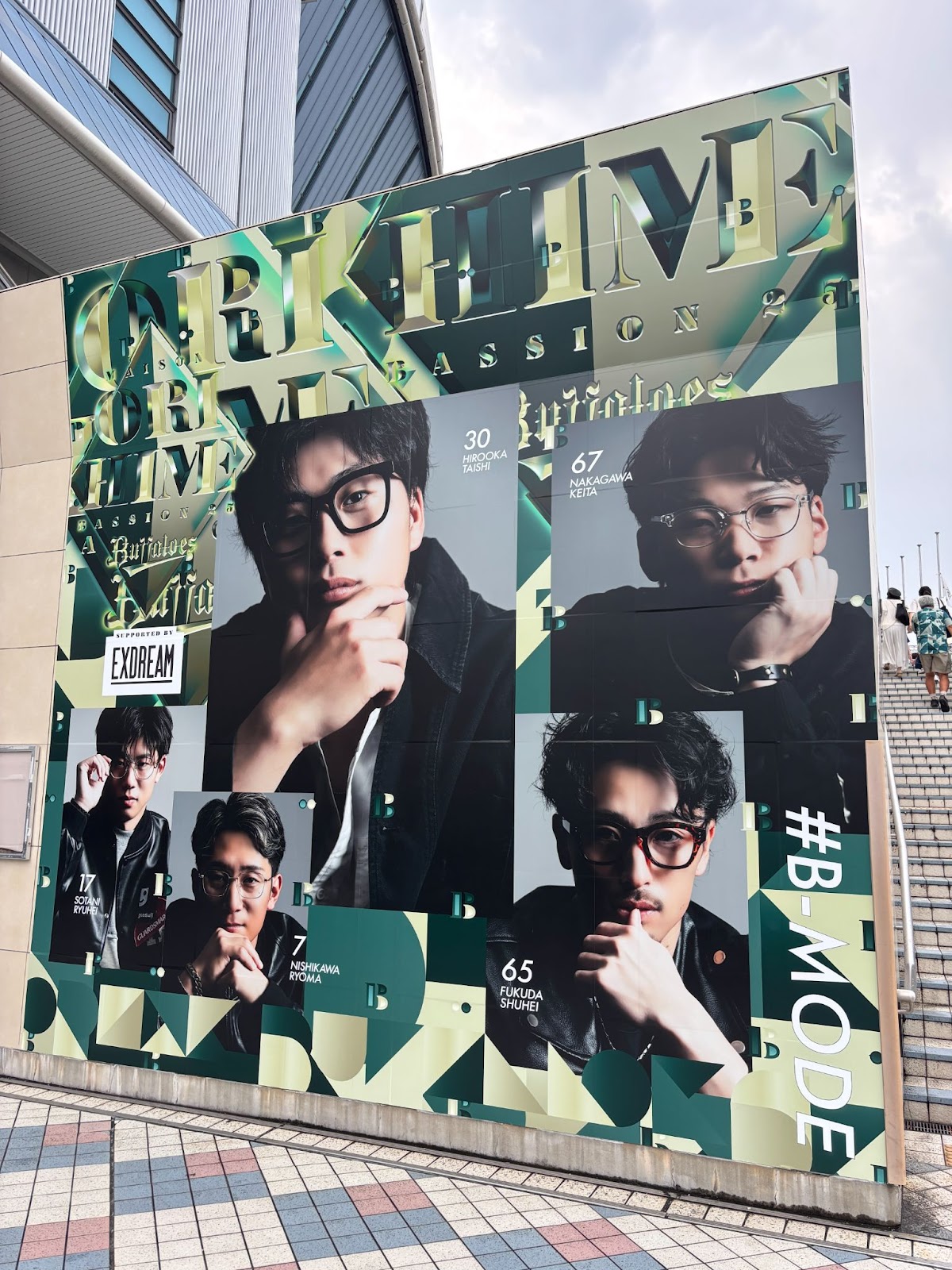
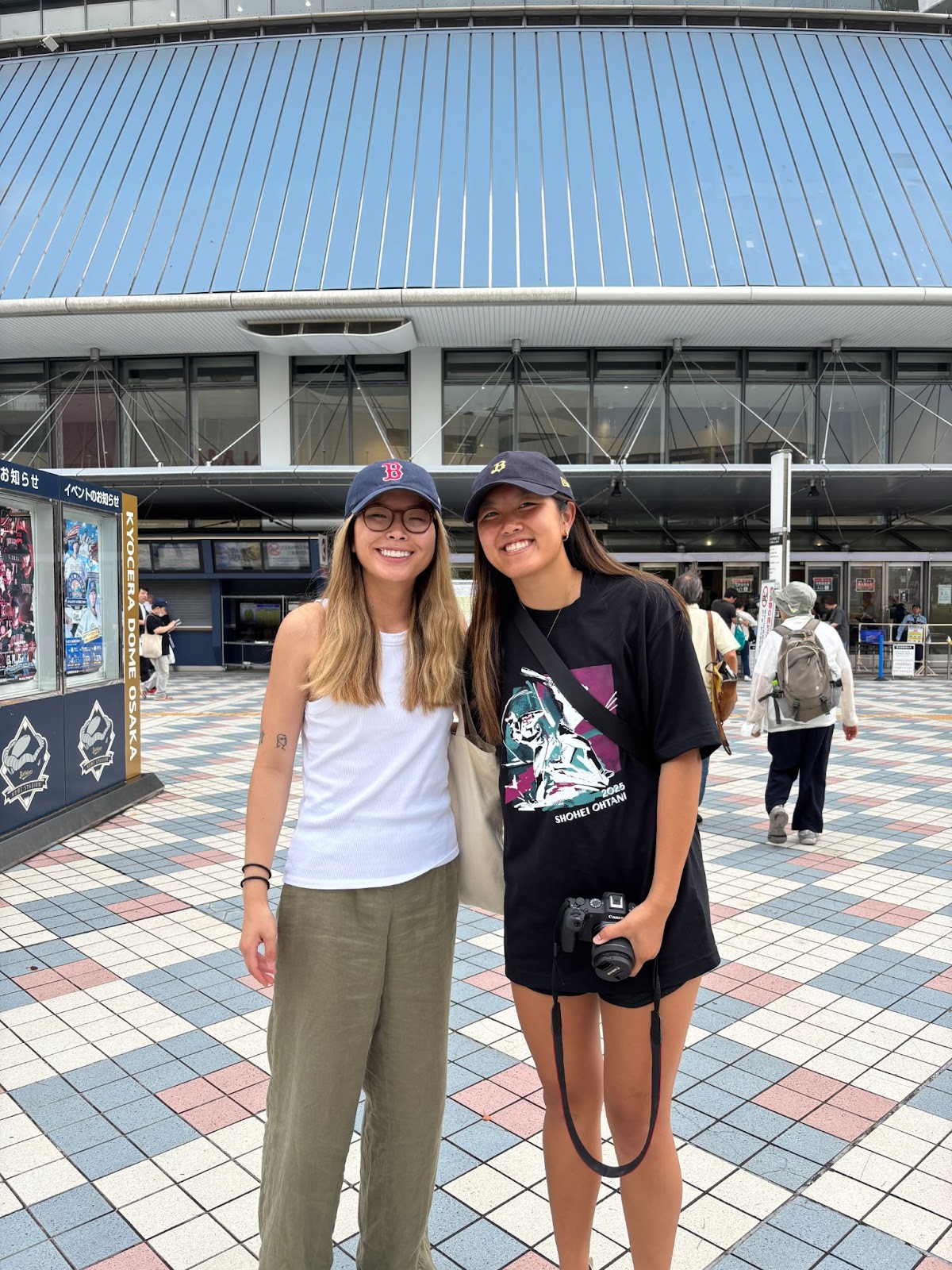
We arrived at the Kyocera Dome around 4:08 pm, and our Uber driver dropped us off below the gates at street level. We received a special B Mode-themed jersey with our tickets. Surprisingly, the giveaway pickup area was separate from the main gates. Themed banners were on display around the stadium for the promotion.
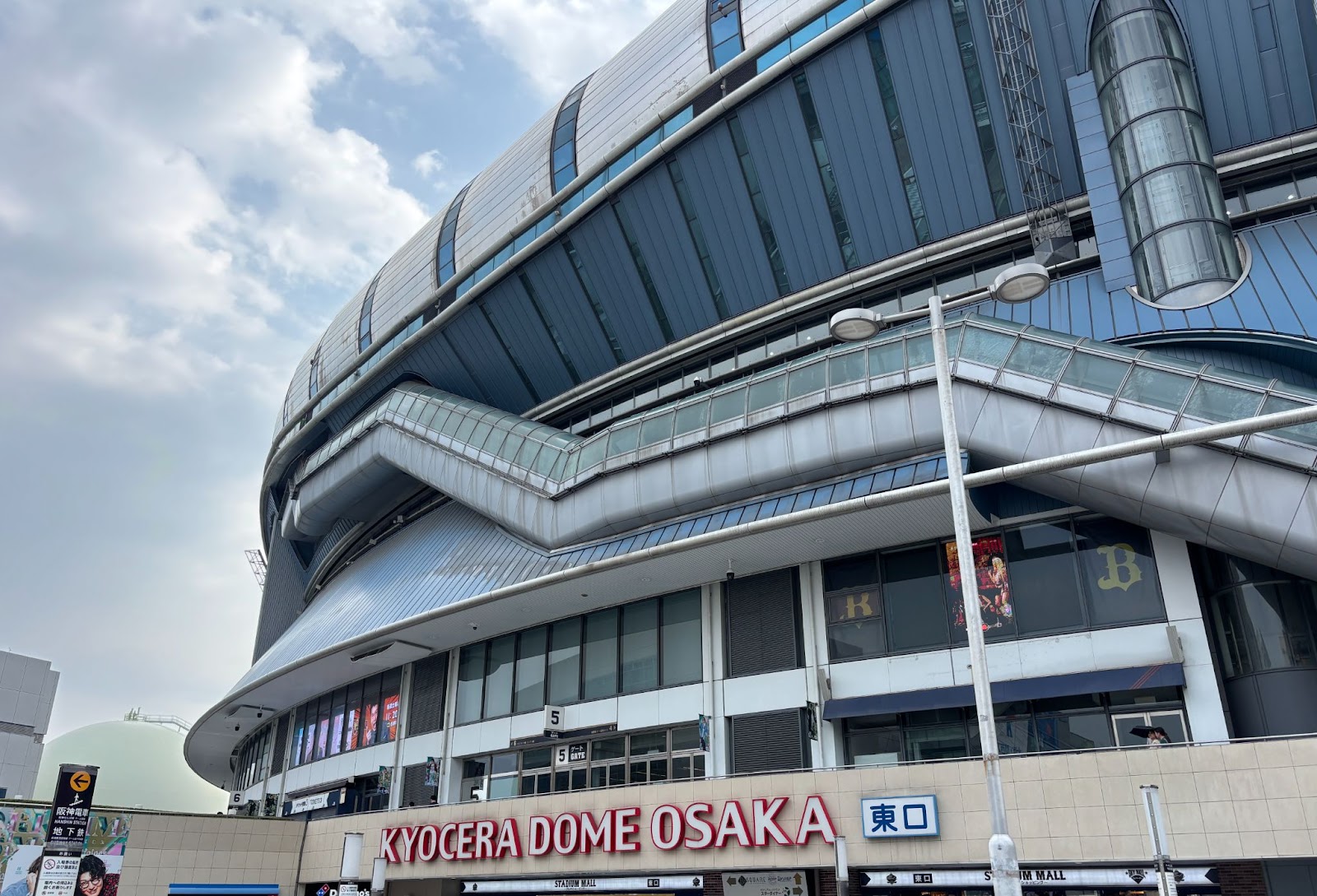
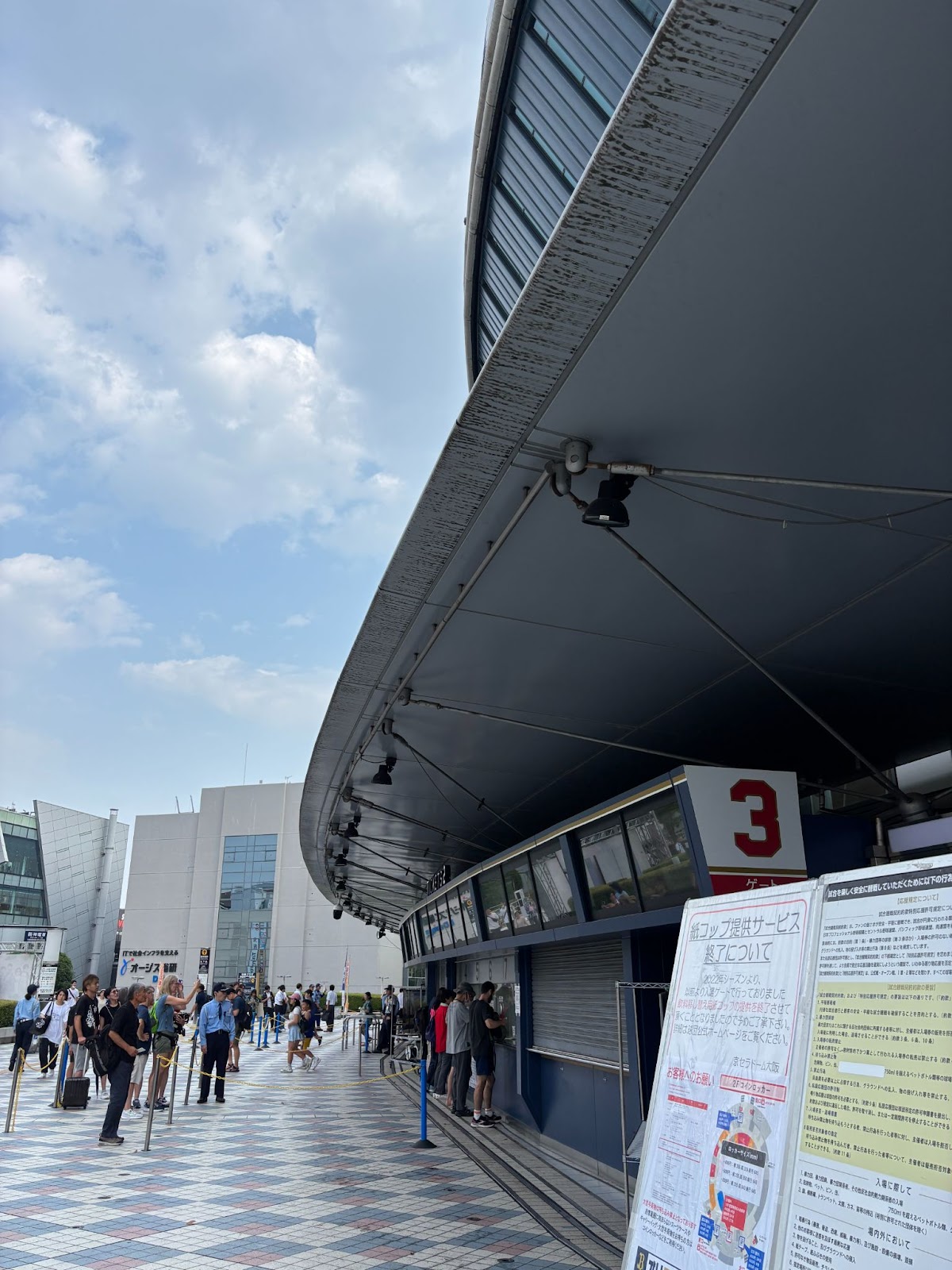
The outside of the Kyocera Dome resembles a spaceship. It opened in 1997, so it’s a fairly new building. The 90s weren’t exactly a groundbreaking time in architectural design, and some of the futuristic elements haven’t aged well. Sure, the Kyocera Dome isn’t the most aesthetically appealing stadium, but I was more concerned about the atmosphere and fans.
MLB releases tickets for the full season at once, while NPB ticket sales vary by team. To purchase Buffaloes tickets, I first had to join the BsCLUB (the team’s fan club). Registering required entering my name in half-width Kanji using a special tool, which was challenging as I don’t speak Japanese. The Buffaloes began selling tickets just over a month before the game, so I bought mine in late May. Our digital tickets cost 9,600円 (about $65).
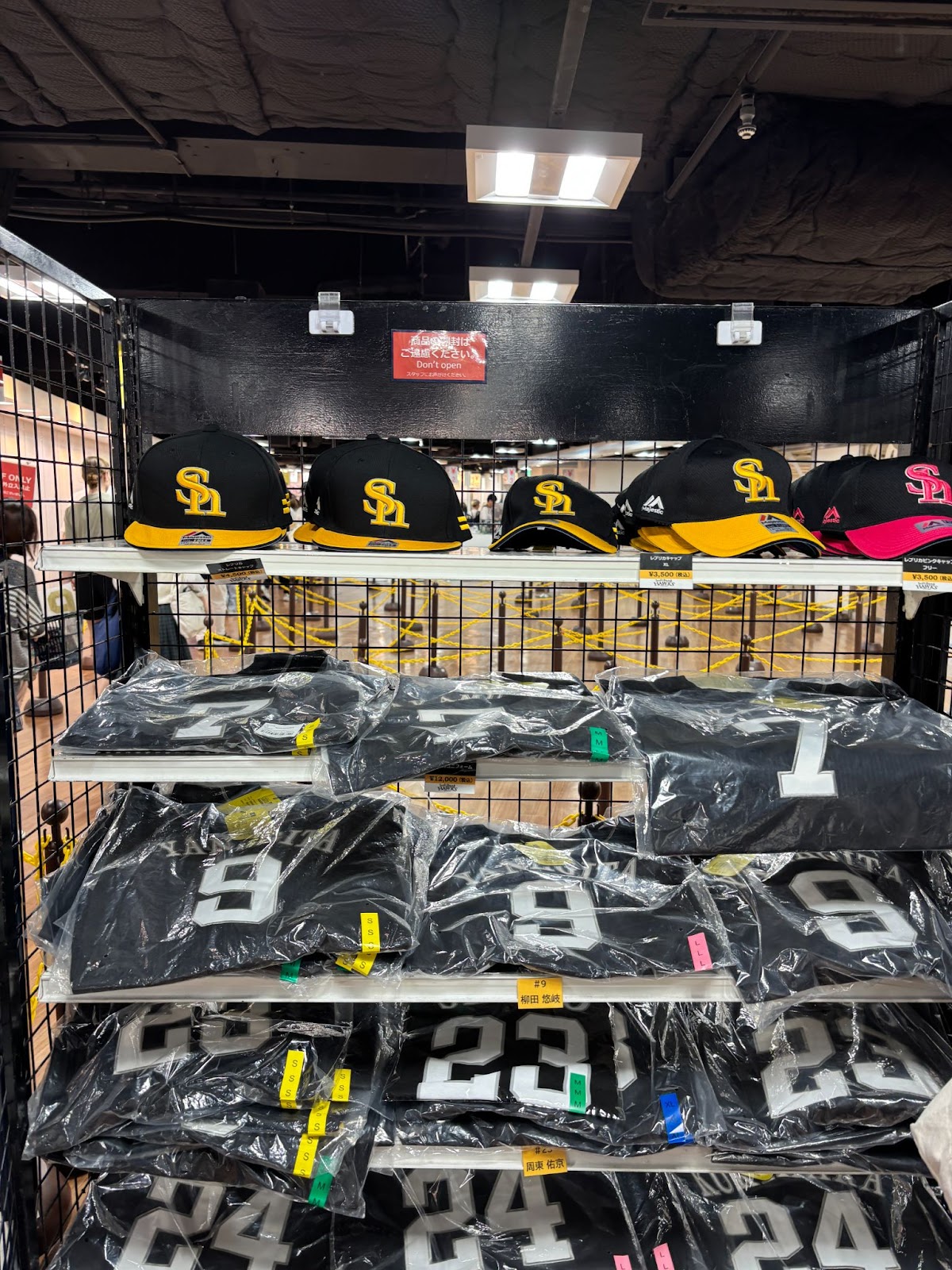
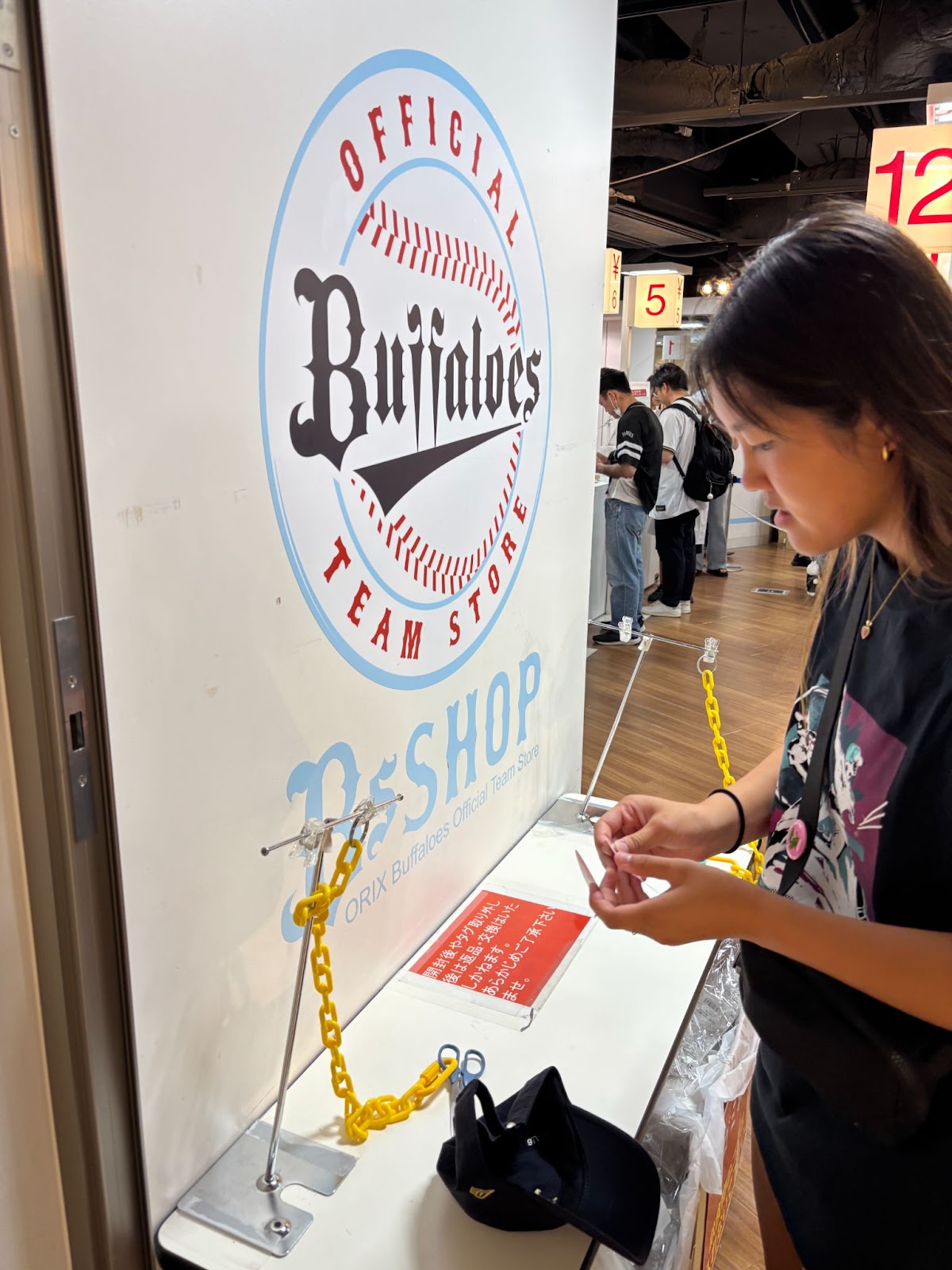
Before officially entering the stadium, we hit up the gargantuan team store. The Buffaloes sold gear for the Fukuoka Softbank Hawks, the opposing team. I’ve only seen this at Fenway before, so I appreciated the Buffaloes’ gesture. I bought a Soichiro Yamazaki (my favorite Buffaloes player) shirsey and my sister also purchased a hat, which she wanted to wear during the game. Just past the registers, the Buffaloes had a special table set up to carefully remove clothing tags with scissors.
Upon entering the seating bowl, we immediately realized we were on the wrong side of the stadium. We managed to catch a glimpse of the Softbank Hawks’ batting practice before our grumbling tummies ushered us back to the concourse for food. I encountered one Japanese fan wearing a Red Sox hat. I smiled at him, but since the Japanese tend to be polite rather than friendly, he gave me a puzzled look. Internationally, sports hats are often viewed more as a fashion statement than a symbol of fandom.
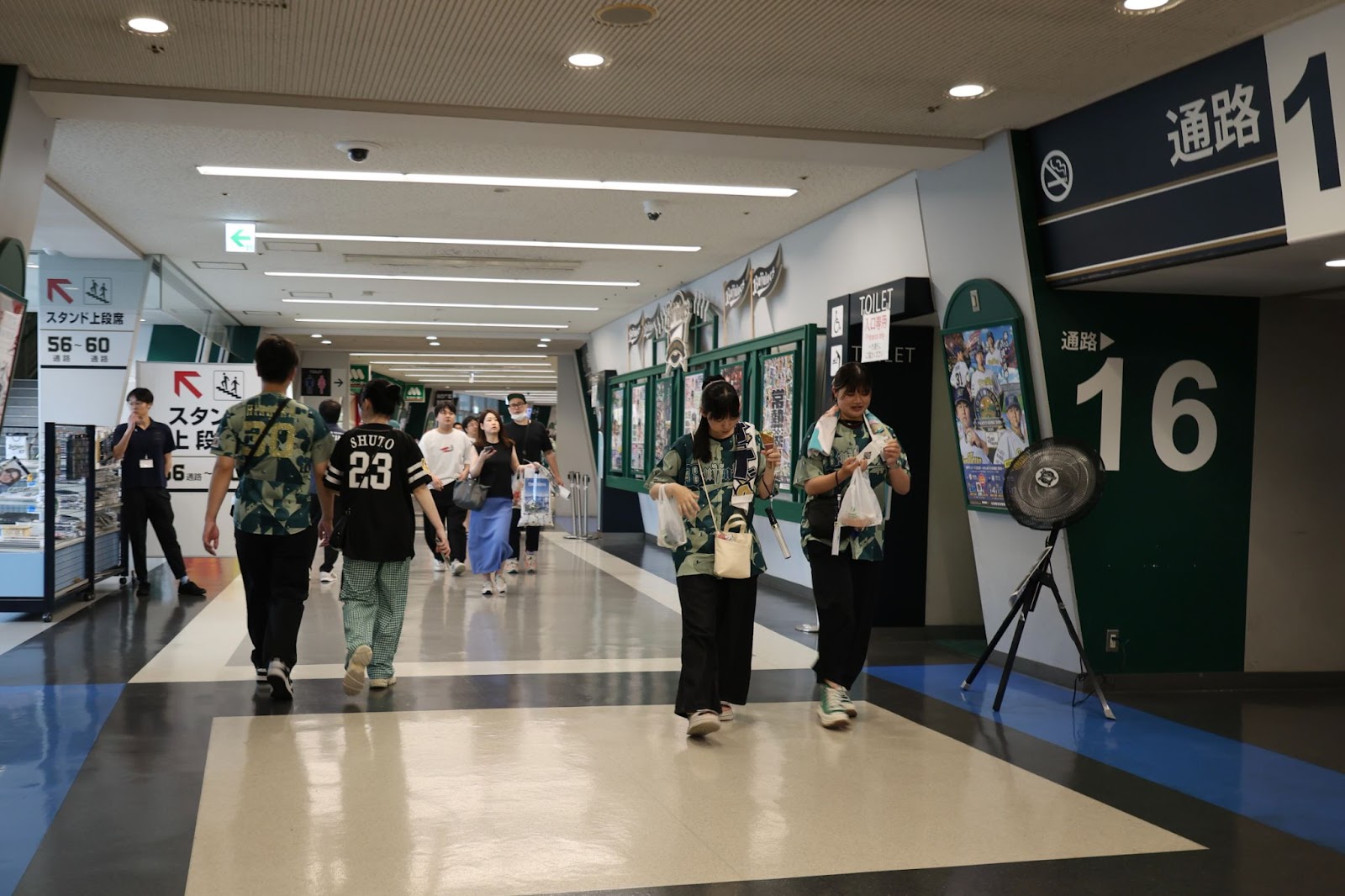
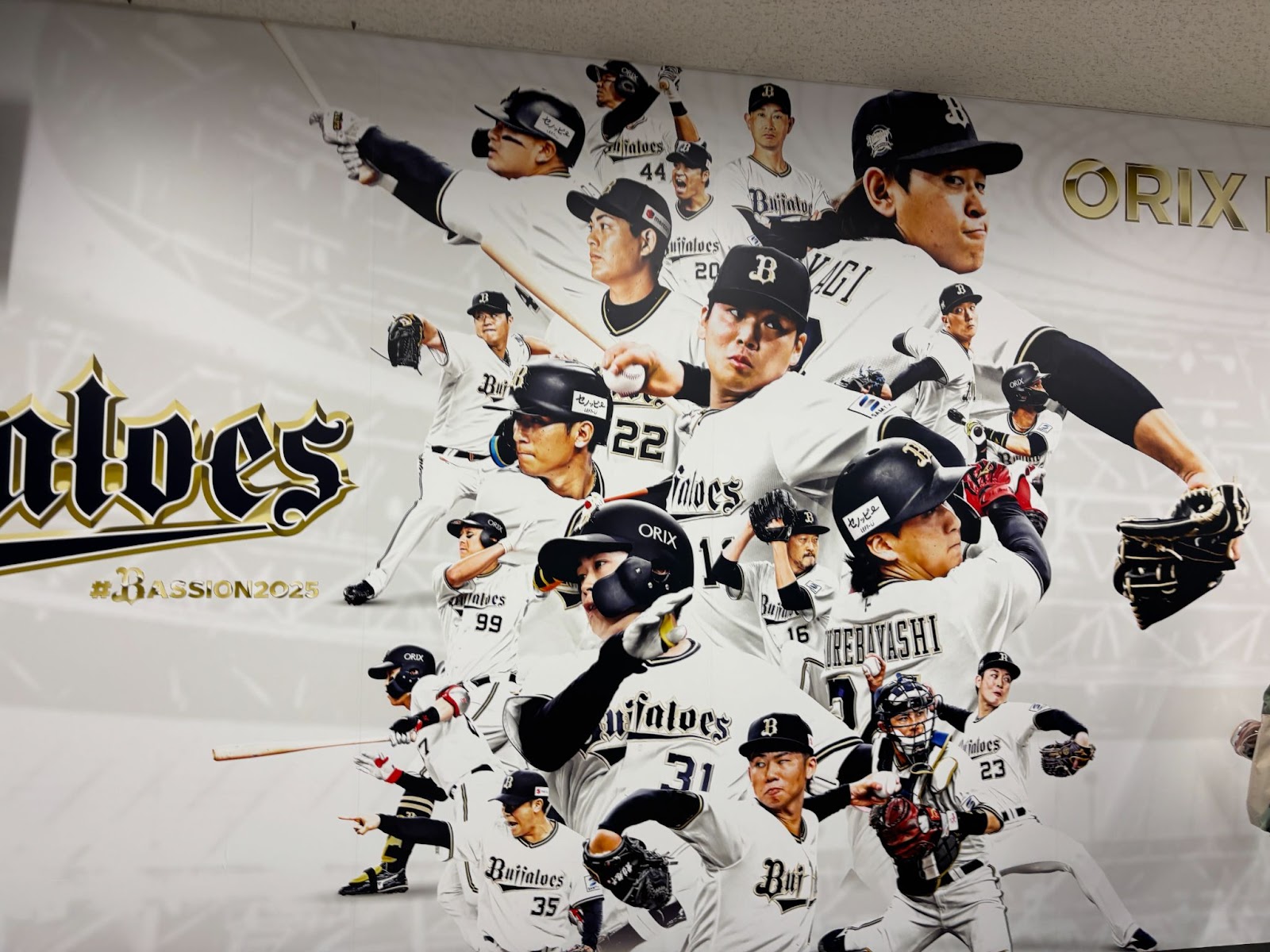
The Kyocera Dome had a solid selection of food, ranging from traditional options like okonomiyaki (savory pancakes), takoyaki (fried octopus balls), bento boxes, and ramen to stereotypical American (hot dogs, French fries, and hamburgers). We saw a couple of Domino’s and KFC stands. Asahi is a popular beer in Japan. Beer girls were serving alcohol to seated fans. The food was cheap, especially compared to MLB games, where everything is price-gauged.
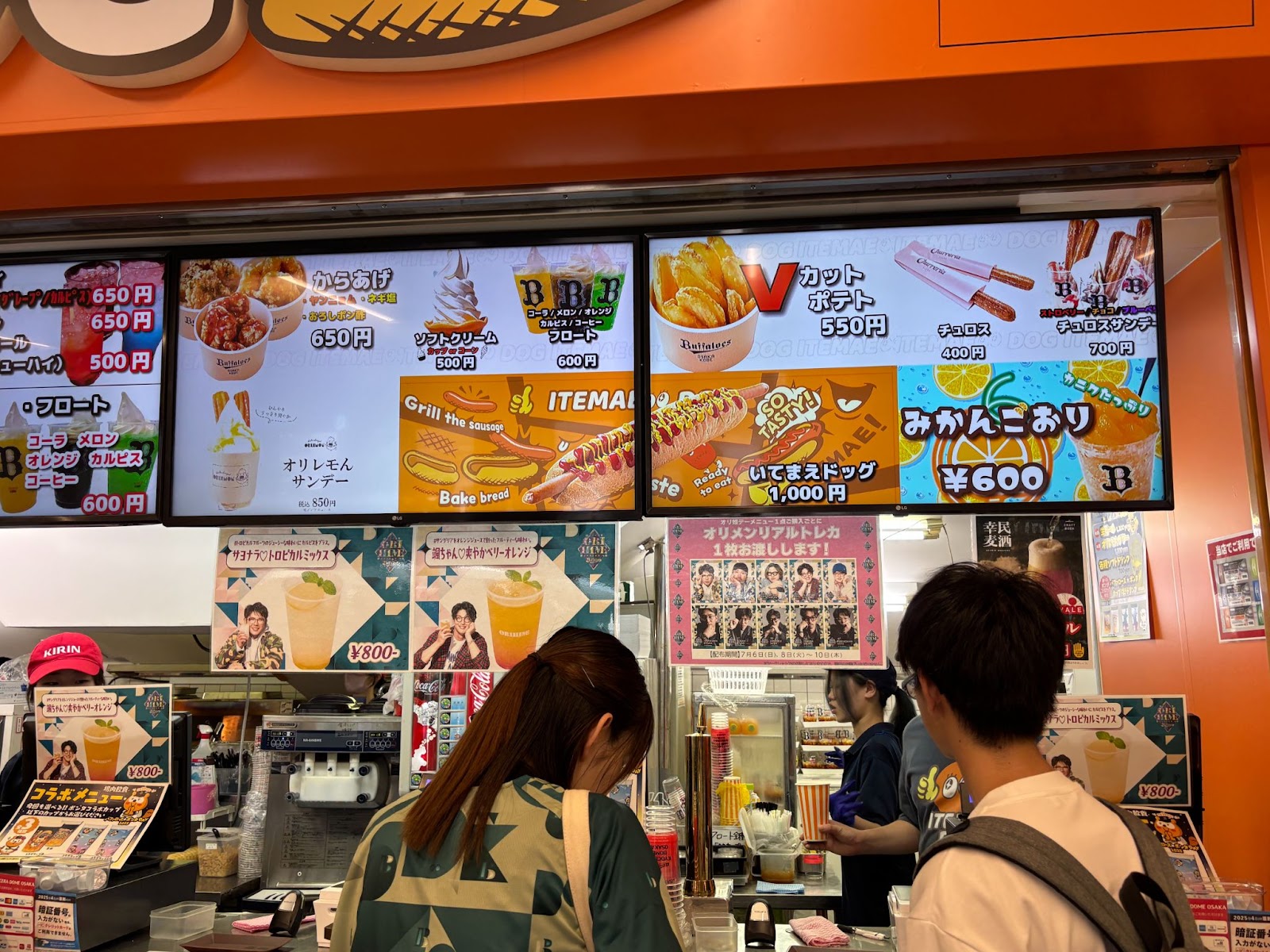
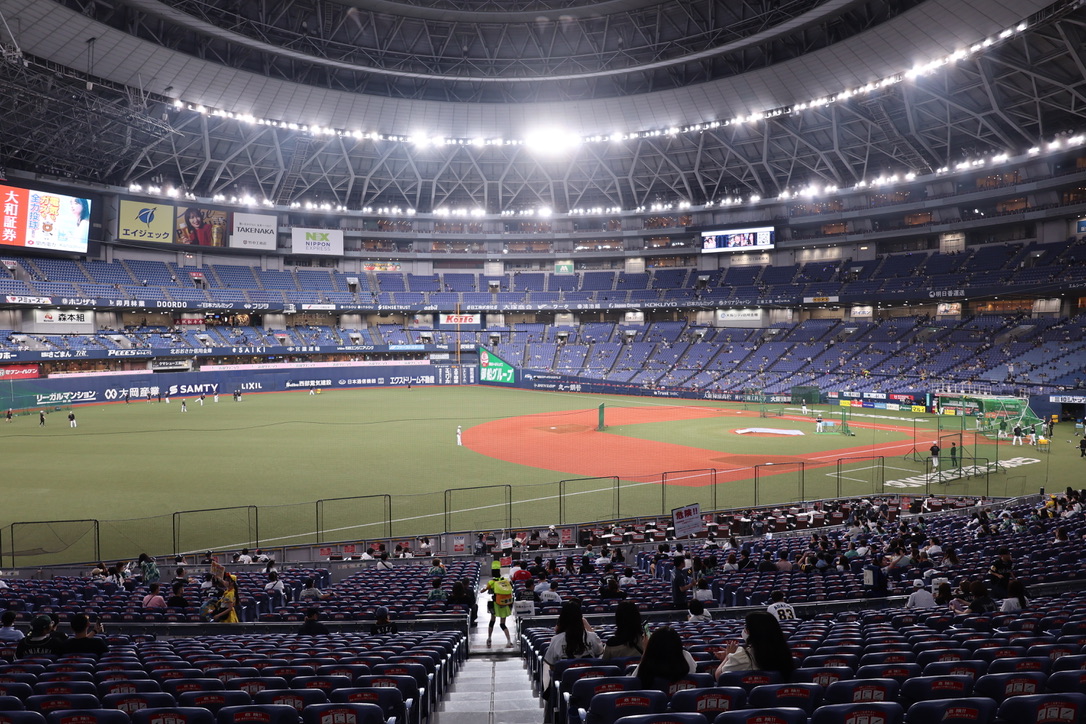
My sister tried the Itamae Dog, an orange float soda. I ate the Toribo (large chicken fries) and drank a lemon highball. I also received a special Soichiro Yamazaki baseball card with my order. We both agreed the food was delicious. You can see in the photo below that our seats had individual fans blowing a very mild stream of air.
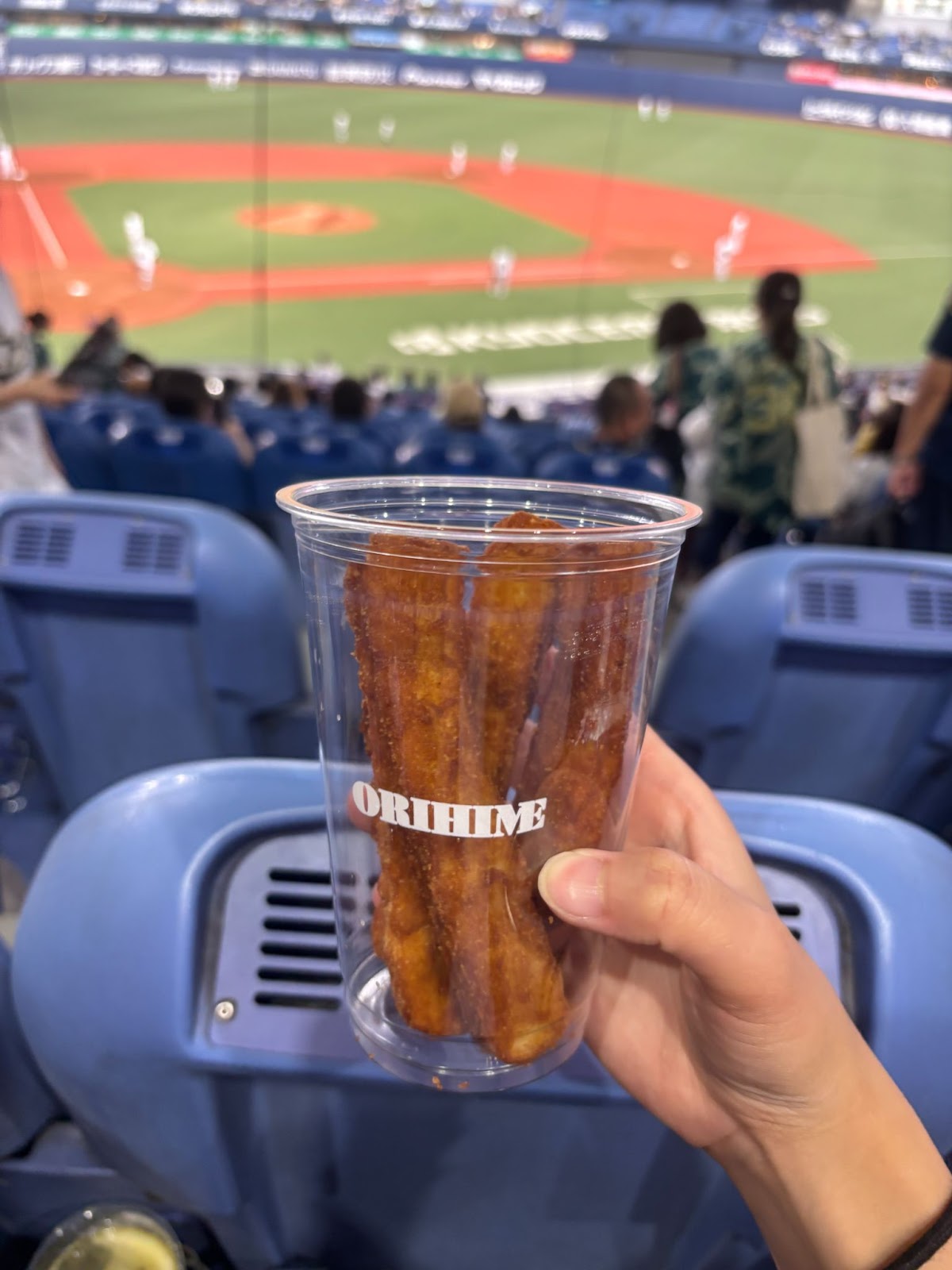
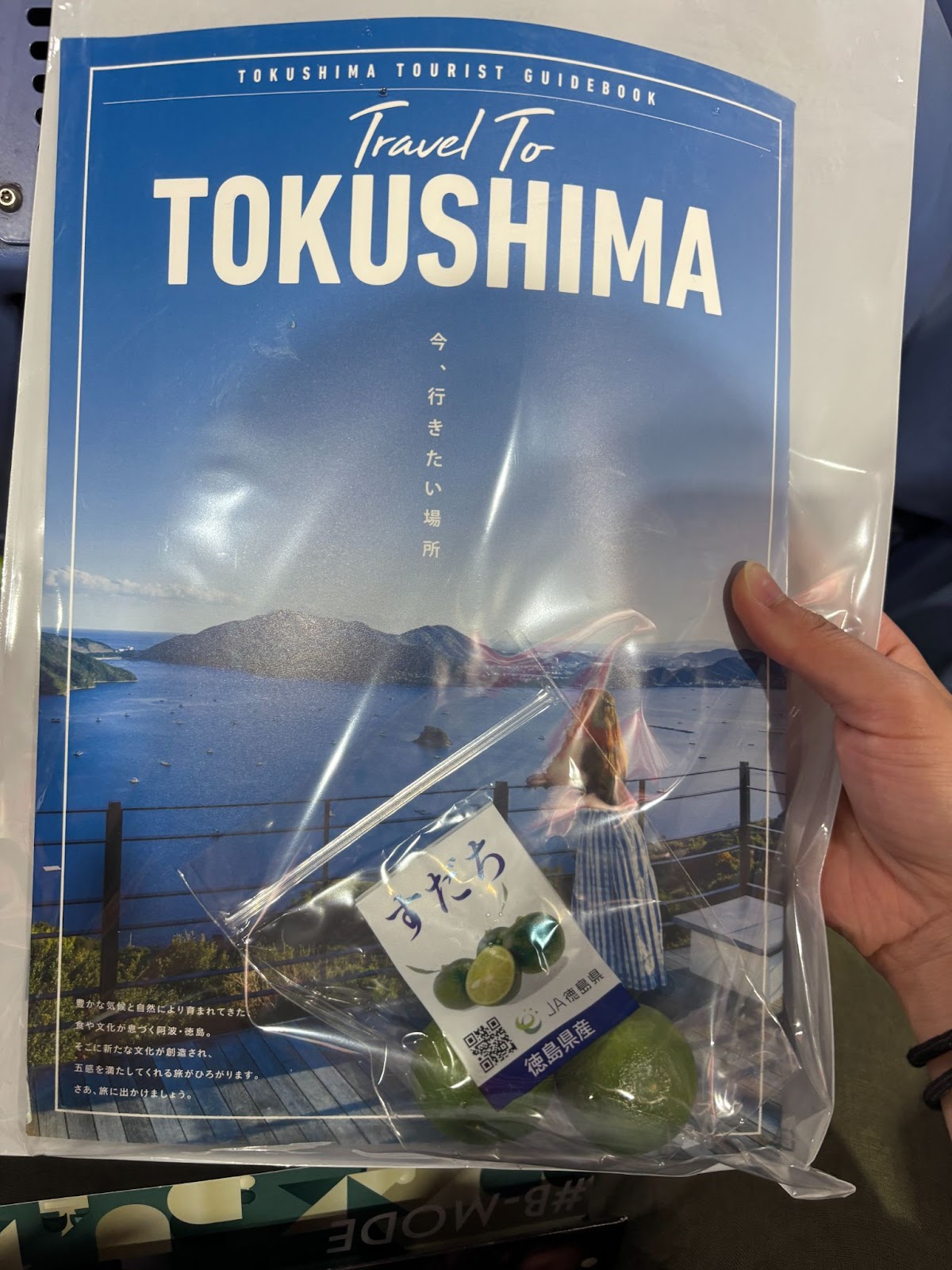
Our seats were on the first base side. Similar to European football games, the fans were divided by team. SoftBank Hawks fans occupied the third base line and left field, while the Buffaloes fans were around first base and right field. Each team’s ōendan (official cheering squad) was positioned in separate outfields (Buffaloes in right field and SoftBank Hawks in left). Both ōendans had drums and megaphones to generate noise, and flag bearers waved flags when their team was batting. We were given fan clappers upon entering the stadium and a lime for a Tokushima travel promotion. There were only a few Western fans in attendance.

BsGravity, the Buffaloes dance vocal group, gave an opening performance 20 minutes before the game, joined by the team’s mascots, Buffalo Bull and Buffalo Bell. They sang the team’s theme song “Sky” by the Japanese band Mega Stopper.
The Buffaloes were in first place in the Pacific League when we saw them play. They’re currently in 3rd place. Former Cubs pitcher Anderson Espinoza took the mound for the Buffaloes. He initially looked strong and pitched two scoreless innings. The fans had a special “Vamos Espinoza!” cheer for him, and hearing Japanese fans chant in Spanish was a heartwarming moment of cultural exchange. The Japanese style of play seemed a little slower than MLB. Both teams featured lefty-heavy lineups. I’m not sure if this was a team-specific thing or common throughout the Nippon League.
At the top of the fourth inning, we decided to grab ice cream. While waiting in line, we heard raucous cheering from the stadium. Espinoza had given up a grand slam in the top of the fourth inning. Later in the inning, Buffaloes’ center fielder Keita Nakagawa hit a home run off the Hawks’ starter Kohei Arihara. This was the only run the Buffaloes scored in the game. Thanks to our dessert quest, we missed the only two home runs of the game.
The Softbank Hawks rallied again in the fifth inning and scored four more runs. Former Red Sox player Jeter Downs drove in three with a bases-clearing double.
BsGravity took the stage again when the Lucky 7 arrived (the Japanese equivalent of the 7th inning stretch). The Buffaloes sold souvenir light-up sticks that flickered in sync with the performance.
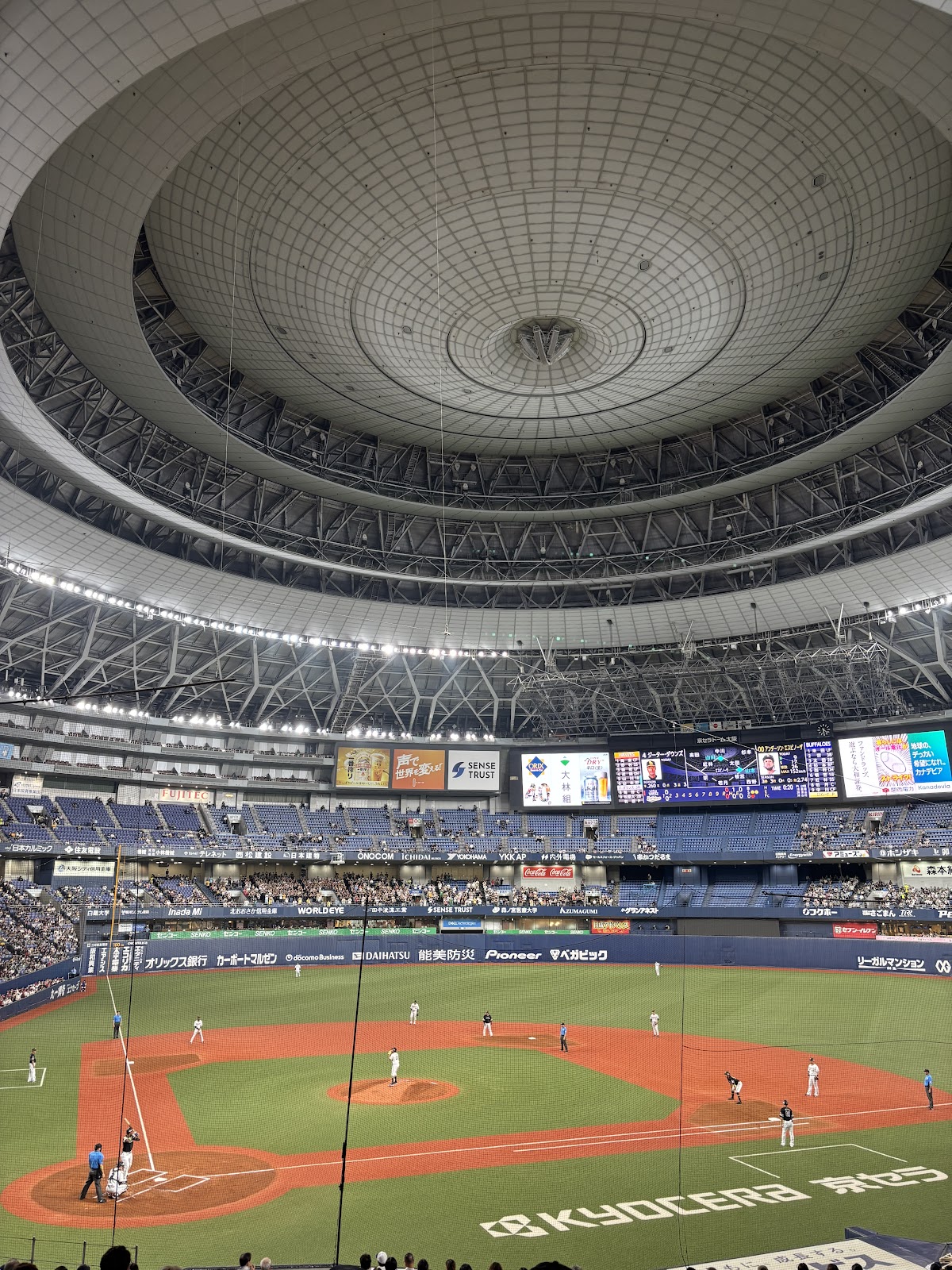
The Kyocera Dome reminded me of the Rogers Centre in Toronto. They’re both indoor stadiums with cavernous roofs and waves of blue seats. While the lower seating bowl was filled with fans, the upper levels were significantly less crowded, and some sections remained empty throughout the game. Moreover, I was surprised by the lack of cultural barriers. Although we couldn’t understand everything the announcers were saying, we were able to follow the game’s progression as ball knowers. English words like strike, ball, and strikeout were part of their vocabulary.
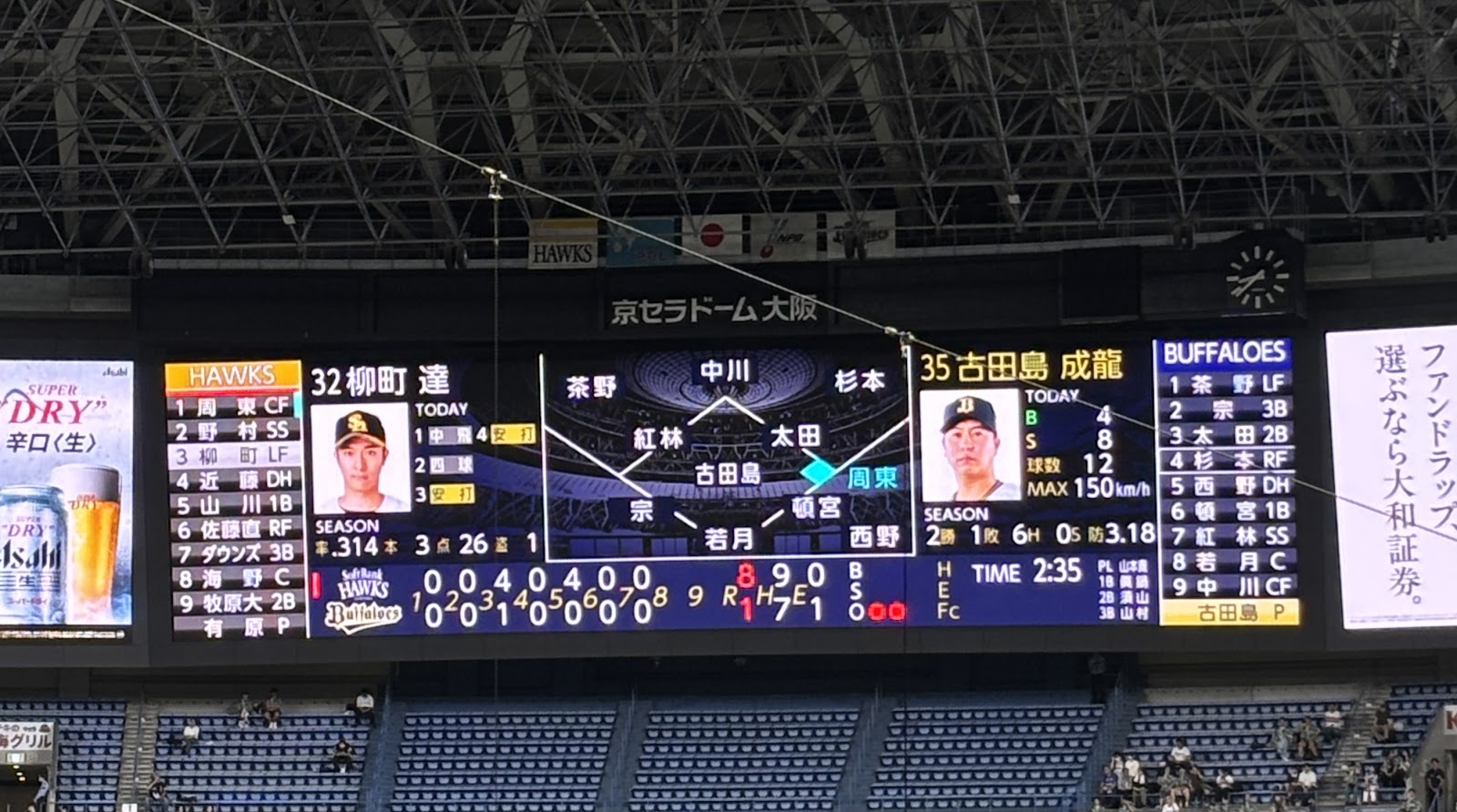
The Japanese umpires’ gestures were the same as their American counterparts (albeit their calls weren’t as egregious). The Japanese fans’ coordinated collective enthusiasm was palpable from the cheering and singing. Each player had a special song. Despite being down by eight runs, the Buffaloes fans continued cheering for their players. We didn’t hear any heckling, booing, or screaming, even after Espinoza gave up the grand slam. Unlike American baseball games, the fans weren’t treating the game as a social drinking event. They actually paid attention to the game.
By the bottom of the eighth inning, it was apparent that the Buffaloes would lose the game. It was 9:00 pm, and we were exhausted after a travel day, and we had been up for over 12 hours. We felt a twinge of guilt leaving early since Japanese fans typically stay for the entire game. Despite not seeing the Buffaloes play at their best, we had a great experience at our first NPB game. It was definitely one of the trip’s highlights.
Since returning home, I’ve had some time to reminisce about the trip. When I left for Japan three weeks ago, the Red Sox were in a slump, having been swept by the lowly Angels and the division-leading Blue Jays. Now, heading into the All-Star Break, they’re the hottest team in baseball. In sharp contrast to the mercurial nature of American baseball fans (myself included), Japanese fans display an unwavering passion for the game.
At times, my sister and I were stuck in a tourist purgatory. Navigating Japanese train stations felt like a Sisyphean challenge. The humidity was suffocating, we were jetlagged throughout the trip, and it seemed like we couldn’t escape the crowds of tourists wherever we went. We quipped, “How dare other tourists decide to travel to Japan at the same time as us and visit the same attractions!” Some temples offered a welcome break from the masses, while others felt more like tourist traps. Like Phoebe Bridgers, I got bored at the temple. What I yearned for was an authentic experience of Japanese culture. But as the trip progressed, my perspective shifted. No matter where you go, you’re always bound to encounter loud, obnoxious tourists. However, the more I interacted with the Japanese, the more I realized how gracious and polite they were. Some moments truly captured the spirit of the country, whether we were sharing a late-night dinner with salarymen in an izakaya outside Shimbashi Station in Tokyo or attempting to climb Mt. Fuji (a storm thwarted our hike).
Many of my interactions with locals revolved around my baseball hyperfixation. During a ramen-making class in Mt. Fuji, one of our hosts told us she was from the Iwate Prefecture, and was surprised to hear that I was familiar with the area because Dodgers pitcher, Roki Sasaki, is from there as well. Reading about Sasaki’s hometown in The Athletic helped me connect with her, making the conversation more memorable. Still, nothing stood out more to me than the baseball game at the Kyocera Dome. It was an undeniably authentic Japanese experience that embodied the energy, enthusiasm, and resilience of their people.
There’s still so much of Japan I’d love to see. My sister and I want to scale the entirety of Mt. Fuji sans thunderstorms. Other Nippon League stadiums are on my bucket list. The Tokyo Dome is one of them, but I’ll keep it on my radar for a future trip – maybe when the Red Sox are playing there.
Baseball started in the United States, but its heartbeat permeates throughout the world, transcending borders and cultures. Experiencing how Japan embraces and elevates the sport reminded me that baseball’s magic lies in its ability to bridge and connect people. In an Ameri-centric world that often feels divided, the universal love for baseball brings us together, pitch by pitch, cheer by cheer, and hot dog by hot dog. Ganbatte!