
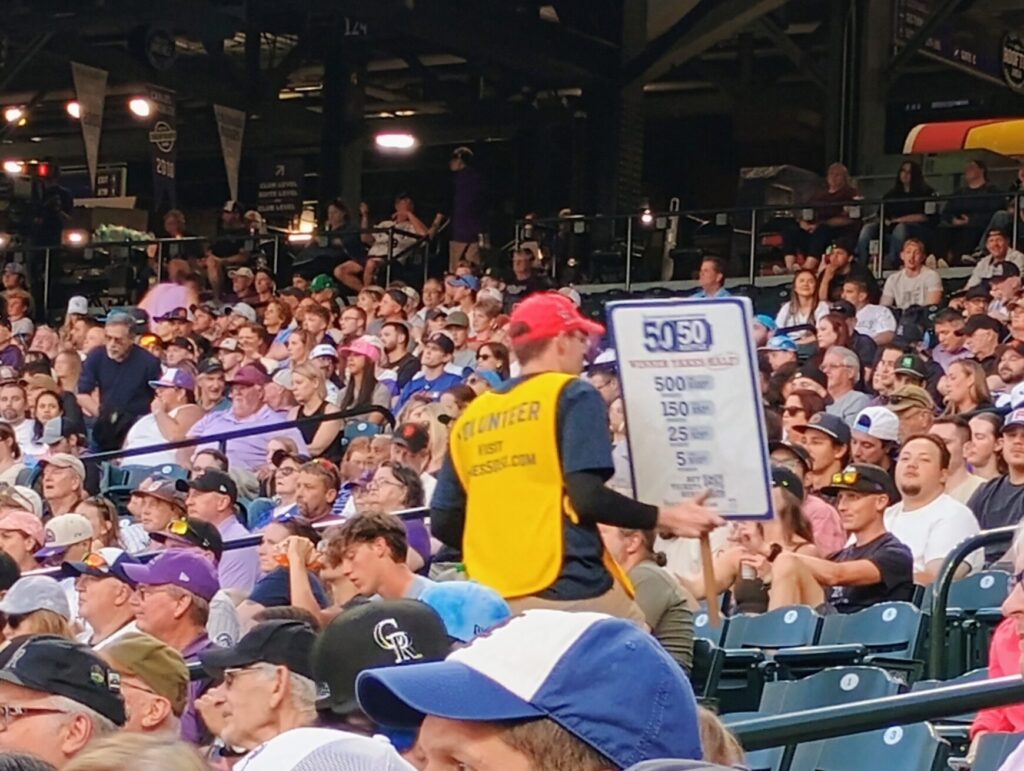
Colorado’s professional sports teams at one time each paired with local nonprofits to run 50/50 raffles that yearly pulled in hundreds of thousands of dollars.
Not all have kept with the practice. The Colorado Rockies and its namesake foundation is the sole team that maintains a partnership. But records show even with a lousy team record, Rockies fans like the chance to win some cash.
Signs announcing the 50/50 drawings – where the holder of the winning number splits the entirety of the proceeds from that day’s offering after initial expenses – for years regularly appeared during the season at each team’s venue.
The remaining 50 percent, by law, is to go toward the nonprofit’s charitable function, whether it be helping defray the costs of running youth sports leagues, offset expenses of education programs, feed into scholarships, or some other bona fide endeavor. A part of the half-pot frequently goes to the charitable foundation run by the sports team partnered with the nonprofit.
And while state and federal records show the proceeds make their way as intended, there’s one little hitch that is not as public.

If the buyer of the winning number doesn’t claim the prize within 30 days, the nonprofit gets to keep the entirety of the money.
And they don’t have to tell you that you have won, even though they know.
It’s happened dozens of times, The Denver Gazette has learned.
“That got a little dicey after a while, as people found out we knew who won but didn’t say anything,” said a former insider who worked with the raffles for one of the sports teams, agreeing to speak freely only if their name was not used because they feared professional repercussions. “A couple times there were some pretty heated arguments from people who didn’t keep their receipt, but we had their credit card info that they were the purchaser.”
The Colorado Avalanche along with the Denver Nuggets and Colorado Mammoth, all owned by Kroenke Sports, were among the first in town to present the 50/50 raffle, teaming with the Colorado Amateur Hockey Association in about 2012.
The Colorado Rockies followed suit, pairing with the Metropolitan State University Denver Alumni Association in 2018.
Denver Broncos Charities obtained its own license to run raffles in 2021 and teamed up with a variety of nonprofits – the Denver Boys and Girls Club among them – to split the proceeds.
By 2023, only the Rockies Foundation and MSU Denver remained active, according to records and interviews.
The other sports teams simply didn’t see it as a profitable venture anymore.
“As part of the Denver Broncos Foundation’s shift to high-growth and high-impact programs aligned with its new mission, vision and values, we transitioned away from the 50/50 raffle following the 2022 season,” said Allie Engelken, executive director of the foundation and the team’s vice president of community impact. “While the 50/50 raffle once served as a key fundraiser for our philanthropic efforts, we made the decision to redirect our efforts toward initiatives better aligned with current goals as we evolved our foundation priorities with the needs of our community.”
Initially, the Broncos Foundation partnered with the National Sports Center for the Disabled, Engelken said, but soon realized that handling the entirety of the raffle itself became a time-consuming effort with only half the return.
The Broncos Foundation in 2023 showed revenues topping $5.7 million, according to tax records – demonstrably more money than it had taken in the previous four years combined, and without a raffle.
It made nearly 120 distributions to a variety of nonprofits totaling nearly $4.9 million, the largest of which was a $500,000 donation to Momentum Advisory Collective, a group that works toward breaking the cycle of youth incarceration, and a $467,000 contribution to the Boys and Girls Club of Metro Denver, tax records show.
Said another member of the organization not authorized to speak: “When we changed from the raffle model, we didn’t hear anything from fans about missing it. Some folks didn’t even realize it was there.”
 A poster on a wall behind centerfield at Coors Field advertises the 50-50 raffle in which the winner is to get half the pot. Colorado law allows the nonprofit sponsor to keep the money if no one claims the prize, even though the charity knows who won.
Similarly, Kroenke Sports Charities moved away from the 50/50 raffles, showing greater reliance – and financial returns – with other ventures such as charity golf tournaments and auctions of player jerseys taking the lead.
In 2023, the group brought in more than $1.6 million in events other than a raffle. In its final year running a 50/50 raffle, the Colorado Amateur Hockey Association, the corresponding beneficiary, brought in just $40,000, tax records show.
At Coors Field, however, things are different.
Each game there are volunteers, sometimes more than a dozen, walking concourses up and down seating sections carrying placards that proclaim the 50/50 raffle.
“We were approached by the Rockies in January 2018, originally the Metropolitan State College Foundation, but it was the alumni association that partnered,” said Jamie Hurst, MSU Denver’s associate vice president for strategic engagement, who oversees the 50/50 raffle program and doubles as a certified games manager.
“It’s really difficult to staff the raffles since you need so many volunteers,” she said. “You must be a partner and for us, we’re lucky with more than 110,000 alumni. That makes our pool very large to draw from.”
What that’s meant is a revenue stream that has been firm and consistent, even if the Rockies as a baseball team has not.
The breakdown runs something like this: Half the proceeds go to the raffle winner. Of the remainder, about half goes to the Rockies Foundation (last year it was $175,000) and the other half goes to the alumni association.
From there, the association moves the funds to a segregated account with the MSC Denver Foundation, which then doles it out to a variety of programs, scholarships, athletics, all at the request of the volunteers who sold the tickets.
They don’t benefit specifically from the funds – state law prohibits any charitable gaming volunteer from being paid or benefitting for their time – but can dictate where it’s headed, Hurst said.
“It’s about 40 to 80 different programs that get direct funding,” she said. “The precision flight team, aerobatics, lacrosse, the pom squad, choir, sports management programs, academic scholarships.”
Anyone is eligible to benefit from the alumni association’s efforts.
Winner doesn’t always get half
But The Gazette learned that sometimes the financial benefits from a raffle – namely half of the proceeds that are supposed to go to the winner – don’t always get there.
That’s because the Colorado Secretary of State’s office in June 2014 passed a new regulation that changed how raffle winners are to be notified.
Typically, during a game there’s a moment when the winning raffle number is displayed on the scoreboards that encircle the stadium. It takes up a relatively small space, but it’s there and stays posted for a short while.
At the time, ticket sales were partly cash and partly credit card transactions and buyers would fill in some contact information. Winners had to present their ticket stub.
But the regulations required nonprofits to send notifications by mail to anyone who had won the raffle.
With the advent of internet sales and the prevalent use of credit cards, the regulations allowed for nonprofits to simply post the winning numbers on their website and wait for someone to step up – even though the buyer’s information was captured with the credit card transaction.
The Covid-19 pandemic changed how internet sales would work, allowing for anyone to buy a raffle entry without having to be at the game.
“As long as you’re in Colorado, and our software uses a geo-map,” Hurst said. “You don’t have to be in the state to claim it, but you do have to be here to buy it.”
Hurst said the alumni association hasn’t stayed fast to the 30-day prize-claiming rule, allowing winners to make their claim outside that timeframe.
“We’d rather err on the side of inclusivity,” she said.
But what of those times no one reaches out – even if the association knows who it is?
“Before Covid it was largely cash sales; during Covid it was all cashless and now it’s all credit card,” she said. “If the ticket is online we’ll proactively reach out.”
Financial records filed with the Secretary of State’s office show MSU Denver Alumni Association during the 2024 baseball season did not have any winner claim a prize 18 times.
Prizes that were awarded varied widely, from a pair of $23,000 winners to a more pedestrian $1,000, records show.
Given the averages, that’s about $100,000 extra the nonprofit was able to pocket.
Hurst said the group hasn’t run into a situation where a winner identified by credit card sales doesn’t have their ticket, which is required by state law.
“I can see how that’s a potential flaw,” she said.