
During Twins President Derek Falvey’s wide-ranging, season-ending sit-down with the media on Tuesday, he was asked what the Twins’ payroll would be in 2026. He didn’t answer, but we’ll find out. And when that number is released, I want you to understand what it means. So I’m going to give you five payroll levels and what they mean for the future of your Minnesota Twins. That’s because there was also one inadvertent admission during that session: payroll matters.
Falvey was also asked how he viewed the Twins roster for the 2026 season. He replied that it depended on ownership. “Specifically working with ownership around exactly what the vision is for this team going forward and opportunities and the markets and things like that.” That’s an interesting and backwards response, because usually ownership would lean on, say, their President of Baseball Operations to evaluate the current level of the team and the free agent market. But you know what ownership can dictate?
They can dictate a payroll budget, which was the very next question. “I think that’s a conversation that we’ll continue to have, certainly with the Pohlads and whatever conversation they’d like me to have with the limited partners”, replied Falvey. So Falvey doesn’t know what we can expect from the Twins next year until he talks to ownership. And he doesn’t know what he has to spend until he talks to ownership.
Well, of course. It is well-documented that the decline of the Twins’ payroll has influenced the decline of the Twins over the last two years. However, it has also been the primary limitation of the team since its inception. For that matter, it has been a critical factor of every baseball team throughout their history, and while we’re at it, for the vast majority of other businesses as well.
Listen, I love underdog Disney movies, too. But our love of underdog Disney movies doesn’t change the way the world works. In fact, our sad understanding of the way the world works is what makes us love underdog Disney movies. Payroll matters.
So let’s look at the five levels at which the Pohlads and their new limited partners could reasonably be expected to fund payroll for 2026. They correspond with five grades fans should give them. But before we get to that, you have to know one number: 95.
$95 million is roughly what it will cost the Twins to retain the team they have. Below is the 2026 roster and rough estimates for players’ salaries. I’d encourage the baseball geeks to check my work, and more casual fans to peruse what the lineup and bullpen look like.
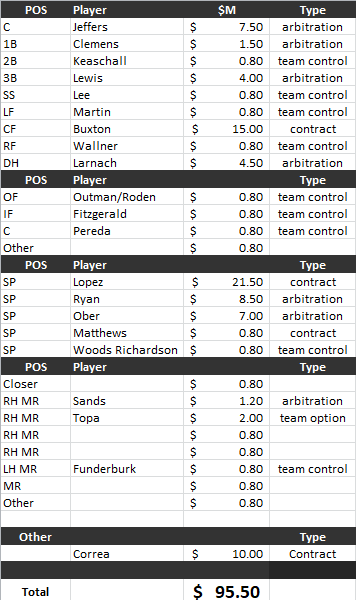
If $95M is the baseline, here are the five levels (and grades) that Twins fans should reasonably expect.
$80M – Grade: F
At this level, ownership is telling you that the historic trade deadline fire sale still wasn’t enough to satisfy their money-lust. To get to this level, the team will either need to trade away some combination of
Pablo Lopez, or
Joe Ryan AND Ryan Jeffers, or
Byron Buxton (who has a no-trade clause).
If the knife cuts this deep, there’s a decent chance that $80M would be the lowest payroll in MLB, behind the Athletics, Marlins, and Rays. The Twins’ win expectations (and likely, attendance) would reflect this.
$100M – Grade D
At this level, ownership is fielding the same team that went 19-36 after the trade deadline, or they’re trading away one of the names above to free up some cash to add some minor free agents, like a couple of low-leverage relievers or a Ty France-level bat. This is a below .500 team. (Maybe well below .500.)
$120M – Grade C
This was roughly what the team’s payroll was this year. They would have about $25M to spend, which is either enough room to add one big bat, or to add a couple of semi-decent bats at first base and designated hitter, and maybe a bargain reliever. The Twins would be projected to be a .500 team and a wild-card also-ran.
$140M – Grade B
This was roughly what the team’s payroll was going into 2025, before they traded away $25M in payroll at the trade deadline. They would have about $45M to spend, which is definitely enough to add two middle-of-the-order bats and a decent reliever or two. They would be projected to be a wild-card contender.
$160M – Grade A
This is about the Twins’ payroll in 2023, when they beat Toronto in the Wild Card round. It is also $20-30M below the average MLB payroll in 2026. However, it provides $65M to spend, which can be allocated to a combination of two or three big bats, two lockdown relievers, and possibly some complementary pieces. They would be an AL Central contender or Wild Card team.
So, there you have it: five payroll levels, five grades, and five expectations. The fact that Falvey is entering an offseason claiming not to know which level we should expect is alarming, because surely that would be revealed if he knew it was good news. Whatever the news, he’s going to have to find a way to make the best of it, because payroll matters. And we Twins fans will have to do the same.
What will the payroll level be? What should it be? Let us know below.