
Last time here on Top 10 Tuesday, we looked at the best National League Division League in MLB Postseason history. Now, it’s the American League’s turn.
It’s entire possible this list is obsolete before the week is over. The Seattle Mariners and Detroit Tigers have played a pair of nail-biters as of this writing, splitting the first two at T-Mobile Park.
And while the series between the Toronto Blue Jays and New York Yankees has been decidedly more one-sided thus far, Vladimir Guerrero Jr.’s heroics in the first two Blue Jay wins produced the kind of material that live on in Postseason lore for generations.
His grand slam in Game 2 was the first in Blue Jays playoff history.
So, yeah. This edition of Top 10 Tuesday might need rewriting soon. That doesn’t mean you can’t enjoy it in the meantime!
A final score of 23-7 posted in an October sporting event? Must be football.
Alas, that was the tally in Boston’s Game 4 win over Cleveland to force a do-or-die Game 5 in the 1999 ALDS. The Red Sox offensive outpouring provided a fittingly historic footnote for the entire series, in which the winning team plated at least nine runs in 4-of-5 contests.
That includes the decisive Game 5 in Cleveland, which opened with three of the wildest innings of postseason baseball since the invention of the television.
Nomar Garciaparra homered in the top of the first to give Boston a 2-0 lead, only for Omar Vizquel to drive in Kenny Lofton then Jim Thome to homer with Vizquel aboard in the bottom of the inning. Cleveland extended its lead in the second when Travis Fryman also hit a two-run home run off of two-time Cy Young winner Bret Saberhagen.
Cleveland’s 5-2 advantage didn’t even make it out of the top of the third. Charles Nagy walked Trot Nixon, who scored before Troy O’Leary blasted a grand slam — the first of two homers O’Leary hit in one of the all-time great individual great playoff games from a Red Sox.
For baseball video games players, this was a grim era if you owned an XBox 360. MLB The Show was exclusive to Playstation at the time, meaning your only option was the vastly inferior MLB 2K series.
2K produced transcendent basketball titles, including the best college basketball video games ever made. Its all-too-short-lived NFL franchise launched the modern era of football simulations, beginning with the revolutionary debut title on Sega Dreamcast and ending with the fan-favorite 2K5. There was even a stretch when the NHL 2K series was arguably superior to the EA titles long synonymous with hockey sims.
For whatever reason, though, 2K baseball titles from its launch with World Series Baseball 2K1 on the Dreamcast until it ended with 2K13 on XBox 360 and PS3 were always sub-par.
Perhaps for this reason, the studio relied on a gimmick offering any gamer capable of pitching a perfect game $1 million. Credit 2K for this, it marketed the penultimate edition of the game brilliantly with the most popular model on the planet at the time, Kate Upton, appearing in ads with superstar pitcher Justin Verlander.
Justin Verlander was an enviable fella in 2012. From hanging out with Kate Upton to producing the top WAR (8.1) and most strikeouts (239), the then-Detroit Tigers ace was on top of the baseball world.
Never was the more crystallized than in his bookending performances during the 2012 ALDS against Oakland.
Verlander opened the series with 11 strikeouts and just one earned run surrendered in a Game 1 defeat of the A’s. In the decisive Game 5, set up with Oakland’s three-run rally in the bottom of the ninth in Game 4, Verlander again struck out 11 in a complete-game shutout.
There have been only two complete-game shutouts in the 13 years since, and none in the Division Series or later.
The 2002 Oakland Athletics rank among the most captivating teams of the last 30 years. At the very least, it’s the most famous team of the post-strike era among casual fans thanks to the 2011 film adaptation of Michael Lewis’ book Moneyball.
Their American League record 20-game winning streak became the biggest sports story of that summer, and set up Oakland for a readymade redemptive mark after a heartbreaking playoff exit the year prior (more on that to come).
Instead, the 103-win A’s ran up against Brad Radke who shook off a challenging start to bookend the ALDS with a pair of wins in Minnesota’s three games-to-two series victory.
Oakland struck for five runs in the first two innings with Radke starting Game 1, though only one was earned. For the series, Radke gave up just two earned runs in 11.2 innings pitched.
Mark Mulder delivered a pair of starts on par with Radke’s, striking out 12 over 13 innings of work and putting up a 2.08 ERA, but was the only one of the A’s big three pitching staff who didn’t struggle. Tim Hudson posted a 6.23 ERA in his two starts. Barry Zito picked up the win but with four walks and four earned runs, was well off of his Cy Young Award-winning pace.
However, it was the bullpen that most notably wilted for Oakland. Ted Lilly was used as a reliever for the series and proceeded to give up four and two earned runs in his two appearances — both A’s losses.
Billy Koch closed out Oakland’s Game 2 and 3 wins. It wasn’t a save situation when he took the mound in the decisive Game 5, with Minnesota leading 2-1, but the three runs all charged to Koch in the top of the ninth ensured a furious A’s rally in the bottom of the inning was not enough.
Two players more synonymous with different Postseason runs later on in the decade — A.J. Pierzynski and David Ortiz — drove in critical insurance runs off of Koch. Pierzynski’s came on an absolutely blasted two-run homer, putting an exclamation point on his 7-of-16 series in which he produced a 1.250 OPS.
While the formula Major League Baseball adopted for its 1981 split-season playoffs was questionable, the expanded Postseason format produced noteworthy games. Both 1981 Divisional Series appear in the Press Break ranking of all-time best NLDS, and a Yankees-Brewers series that went the distance featured the American League pennant winners of both ‘81 and ‘82.
All the ingredients that powered Milwaukee to its lone World Series appearance were present in the strike-shortened 1981 campaign with a pair of Cy Young Award winners in Pete Vuckovich and Rollie Fingers, AL MVPs in Fingers and Robin Yount, and Hall of Famers Fingers, Yount and Paul Molitor.
And while the Brewers were on the ascent in 1981, New York was an empire in decline. A book I have recommended on this newsletter numerous times, Jeff Katz’s Split Season, does a superb job detailing George Steinbrenner’s chicanery behind the scenes. The Yankees boss pit marquee acquisition Dave Winfield and aging legend Reggie Jackson against each other — each player unwillingly — for financial purposes.
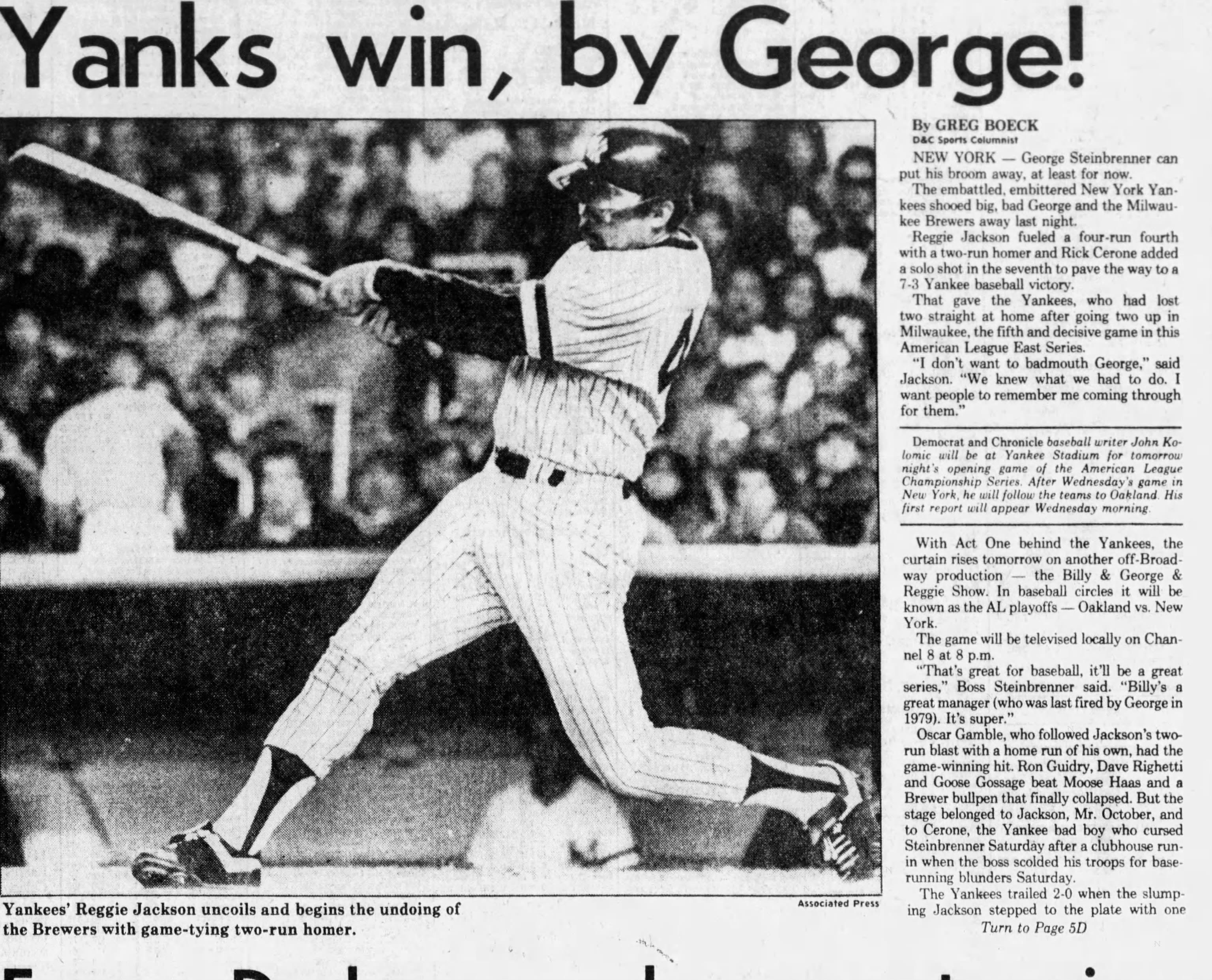
It’s the kind of move that helped crater the Yankees organization for more than a decade, but they had one more big run in them in 1981. After Oscar Gamble’s big Game 1, Jackson gave Steinbrenner something to chew on with a ninth-inning home run in Game 2 to complement Dave Righetti’s outstanding start.
Righetti struck out 10 in six innings, while Goose Gossage pitched nearly three innings to close it out. But with Fingers and Vuckovich starting Games 3 and 4, the Brewers countered with their own sensational pitching to set up a do-or-die Game 5.
Yount went 3-for-5 in the finale with a triple for Milwaukee, but Jackson again stepped up big for the Yankees: 3-for-4 with a two-run home run that triggered a pivotal fourth inning. Oscar Gamble also homered in the fourth, putting a cap on his outstanding series.
The 7-3 win sent New York to the ALCS for the last time until 1996.
After winning four World Series in five seasons from 1996 through 2000, the ensuing half-decade was a trying time for the New York Yankees. I know, I know. It’s sad and your heart really goes out to the Bronx Bombers faithful, but just imagine how difficult it must have been watching them in the Postseason every year but 2002 and in the World Series again in both 2001 and 2003.
To overcome their heartache before the 2005 season, they added a pitcher partially responsible for the beginning of the Yankees’ playoff frustrations: Randy Johnson. Johnson, whose co-World Series MVP performance in the 2001 Fall Classic helped Arizona past New York, picked up 17 wins in his first season as a Yankee on the way to becoming the last 300-game winner.
However, he worked just three innings in a Game 3 no-decision of the ALDS, giving up nine hits, a pair of home runs and five earned runs to the recently rebranded Los Angeles Angels of Anaheim.
Yes, that’s a silly name for a team based in neither the city nor county of Los Angeles, and I attribute the Angels’ lack of a return to the World Series in part to karma for this rebranding. But in 2005, the Halos did score an 11-7 win at Yankee Stadium to wrest back home-field advantage in the best-of-5 series.
After a 3-2 New York win in Game 4, which saw the Yankees score all three runs in the sixth and seventh innings, the series returned to Anaheim where both the Rally Monkey and Garret Anderson had the SoCal fans in a frenzy.
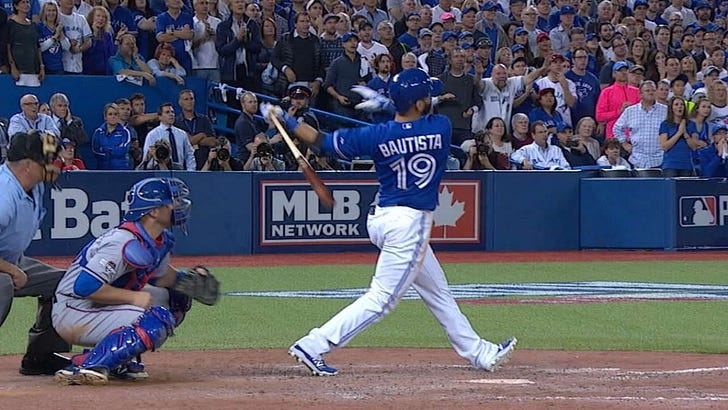
A Postseason bridge in Blue Jays history between Joe Carter’s 1993 World Series walk-off homer and Vlad Guerrero Jr.’s Game 2 grand slam in 2025 is Jose Bautista’s blast in 2015.
Bautista’s iconic reaction to this three-run shot in the decisive Game 5 unofficially signaled the start of a new era for MLB. At least, for me there’s an undeniable symbolism there.
I had a stretch of lapsed baseball fandom in the first half of the 2010s perhaps reflected in this Top 10 Tuesday’s dearth of ALDS mentions from this period. Both my childhood team, the Cubs, and my local club, the Padres, were dismal. The Postseason failed to capture my imagination the same it had in the decades prior. But the rancor that bubbled between the Blue Jays and Rangers sparked my interest.
A marathon Game 2 brought back bad memories; LaTroy Hawkins giving up three straight singles with two outs in the 14th?! It’s the Cubs 2004 September collapse all over again!
But Toronto’s rally from down 0-2 after the extra-innings setback reminded me why October baseball is so special. And, at a time when the sport felt so stodgy about its unspoken rules of decorum, Jose Bautista’s unrestrained emotion captured the moment in a way that truly resonated.
How might the fate of the Oakland Athletics have played out had the repeated heartbreak at the turn of the millennium instead produced more World Series championships?
Well…probably not any better. The Golden State Warriors skipped town for the more affluent San Francisco despite winning three NBA championships in Oakland, and the A’s were routinely competitive in 2006 when the legendary Ghostride the Volvo video dropped in the earliest days of YouTube.
Nevertheless, it’s tragically fitting — or fittingly tragic — how close Oakland repeatedly came to glory as the initial rumors of an A’s move began to publicly swirl. They reached four straight Postseasons to begin the 21st century but never advanced to the ALCS, their Game 5 loss to the Red Sox in 2003 marking the end of this run.
The finale pit two of the premier pitchers of the 2000s head-to-head, with Pedro Martinez starting for Boston and Barry Zito on the hill for the A’s. Both were dealing through five innings, too, with Jose Guillen’s fourth-inning double driving in the lone run to that point.
Jason Varitek’s home run in the top of the sixth cracked Zito’s seemingly impenetrable armor, providing an opening for Manny Ramirez to drive a dagger straight through the Oakland ace.
In a prelude to the following year’s comeback ALCS win over the Yankees, Ramirez powered Boston to a rally from down 2-0 in the 2003 ALDS. The resulting 4-3 Red Sox win was the third game of the series decided by one run, and two of the series’ five contests went to extra innings.
As history bears out, Cleveland bouncing the Yankees from the 1997 ALDS is all that prevented an incredible five-peat. It wasn’t easy, though: The club now known as the Guardians had to rally from a 2-1 hole after losing Game 3, 6-1.
They might also have faced an insurmountable hole early in Game 4, if not for Brian Giles making one of the best defensive plays in modern-day Postseason history.
Giles’ brilliant throw limited the damage to two runs for the Yankees in the top-half of the first. That was all New York could muster in Game 4, as veteran Orel Hershiser blanked the Bronx Bombers for the next six innings and Sandy Alomar homered off of Mariano Rivera — who came in pursuit of a four-out save — to send it into the ninth tied at two.
Omar Vizquel drove in Marquis Grissom for the winning run and set up Game 5.
While Manny Ramirez’s career as a Yankee slayer is more synonymous with 2004 and his time in Boston, the journey actually began here with a two-run double off of Andy Pettitte, setting Cleveland on course to a 4-3 win.
Although not appearing in this Top 10 Tuesday countdown, this seems an appropriate time to mention one of the most memorable single ALDS games ever played. In a rematch between Cleveland and New York a decade later, a swarm of small, gnat-like insects called midges infested the field and resulted in an erratic eighth inning from Joba Chamberlain.
The midge-swarm felt like fate intervening on behalf of a long-suffering organization. Alas, the Guardians have taken over the role the White Sox, Red Sox and Cubs all occupied earlier this century as the most forlorn franchise. I’d add the 1997 season ending in a World Series loss to the Marlins, of all teams, as indicative of Cleveland’s plight.
The Continued Plight of the Cleveland Guardians 
When the 2016 Chicago Cubs exorcized the Curse of the Billy Goat, Major League Baseball — and perhaps major team sports as a whole — acquired a new bearer of the heaviest championship cross.
The George Steinbrenner of the 1980s was the Jerry Jones of today: A megalomanic overlord whose meddling rendered a once-dominant franchise impotent. The New York Yankees of the ‘80s and pre-strike ‘90s were a punchline.
Scratch that. Steinbrenner was the punchline, immortalized as such in pop culture with his portrayal on Seinfeld and The Simpsons villain Mr. Burns borrowing managerial traits from the convicted felon.
Returning from the strike in 1995, however, the Yankees were on the cusp of becoming Major League Baseball’s most dominant modern-day dynasty. It was a fascinating transitional period for the organization, with Mattingly still in the Bronx and longtime Red Sox star Wade Boggs recovered from his vicious bar-room brawl with Barney Gumble and now donning pinstripes.
However, a young Jorge Posada debuted (for all of one plate appearance) in 1995, and 21-year-old shortstop Derek Jeter played 15 games. Veteran bedrocks of the turn-of-the-millennium World Series dominance, Paul O’Neill and Bernie Williams, both had excellent 1995 campaigns.
Like the Yankees of the time, Ken Griffey Jr. was also priming up for a historic stretch in 1995. The Kid was certainly an established star by this juncture in his career, having already appeared in six All-Star Games by the time the ‘95 Postseason arrived. He led the American League in WAR in 1993 (8.8) and homered 45 times, and the following season was threatening Roger Maris’ then-record 61 home runs at the time of the strike, having hit 40 by Aug. 11.
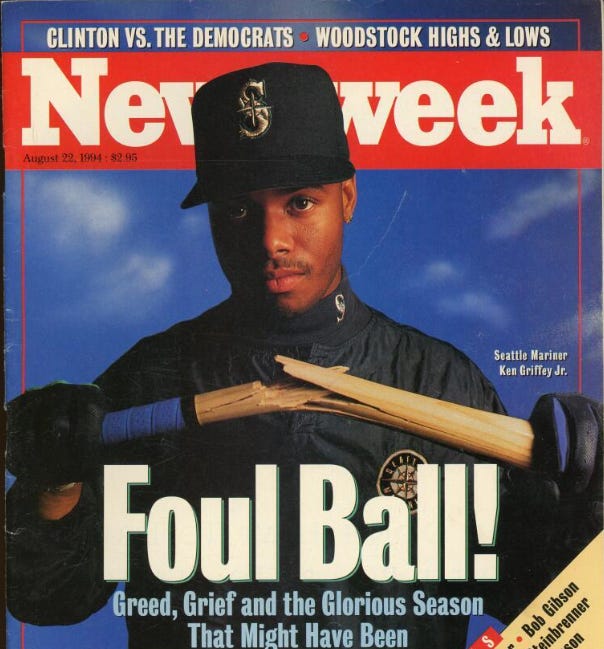
The image that is forever implanted in my memory as most symbolic of the ‘94 strike is the Newsweek cover of Griffey holding a broken bat above the headline “FOUL BALL!”
So while contemporaries Barry Bonds and Frank Thomas were perhaps better than Griffey come 1995, it’s fair to argue Junior was becoming the face of baseball. And that argument evolved into more of an indisputable fact over the next few years when he solidified his place in Cooperstown.
Griffey had three straight top-four finishes in the AL MVP voting from 1996 through 1998, including his winning the award in 1997. He mashed 56 home runs in 1997 and 1998, setting a Mariners franchise record that stood until Cal Raleigh broke it this season.
And this meteoric run ignited with a remarkable performance in the 1995 ALDS, the first Postseason series in Seattle Mariners history.
The Kid was ridiculous, going 9-of-23 with a staggering five home runs over the five-game set. However, it was a Griffey single that initiated perhaps the most famous sequence in Mariners history.
In the 11th inning of Game 5, Junior followed Joey Cora for back-to-back singles with Edgar Martinez stepping up. Edgar Martinez was one of four Mariners to exceed an OPS of 1.000 for the series, joining Tino Martinez, Jay Buhner and Griffey.
And Edgar Martinez teamed with Griffey to deliver the ultimate heroics of the series.
The prevailing and enduring narrative of Major League Baseball’s post-strike comeback that lasted unofficially until the mid-2000s steroid trials is that it wasn’t until the 1998 home-run chase that it again became America’s Pastime.
And I think that’s probably an accurate recollection. However, for me, this series and the subsequent World Series between baseball’s two best teams — Atlanta and Cleveland — helped restore some of my lost interest in the sport as an adolescent.
Few plays at the plate have ever been more iconic or as consequential as Derek Jeter’s toss to Jorge Posada in Game 3 of the 2001 ALDS between New York and Oakland.
The seventh-inning play at the plate preserved a 1-0 Yankees lead, and New York staved off elimination in a three-game sweep. Mike Mussina gave up just four hits in seven innings of shut-out pitching, while Mariano Rivera threw a rare, two-inning save.
Posada was also responsible for the lone run in this game, homering off of Barry Zito — one of only two hits the A’s starter surrendered in an otherwise dominant start.
I’ll admit plenty of personal bias in ranking this the No. 1 ALDS of all-time. The Flip is, for me, the most iconic play in Division Series history and a moment I directly correlate with Jason Giambi jumping ship to New York the following offseason.
The out also sparked a rally from the Yankees spanning the week that was exactly one month after the Sept. 11 terrorist attacks. You didn’t need to be a Yankees fan — heaven knows I was certainly anything but — to be happy for the reveling New Yorkers.
The entire six weeks from when MLB returned on Friday, Sept. 21 that year and ended in the greatest World Series of my lifetime the first weekend of November marked a stretch in which baseball most felt like America’s game.