
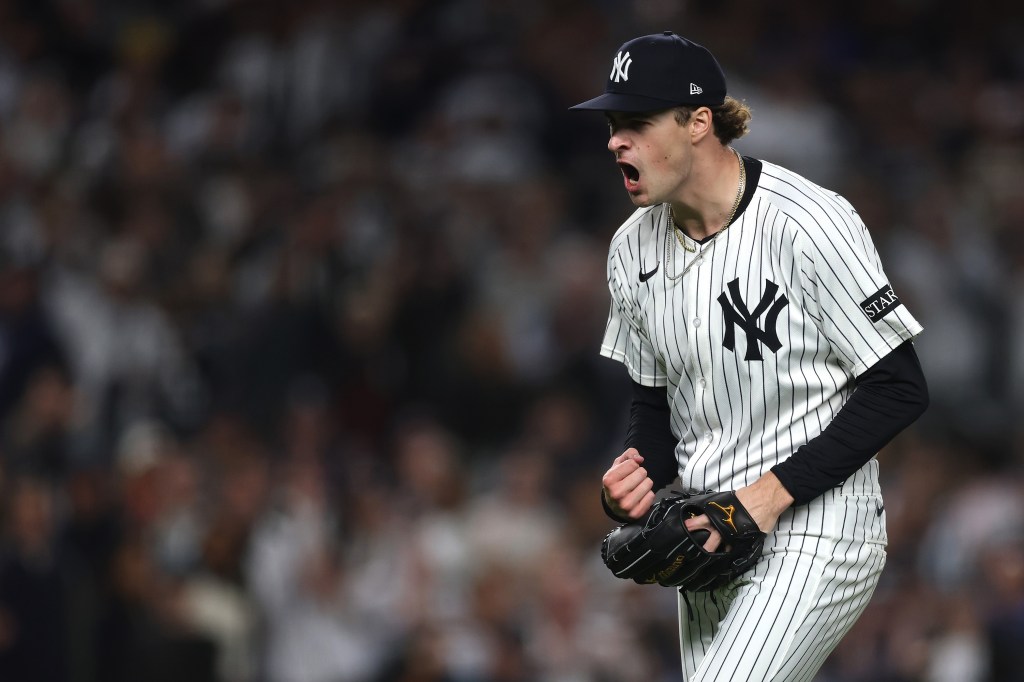
Cam Schlittler started the season at Double-A.
So did Jacob Misiorowski.
Trey Yesavage began the year in the Florida Complex League before skyrocketing up the Toronto Blue Jays’ system, pitching at four minor-league levels before making his MLB debut less than a month ago.
Yet all three have left major marks on this MLB postseason, as have a number of other rookie pitchers in a compelling youth movement that’s sweeping the sport.
“It’s a lot of weight on your shoulders as a rookie,” Schlittler, 24, said Tuesday at Yankee Stadium of being entrusted on the postseason stage.
“I think the guys that separate themselves are going to be the ones that are confident in themselves and [are] just going out there and treating it like another game.”
In his postseason debut last Thursday, Schlittler propelled the Yankees to the ALDS by hurling eight scoreless innings with 12 strikeouts against the Boston Red Sox in a do-or-die Game 3 of the Wild Card round.
That was the 15th MLB appearance by Schlittler, who made his debut in July.
Three days later, Yesavage threw 5.1 no-hit innings against the Yankees, striking out 11, in a Blue Jays victory in Game 2 of the ALDS.
Yesavage, 22, made his MLB debut on Sept. 15 and boasted only three games of big-league experience before Sunday’s gem.
“I feel like for the most part, I’ve always had [poise]. I would say in college is when I really learned that, just talking about the mental game and not getting too high, but not getting too low,” said Yesavage, whom Toronto took out of East Carolina in the first round of last year’s draft.
“If something goes bad, just brush it off. But if something goes really good, still being able to brush it off and move on to the next pitch.”
Misiorowski, 23, made his MLB debut for the Milwaukee Brewers in June and pitched in 15 regular season games, including 14 starts. The flame-throwing right-hander earned a controversial All-Star selection after only five career starts.
But Misiorowski looked every bit the All-Star on Monday, when he tossed three scoreless innings — and threw 31 of his 57 pitches at 100+ mph — in an ALDS Game 2 win over the Chicago Cubs.
And Misiorowski is hardly the only rookie to dazzle with his stuff in these playoffs.
Schlittler’s sinker averaged 99.0 mph during his 4-0 win over Boston, during which he became the first pitcher in MLB history to throw at least eight scoreless innings with 12 strikeouts and zero walks in a playoff game.
Yesavage, meanwhile, disarmed the Yankees with baseball’s highest release point and devastated them with his mid-80s splitter, eliciting 11 swings-and-misses with that pitch alone.
“We’ve all, I think, marveled to some degree at the stuff these pitchers have over the last five, seven, eight, 10 years, right?” Yankees manager Aaron Boone said.
“I think more so even this year, it feels like it’s even gone to another level. You turn on every game, and this guy is throwing a 99-mph cutter. This guy’s got a 95-mph split.”
And there’s more.
In his fifth MLB appearance, 23-year-old left-hander Connelly Early started Wild Card Game 3 for Boston and traded zeroes with Schlittler through three innings. Boston’s defense let Early down in the fourth, however, and he was charged with four runs (three earned) in 3.1 innings with six strikeouts.
Another Red Sox rookie lefty, Payton Tolle, retired the only batter he faced in Wild Card Game 2 in his eighth MLB appearance.
Roki Sasaki has emerged as a much-needed late-inning bullpen weapon for the Los Angeles Dodgers, hurling 2.1 scoreless innings over three appearances in the playoffs thus far.
Sasaki, 23, closed out both of the Dodgers’ wins in Philadelphia to go up 2-0 in the NLDS, earning a save both nights behind a fastball he dialed up to 101 mph.
Los Angeles won the sweepstakes last offseason to sign Sasaki out of Japan, but the right-hander pitched to a 4.46 ERA over 10 appearances, including eight starts, during an injury-riddled regular season.
“They have nasty stuff,” Yankees catcher Austin Wells, who caught Schlittler’s dominant playoff debut, said broadly of the rookie revolution.
“A lot of it is maybe some stuff guys haven’t seen before. For example, the Yesavage guy’s splitter from that angle. Not many guys throw like that. So I think there’s definitely a bit of an element of surprise, and not a lot of data backing what their stuff actually does and what to expect.”
The Mets, too, relied heavily on rookie right-handers during the playoff push.
Nolan McLean, Jonah Tong and Brandon Sproat made their MLB debuts in rapid succession, none earlier than Aug. 16, and remained part of the rotation until the regular season ended with the Mets missing the playoffs.
The best of the bunch was McLean, 24, who went 5-1 with a 2.06 ERA in eight starts, demonstrating the elite spin rate that made him a prized prospect.
“With what they’re able to do now with optimizing pitchers with the high-speed cameras, with grips and what a ball does, and how an individual pitcher’s body composition works to optimize them with what they should be throwing and can be throwing, I think you’re seeing that probably at a younger age,” Boone said.
“It’s remarkable, the amount of young, impactful people that come up and, right away, you can trust in big situations.”