
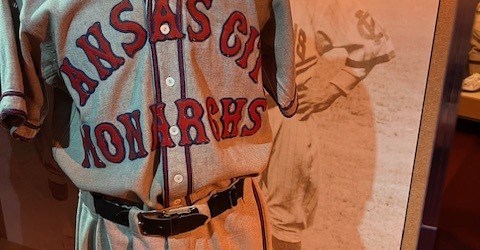
On a recent swing through Kansas City, my daughter and I made a stop at the Negro League Baseball Museum. We started the excursion at Arthur Bryant’s, one of our favorites and one of many outstanding barbecue restaurants in the metro area.
If you’re planning a trip to the museum soon, a word of caution: 18th Street is torn up and under construction from The Paseo to Highland. There are workable detours, but it would have been handy to know that ahead of time. The neighborhood is awash in history. From the Paseo and 18th, you can see the Paseo YMCA, where the Negro Leagues got its start in 1920. Across the street from the Museum is the fabulous Gem Theater. Next door to the Jazz Museum sits the Blue Room. When I close my eyes, I can almost hear the music of Count Basie, Ella Fitzgerald, Duke Ellington, Charlie Parker, and Etta James, and imagine the vitality of what this neighborhood must have been back in the day.
Every time I drive through the neighborhood, I wonder if the Royals should consider building their new stadium here. They could use the land that currently houses the Kansas City MLB Urban Youth Academy and give the Academy some land (and new facilities) in the trade. That parcel is just half a block south of I-70 and just west of the 18th and Vine District.
There’s also a couple of possibilities near the old Municipal Stadium site. There is some land at Paseo and 22nd that looks large enough to hold a stadium and another possibility in a parcel between 22nd and 24th bordered by Vine and Woodland Avenue.
There would be obstacles, naturally. Some homes and businesses would have to be purchased, and the residents and owners compensated for their inconvenience. The City would have to dump some serious money into building out the road and parking infrastructure.
But it’s not downtown. In fact, it’s not even walkable to downtown. It’s a long shot and a pipe dream, but can you imagine the effect it would have on the 18th and Vine District?
It’s been a few years since we last visited and the Museum remains it’s wonderful, spectacular self. Kansas City really has a fine collection of museums with the World War I, the American Jazz Museum and the Arabia Steamboat. Add all the spectacular fountains and parks and its vibrant food scene to a city that’s relatively easy to get around in, and you have one of the finest cities in the country. Paris of the Plains indeed.
The Museum is currently fundraising for a large expansion which promises additional space for new exhibits as well as a research library and an events center. I’m excited to see what the new addition will bring.
As for the exhibits, where to begin? My daughter was fascinated with the Field of Legends. Both of us were enthralled with the Buck O’Neil exhibit. We met Buck once, entirely by chance, at a game at Kauffman one hot summer evening. Buck was very gracious, taking a few minutes to chat and signed my program, which remains one of my treasured baseball artifacts. The world needs more Buck O’Neils.
I’ve always loved the uniform display. Having written extensively about the history of the Negro Leagues, it was enjoyable to see the uniforms of many of these trailblazers.
The autographed baseball display, courtesy of Geddy Lee, the lead singer and bassist for the rock band Rush, is spectacular. My only suggestion to the museum is to put a small sticker below each ball displaying the name on the ball. There were several balls where the signature had begun to fade and was illegible. I’ve got just enough OCD that not being able to read the signature drove me batty. It is an impressive collection and worth the price of admission alone.
I do wish the museum had more physical exhibits. Hats, balls, bats, spikes, uniforms, you name it. I also understand that many of those items have most likely been lost to time, which is a shame.
In many ways, Kansas City was the epicenter of the Negro Leagues, from it’s founding and through the dominance of the Kansas City Monarchs. The city was home to many of the all-time greats, who were raised here or spent many years living in Kansas City. Guys like Buck and Satchel Paige, Hilton Smith and Newt Allen, J.R. Wilkinson and Frank Duncan. Is there another city in the country with the Negro League history to match Kansas City? I think not.
I will continue to bang the drum for the Royals and the Negro League Museum to include a small display for my man, George Spriggs. Buck O’Neil often said he came along at just the right time. Spriggs, unfortunately, came along at the wrong time. A gifted athlete, he started playing in the Negro Leagues after integration. Spriggs played for the Monarchs, who by that time were a barnstorming outfit. The League was already in decline when he received a call from Uncle Sam. After serving his country, Spriggs signed with the Pirates, who, unfortunately for him, were an organization loaded with high-caliber outfielders, guys like Clemente, Stargell, Virdon, Alou, Mota, and in the farm system, Al Oliver. That was an amazing collection of outfield talent.
By the time he finally got a fair shot with the 1969 expansion Royals, it was too late for him. He was already 32 years old and in the twilight of his career. Spriggs was one of the last men to make the jump from the Negro Leagues to the Majors and the only alumnus of the Negro Leagues to play for the Royals. Had he played 20 years earlier, he’d have been a star in the Negro Leagues. Had he played 20 years later, he’d have been a very solid major league outfielder.
As you leave the Museum, you will see a spectacular painting of Jackie Robinson, wearing a Monarchs uniform, sliding into home plate at Municipal Stadium. The piece, by the immensely talented Kadir Nelson, is one of the highlights of the Museum. In fact, I could spend all day just looking at paintings by Nelson and Graig Kreindler who is another supremely talented baseball painter.

The Museum remains one of the crown jewels of Kansas City’s Museum portfolio and a must-see for every baseball fan.