

There are many films about the success of Pittsburgh baseball legend Roberto Clemente. But there are few telling the story of the man outside of the jersey.
Emmy Award-winning filmmaker and Indiana, Pennsylvania, native David Altrogge has created a film that does just that. “CLEMENTE,” which premiered on Sept. 12 and is available to watch now on the History Channel, won the SXSW Audience Award. Altrogge’s storytelling and production company, Vinegar Hill, produced it.
“Ive got to make this movie,” Altrogge says. After finishing another film in 2018, he was searching for his next project. He went back to this roots: Pittsburgh. “I wanted to do a film that would give people hope, inspire people and remind people that we’re capable of so much good as people,” says Altrogge.
The film showcases different forms of storytelling, from animation to interviews, archival storytelling and exclusive home videos.
The film also has some large names attached to the project, from locals such as Duane Rieder, founder of Pittsburgh Roberto Clemente Museum, to LeBron James and Michael Keaton. Along with notable figures, Clemente’s children, Roberto Clemente Jr., Luis Roberto Clemente and Enrique Roberto Clemente, also appear.
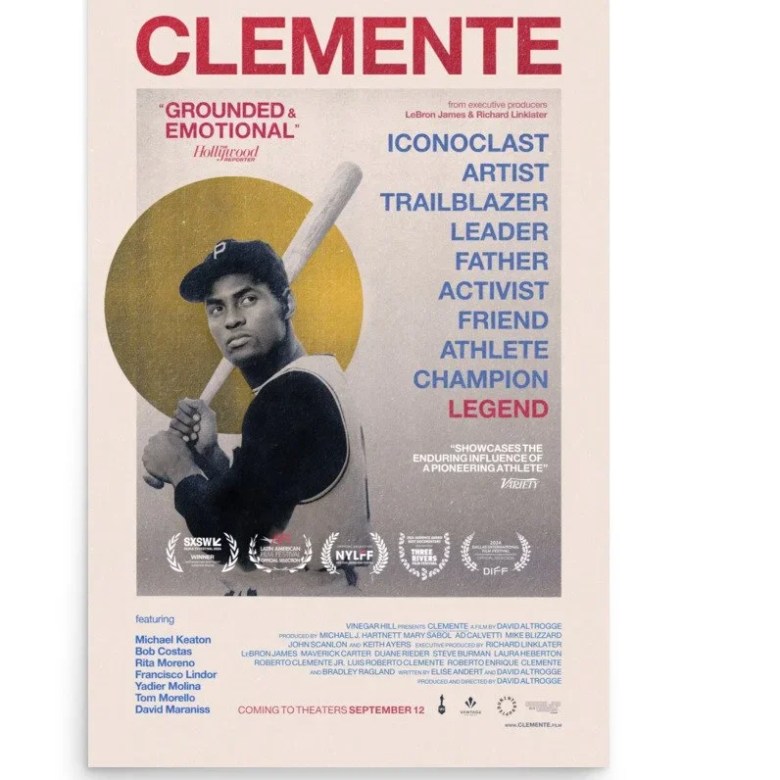 The poster for “CLEMENTE.” Image courtesy of Vinegar Hill.
The film features sharp narration, building the story up to the athlete’s final interview in 1972 with Sam Nover of the network now known as WPXI. It tells his story from childhood growing up in Puerto Rico to his last breath.
Altrogge was able to take home videos to tell the story of the family. He told me the home videos were actually 20 years old. An old film company had possession of the videos and it took about a year to get the copies of the film. “It was kind of an epic, epic search to find them,” he said. But they were essential to tell the story.
Animations show how Clemente fell in love with the sport of baseball as a young boy, throwing a ball against the wall and perfecting his unique catching and throwing skills. Home videos follow the love story of Clemente and his wife, Vera, and the birth of their three children.
Altrogge was one of Vera’s final interviews before she died in 2019. It opened the door for others to sit down and tell their stories.
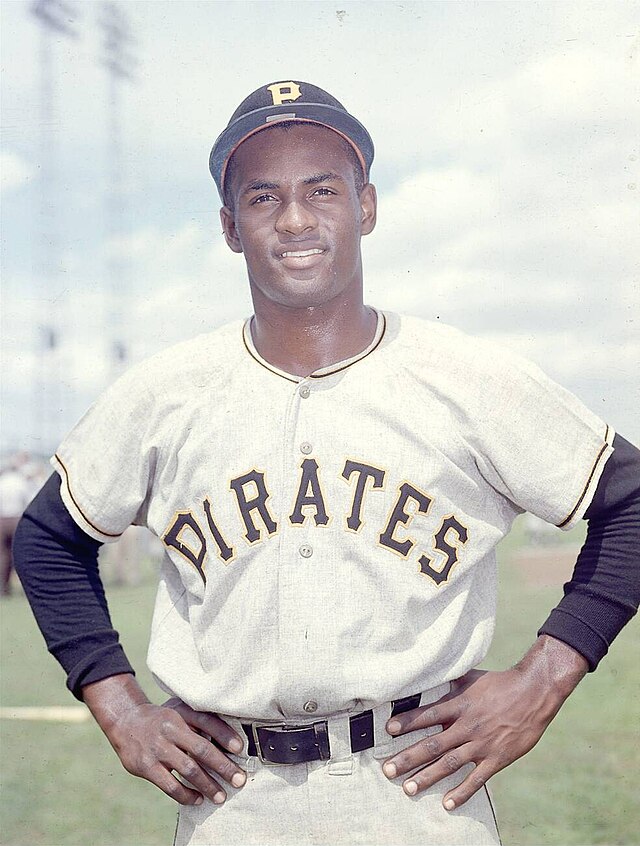 Roberto Clemente playing for the Pittsburgh Pirates in 1957. Photo courtesy of Wikipedia Commons.
Clemente changed lives for the better. In the film, we hear the fan-turned-friend story from Carol Bass. What started when Bass once gave Clemente a ride to the airport ended up being a close friendship.
Despite being one of baseball biggest stars, he was still a genuine soul at heart.
Another story told by Harry Hayden, a young boy who stopped Clemente after a practice or game. He shared how greatly impacted he was by his hero’s death.
We are also taken on the ride where he first entered the league, an outcast for being both dark-skinned and Latino. He never felt he belonged, regularly experiencing harsh comments such as “go back to where you came from” or being mocked for his accent by the media in interviews. Near the end of his career, though, Clemente finally received accolades after winning most valuable player award. He was the leader of the first all Black and Latino starting lineup in MLB history in the 1971 World Series game against the Philadelphia Phillies.
Altrogge tells Roberto’s story in a beautiful way on screen. Throughout the entire film, there was one line that stuck with me. Roberto Clemente said, “I feel like God put me on earth to play baseball.” Then I remembered Altrogge telling me he felt like he needed to make this film. I asked him if he felt the same way about this film as Roberto did baseball. He said, “I do think I’m here to tell stories; it’s the only thing I know how to do and the only thing I’m good at. It brings me so much joy to tell stories.”
The film has been shown in theaters all over the country and Puerto Rico. It will also be on more streaming platforms later this fall.
Altrogge held a special Pittsburgh premiere at the Byham Theater Downtown on Sept. 13. The night was presented by the UPMC Community Commitment and a grant from the Richard King Mellon Foundation, First Commonwealth Bank and Lynch Carpenter.