


By Rob Rains
In December 2003, Chaim Bloom spent several nights sleeping on the floor in a friend’s hotel room during baseball’s winter meetings in New Orleans. It was far from glamorous, but Bloom was still a student at Yale and he was not in the city on a sightseeing vacation.
Bloom was there to try to meet as many people as he could, to hang out and mingle in the hotel lobby, while pursuing his goal of trying to land a job working in baseball.
“I was already doing some work for Baseball Prospectus at the time, so I had a few people that I kind of knew from my virtual work with them,” Bloom said. “I knew I could chat with them in the lobby while I was waiting to see if there were people who worked for teams that I could mingle with.
“The sole purpose was to go there to network and see if I could make some headway on getting in the game.”
Bloom did not come away from those meetings with a job. He returned to school and started constantly sending emails, writing letters and making cold calls, seeking advice.
“I just wanted to pick people’s brains because the odds of getting a job off of that are near zero,” Bloom said. “The Padres internship came out of that. It was a two-month gig and they made it very clear they couldn’t pay me and couldn’t hire me at the end of it, but it was a chance to get some work with a team.”
 Working in baseball was a career that Bloom decided to pursue after falling in love with the game while growing up in suburban Philadelphia. Two decades ago, he was setting out on a journey driven by hope and ambition but with no idea where it would take him and with no final destination in mind.
“When you are trying to get in the game, I think the best way to make progress in this game is not to look too far down the road,” Bloom said. “I think I got lucky in a few ways, but I certainly worked for it. I was lucky that when I did get in the game, I loved it. That’s not a given.
“There’s a lot of sacrifices you make to do this. It’s not as glamorous as people think, really any job in the game. Any given day is full of a lot of things you don’t daydream about when you daydream about any job in this game. The fact I was able to get in and that I really enjoyed the work was a blessing.”
On those days spent working the lobby of the Marriott Hotel, Bloom did not know how his career would unfold – about how an internship with the Tampa Bay Rays would turn into a full-time job; how success there would lead him to a job running the Boston Red Sox, or now, to his new job as the president of baseball operations for the Cardinals.
To get a better understanding of how Bloom has built a career in the game at the still-young age of 42, STLSportsPage.com reached out to people who have worked with Bloom and known him over the last 20 years. They paint a portrait of a man who loves his family, is devout in his faith, and has an appetite for working with people, all ingredients that have fueled Bloom’s career.
“He’s smart; he never stops learning, that’s what makes this young man tick,” said Mitch Lukevics, who became a mentor to Bloom during the early years of his career with Tampa Bay. “He’s a good person. He’s well-liked. He knows his strengths; he knows his weaknesses and that’s what makes him good at what he does. He doesn’t know it all. That’s the kiss of death in this business.
“He respects people. He treats people the way he wants to be treated. All of the things you should have with leadership he has because he’s learned it. He kept learning and he kept learning.”
Bloom’s desire to learn was already part of his DNA even before he knew that he wanted to work in baseball.
“I liked playing it; I just wasn’t any good at it”
Bloom’s father was an eye doctor and his mother was a teacher. He is the oldest of two boys and is named for his mother’s uncle. In Hebrew, Chaim means “life.”
His first baseball experiences came playing the game in Little League.
“I liked playing it; I just wasn’t any good at it,” he said. “You didn’t have to be much of a talent evaluator to realize I didn’t have any.”
What Bloom had, almost from the start, however, was a love for the game.
“I’m not sure I can pinpoint the why,” he said about how that happened. “I just know I was hooked. I just really got into everything about the game; the intensity of the competition, the game’s history. There’s so many ways you can connect with it. I don’t know if I can put my finger on why. It was just one of those things.”
It was when Bloom was finishing high school, and in his early years at Yale, when the idea of working in baseball became a career goal.
“I was passionate about it,” he said. “It was a time in the evolution of the game when pathways into front offices were really starting to open up for people with backgrounds like mine and I basically just decided I was going to go after it. I was going to scratch and claw and see if I could hustle my way in there.
“I was fortunate to be at a point in my life that even though the odds are against me, if I was going to take this chance, I should do it now and I went after it. I was lucky enough to get a couple of opportunities and made the most of them.”
When he had arrived on the Yale campus, Bloom had not decided on a major.
“At that time you didn’t have to declare a major until the end of your sophomore year,” Bloom said. “I had taken some Latin in high school and I ended up taking a couple more classes and I enjoyed them. They were challenging; they were fun. When it came time to declare a major I just decided to go with it. Right or wrong, I had told myself it realIy didn’t matter what I majored in for the career I was trying to build.
“I don’t know if that was smart or not in my case but when people ask me for advice I usually do not advise them to go major in Classics. What I do tell people is that I think it’s important to study something that you enjoy, something you are passionate about and something that gives your brain a good workout.
“So much of what we do in this industry is about adaptability. Sure there are certain jobs that are hard skills that are really important but the game is always moving, so learning how to learn is actually really important. In our business a lot of the best executives, the best coaches and sometimes players too are the best learners. They just move forward and get better quicker. This is a game that demands that out of you.”
Bloom was able to get an advanced education in baseball thanks to the years he spent working for the Rays. Two people he met there – Lukevics and baseball lifer Don Zimmer – became major influences in his life.
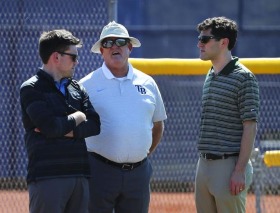 Lukevics, who now is a senior advisor for player development and baseball operations for the Rays, took an early liking to Bloom.
“We were the smallest player development staff in baseball and he became my assistant,” Lukevics said. “He wanted to learn. There was no job too small, and he kept learning. He had a wonderful paid education here and he took it and put it to good use.”
Lukevics has spent his life working in baseball, but he admits he learned from Bloom as well.
“I don’t know how many years I had in the game at the time, but this young guy helped me to open my mind, to think a little different at times, don’t stay within,” Lukevics said. “Be a little more creative. Think a little more out of the box. I had all the experience but he helped me as well and I will never forget it.”
Bloom knows he was lucky to meet Lukevics at such a critical stage in his career.
“Mitch was incredibly generous with me just in terms of really trying to teach me,” Bloom said. “When you are thinking about getting in the game you think about being around the stuff on the field, you think about being around baseball decisions. Many of the roles are administrative and in some cases really kind of ground-level tasks like stuffing envelopes full of meal money, getting bus schedules, things like that.
“But looking back I really treasure that I got to do those things, in part because I still feel like I had enough of a grassroots education in player development to relate to a lot of the work that goes on. There are so many things you learn just by being present and being around … I learned so much about the game that was not apparent to me from the outside.
“Mitch deserves a lot of credit, the approach that he took with me. I just tried to soak up everything I could from him and from so many people around me.”
One of the others working for the Rays at the time was Zimmer, who Bloom would find out years later also became a mentor to John Mozeliak when he was with the Rockies at an early point in his own career.
“I got to know Zim and soak up the experience and wisdom he brought to everybody around him,” Bloom said. “I feel lucky to have gotten to know him and learn from him. What an incredible baseball life.”
Zimmer died in 2014, before Bloom went to work for the Red Sox, but when he was there Bloom occasionally would stop by Zimmer’s plaque in the team’s Hall of Fame at Fenway Park.
“I would walk by it once in awhile and give him a little wink because I really appreciated the things I was able to learn from him and watch him go about what he did,” Bloom said. “Talk about someone who showed what it meant to honor the game and be able to pass that on … He was a living legend. He turned double plays with Jackie Robinson.
“He never carried himself like he was bigger than the game. He never carried himself like someone who was going to take more than he gave and he gave a lot to the game and the people around him. I was just glad I got to be one of those people who got to learn from him.”
Of all of the lessons that Bloom learned in those years, Lukevics believes one stands above the rest, which was important when he went to work for the Red Sox and will be important now in his job with the Cardinals.
“One thing he has, one thing he learned from player development, is patience,” Lukevics said. “If you do not have patience in player development you’re in the wrong department. Going through some streaks and slumps, errors and immaturity because he is a high school player. You stay with him and stay with him and boom he’s in your lineup in the big leagues. Chaim has that type of patience. You have to have it.”
Lukevics watched as Bloom progressed through the Rays organization, and saw him get interviews for jobs running other teams. All of those jobs went to somebody else, until he was hired by the Red Sox in October 2019.
“You didn’t want to see a call from me”
Brian O’Halloran had a passing relationship with Bloom from seeing him at various baseball activities but the two had not worked closely because the Rays and Red Sox were division rivals.
What O’Halloran, the general manager of the Red Sox at the time, soon realized, however, was that Bloom’s new job was not going to be easy.
“He came here at a time when we had some challenges in front of us,” O’Halloran said. “He gets the job, and in the ensuing months we lost our manager for a year, we lost a draft pick, Covid hit – a lot of challenges. And we knew at the time we were going to have to undergo a transition phase and try to compete at the same time in a demanding market. None of these jobs are easy but his certainly was a challenge.”
The move that garnered most of the attention was having to trade Mookie Betts.
“It was a salary dump,” said Boston Globe sports columnist Dan Shaughnessy. “I never blamed him for trading Mookie Betts and it’s unfortunate if anybody does. That’s totally unfair. His hands were tied behind his back. He was brought in to help them stop losing money on an annual basis. Mission accomplished.”
 Despite the difficulties of the job, O’Halloran knew how much Bloom wanted to succeed.
“He’s extremely competitive,” O’Halloran said. “We all are in this game but it really stood out how much he cared about winning. He was a relentlessly hard worker who put incredible time and devotion into the team. He’s motivated by winning but also doing it with a group of people, a team, bonding together in a larger sense.”
After the Red Sox enjoyed a bounce-back 92-win season before losing to Houston in the AL Championship Series in 2021, Shaughnessy reached out to Bloom.
“I remember I wrote a column and I called him up and said, ‘OK Chaim, take your victory lap now,’” Shaughnessy said. “He was very funny about it and humble. It really was the only good year the Red Sox have had since 2019.”
Despite having a reputation of being harsh and critical of the local sports teams and their executives, coaches and players in the tough media market of Boston, Shaughnessy grew to like Bloom. When back-to-back 78-win seasons in 2022 and 2023 led to Bloom’s dismissal, Shaughnessy tried to come to his defense.
“If you had his job you didn’t want to see a call from me,” Shaughnessy said. “That couldn’t have been fun … He was extremely fair and available. I don’t think he got crushed like some other guys had over the years. He was spared. People were blaming the owners; I certainly was.
“He was never a dartboard like a lot of guys who come here. He got in and out with his reputation pretty OK. People didn’t know much about him when he came and didn’t know much about him when he left.”
One person who did know a lot more about Bloom after working side-by-side with him for those four years was O’Halloran, who is now the executive vice president of baseball operations for the Red Sox.
“He is just an outstanding human being,” O’Halloran said. “Immediately he was an easy guy to get to know and to establish a relationship with and work with. Chaim is someone who builds relationships with all types of people.
“We just went through a lot collectively together. As much as he puts into his work, which is something that really stands out in an industry where everybody works hard, is he’s also a great family man.”
What Bloom didn’t know at the time he was fired by the Red Sox was that he wasn’t finished working in baseball in Boston – he just was going to be doing it on a different level.
“They are just people. They have hearts”
Adam Diliberto met Bloom in the fall of 2024, when his son Jay and Bloom’s youngest son Judah became teammates in the Newton, Mass., Little League. Diliberto was one of the team’s assistant coaches.
Diliberto also happens to live across the street from Shaughnessy’s daughter, and his grandson also was on the same team.
“I grew up reading his columns, he was a big figure in the city,” Diliberto said. “I had known Dan for a number of years, and then I ended up meeting Chaim. What struck me is they are just people. They have hearts. They were just trying to be a dad or a grandpa.”
Diliberto initially did not know how to approach Bloom.
“At first I was hesitant to bring up his job too much,” he said. “I just tried to keep it mostly about the kids and what they were doing on the field. Once I got to know him I started asking more questions like how a ballclub works, his career trajectory, in the same way I would ask any person I come into contact with. ‘How did you get into what you do? How did your career end up the way it did?’
“He was a very personable guy, very nice, very polite. He was always appreciative of what we were trying to do as far as coaching the kids and teaching them the basics of baseball.”
Bloom, perhaps thinking back to his own Little League experiences, realized he could accomplish two things at that time – watch his kids play and still get his baseball fix.
“I suddenly came into a lot of free time and one of the ways I decided to use that void was to volunteer to help out with my kids Little League,” Bloom said. “It was the coolest thing I did during that period when work was a lower priority than it had been for a while. It was such a blast to be able to do that.”
There was one day in particular which stood out to Bloom, when Judah and his older brother, Isaiah, actually played against each other. Diliberto asked Bloom if he wanted to coach third base for both teams.
“It was brutal,” Bloom said. “The boys were fine; emotionally I was a mess. My older one, it was an accident, but he almost hit the younger one (with a pitch) and they started jawing at each other.
“I hope the kids enjoyed it but candidly it also was fun for me. It was a very simple and pure thing. It’s more work than you think. Once when the manager had to travel for work he kind of handed things off to me. You have to do advance planning so you don’t have 10 kids screaming at you every inning about where they are going on the field.
“My personality is if I’m going to do it I am going to try to do a good job with it. I don’t know if 20 years ago I would have envisioned sitting there on a Sunday morning with a playing time grid for Little League but there I was.”
His family – including wife Aliza, who he met at Yale, their two sons and a younger daughter – is something Bloom thinks about constantly.
“Family is at the center of everything that I think of outside of the game and honestly there’s some of the same things which drive me on both sides of it,” Bloom said. “The chance to impact other people is one of the main things that gives me satisfaction from my work.
“Family to me is the ultimate expression of that. I’ve been fortunate now to be in a few different spots and build different relationships in the game but you realize it’s a business and people come and go as you spend a career in the game. Family to me should be a constant, and I treat it that way.”
One person who saw Bloom in a different light on the Little League field than he had seen in the past was Shaughnessy, who also was there as a fan, not as a columnist
“It was kind of funny,” Bloom said. “Dan was there at these games to watch his grandson.”
Said Shaughnessy about that experience, “It gave me the appreciation that he loves baseball and that he’s a really good guy. This would be a guy you would want to root for … I think the job with the Cardinals will be a much more fair test of his skill set in the position. This will be a fair evaluation of him. I don’t think the Boston thing was a fair reflection of his skill set.”
“If you don’t learn from your experiences you’re just not keeping your eyes and ears open”
As Bloom makes the transition from running the Red Sox to running the Cardinals, he brings with him all the experience and knowledge he gained in those difficult years.
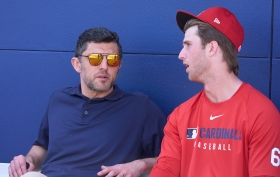 “I do think there are certain things about yourself, things you believe in, you want to make sure you are challenging those as you go and that you are evolving,” Bloom said. “But principles and core values, I don’t think those are very different – what it means to set a road map, and really what it means to make sure you stay disciplined on the road map and that you set the tone for the organization to understand where we are going to and how we are supposed to get there.
“That’s something that’s definitely much more front of mind for me now than it would have been six years ago when I started in Boston.”
There are other ways Bloom will be different in this job as well.
“If you don’t learn from your experiences you’re just not keeping your eyes and ears open,” he said. “There’s obviously some things I would do differently but I am also really proud of a lot of the work in Boston and you can see it starting to come to fruition.
“One of the things that I believe about this game, and I think it’s true about life as well, and is something I really emphasize with all of our people, is the importance of challenging yourself and continuing to grow. We have to keep moving forward and can’t stand still. I think that’s really true in each of us as individuals.
“Even the things that you are proud of and things you do well, you have to constantly learn and grow and look to do things differently and better. Otherwise you are just going to get beat. The game is that competitive … I had a lot of great experiences in Boston, and I really enjoyed it. It’s an amazing place. I’m proud of a lot of what we were able to do.”
Bloom will try to use the knowledge from all of his experiences to help make the Cardinals an annual playoff contender again. Two people who expect him to do just that are Lukevics and O’Halloran.
“I can tell you one thing he’s not going to do, he’s not going to stay stagnant on learning,” Lukevics said. “He’s going to know exactly what maybe he could have done, and he’s going to learn from that and be better in St. Louis. He’s what you want.”
Added O’Halloran, “He’s someone who is really going to care about the organization and winning and will put every once of his effort into achieving that. He loves the game of baseball. I haven’t spent a lot of time in St. Louis but I know it’s a great baseball market with a great history and I think that is something he will really relish as well.
“The fans will get someone who really cares and will put every effort into trying to build a winner. I think the Cardinals made a good choice.”
Taking over a team that has been shut out of the last three postseasons, twice finishing with a losing record, with a dramatic drop-off in their attendance totals, makes Bloom aware of the work that needs to be done.
Doing it with a team that has the storied history of the Cardinals only adds to the challenge.
“It’s really important to leverage that history and really important to use it to your advantage,” Bloom said. “It’s also really important not to get trapped by it and to understand that all of that history was created by people who were forging their own path. That’s why it stood out, that’s why they were successful, and that’s why we now look at it … People were willing to set that standard and to push forward.”
 Bloom knows he is going to be leading that charge and he welcomes the attention that will come with it. He already has been stopped on the street or approached in a restaurant, even before he began his new, more visible job.
“It’s a baseball town,” he said. “I think I’ve been lucky to work in arguably the two best baseball towns in the country. I know what you experience in those places is pretty unusual and is a very cool thing about it.”
Bloom can close his eyes and picture a sold-out Busch Stadium, on a chilly late October night, as the Cardinals take the field.
“You have an environment and an atmosphere that is really hard to duplicate,” he said. “I have yet to experience what that feels like in St. Louis, but I am sure it is going to be pretty great. It’s something that motivates me.”
Getting the team into that position and having the chance to do it year after year is Bloom’s goal.
“One thing about baseball, and I think is true about life, is that baseball just makes you really keenly aware of the things you do not control,” Bloom said. “You have to accept those to some degree. Luck is a factor. For me, that makes it even more important to try to dominate the things that you do control. The important thing is to be able to tell the difference.
“The more you control those things the more you position yourself to get good luck, and the better you will be able to bounce back from things that don’t go your way.”
It’s another lesson he was reminded of over the past year.
“One of the main reasons I enjoy seeing my kids play is it teaches resilience,” Bloom said. “There is a lot of failure in this game and there will be a lot of things that don’t work out the way you want. What separates people in this game isn’t that they never encounter those things, but how they bounce back when they do.
“None of us does this alone. If we are going to have any success as an organization, it’s going to be as an organization. There’s so many people who have experiences that I don’t, that have expertise that I don’t. I like to think I have some things that they might not, but you want people around you who can bring things to the table that you don’t. That’s a really important part of doing anything together.
“I want to be around people that challenge me, push me and make me better. That’s where the fun is.”
Follow Rob Rains on X @RobRains
Cardinals photos by Taka Yanagimo courtesy of the Cardinals
Rays photo courtesy of Tampa Bay Rays
Red Sox photo by the Associated Press
The post How Chaim Bloom went from sleeping on the floor in a friend’s hotel room to running the Cardinals appeared first on News from Rob Rains, STLSportsPage.com.