
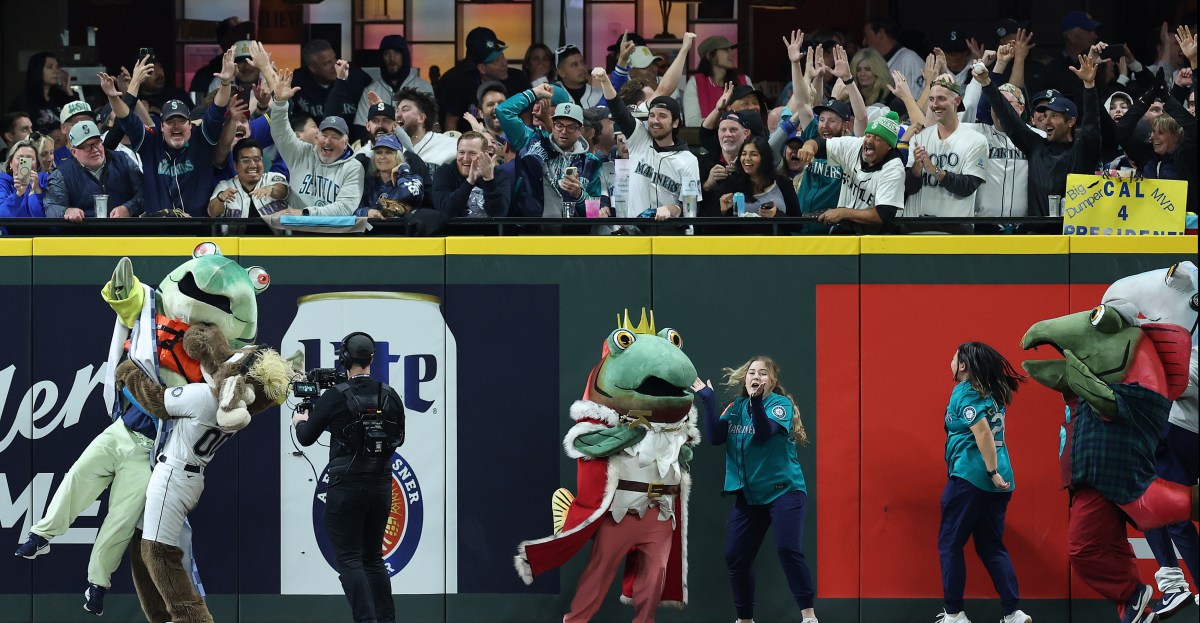
Last night the Seattle Mariners defeated the Detroit Tigers in game five of the American League Division Series, in a 15-inning duel that shouldn’t have happened, but was always going to. The crowd of 47,000 fans roared, quaked, and stayed until the very end. This isn’t just because of the success of the team this year, or any of the years previous. This is because of who the Mariners are, because of how the people in the city of Seattle and it’s outlying regions choose to be. Yet even that passion has its limits. Fans recalling their experience from the game make it clear that while everyone was locked in the whole event, by the time the 14th inning rolled around, a restlessness was starting to grow.
And then the Seattle Mariners made the decision to have another “7 inning stretch” in the middle of the 14th, even including a Salmon Run mascot race. This time, for the first time ever, the floatie-fitted salmon named Humpy won.
Humpy won, and the crowd reignited. The very next inning, to that still-roaring bonfire of passion, the Seattle Mariners won, advancing to the ALCS, something they haven’t done since 2001. It would be the easiest thing in the world to write off that moment in the narrative. A silly mascot race with an obvious gimmick of the same always-loser changing things up for a big moment, to give the crowd a pleasant surprise, almost should be expected. The more important rare win of the night belonged to the baseball team named the Mariners, not a costume of a fish that needs help to swim. And yet… the victories were one, and the same.
The Seattle Mariners are not necessarily a team defined solely by a lack of success. It is much more accurate that the most common identifier is that they have mostly been defined by mediocrity, with occasional bursts towards not just success, but greatness, only to fall short at the most crucial last moments. The cadence the whole Humpy bit takes in each Salmon Run race is a perfect one-to-one visual representation of that. Humpy often approaches the finish line first, with a large lead, only to stumble hard as they watch their competitors leave them behind. A reflection of the team’s overall arc sure, but even more perfectly representing the closest to greatness they have come, that 2001 season that last saw them in the ALCS.
But why Humpy? Why the Seattle Mariners?
We know to think of the Mariners as underdogs, but what does that mean for a fandom, and why is it important? Being an underdog can mean many things. It can mean neglect from those constructing a roster, a lack of effort or skill from either individuals or spread across the whole. Being an underdog can absolutely be a bad thing. Or, it could be everything. To a team, to their fans. Sometimes you are the underdog because the strongest on your team are using that strength not only to lift themselves up, but also those around them. Or sometimes it is just the environment, odds stacked against you by forces out of your control. You construct a good team, a great one… and a division rival consistently manages to field a better one. The Mariners have been underdogs throughout their existence through a shifting list of reasons, including all of the ones listed above, but they have never been the obvious favorites. Maybe they never will be.
But do the Mariners think of themselves as underdogs? There has certainly been an element of hinting at it in the marketing over the years. It wouldn’t have been “Sodo Mojo”, unless the success was seen as somewhat of a magical miracle. There wouldn’t be a “Sea Us Rise”, if there weren’t depths to first rise from. But a wink and a nod are far from a full-throated acknowledgment.
The Humpy bit, in a way, seemed to be that acknowledgment. Humpy is an underdog, but by design. The fact that is by design is important. It was a choice by the team’s marketing, to make a character that would be a perpetual loser, but with the affability to be a crowd favorite. It worked, and it worked perhaps too well. The people have embraced Humpy (well, maybe not Victor Robles), and the desire for his eventual victory is strong. Yet the longer the bit goes on, the weaker it has become. Losers always lose, and underdogs, at least sometimes, win.
On a fanpost that was published here on Lookout Landing, user The_Lad already made statements that echo some of my sentiments around Humpy and the Mariners of it all. Attending a game that coincided with the first anniversary of the Salmon Run, they reasonably expected that the rare win might come then. That after a year of losing, the underdog would have their moment, if but for a moment. It didn’t. Humpy wasn’t being defined by the possibility of success, but by the absolute of failure. In The_Lad’s own words:
It’s not even that Humpy’s losing. He’s being made the fool, some idiot that can’t do anything right and will never, even when the situation so clearly calls for it, will never, ever win. It commits, in my opinion, the cardinal sin of both story and joke telling. It goes through the same motions, the same punchline, the same status quo. Humpy is a loser, and will always be a loser.
But… what if, in a crucial moment, in the moment, what if Humpy won? Isn’t that what we strive for, when we root for the Seattle Mariners? Again, The_Lad beat me to the punch:
But more than that, Humpy is us. At least, Humpy is me. Coming to the ballpark every year, feeling and becoming part of a losing effort, and coming right back next game or year to try again. Out of love. Out of hope.
To me, the what and the why of that hope is important. To live in this world is to have to accept failure. What makes accepting failure easiest for me, is using it as fuel to eventually drive a success. Not in fear or in spite of the stumbles, of the finish lines you never cross, but in a quiet acknowledgment of them. We live for hope, because sometimes the underdogs win. But they have to know they are the underdogs, they have to know they aren’t losers. They have to know that victory is possible, that the “always losing” isn’t the whole point, but rather the setup to it. After enough time passed, every Humpy loss felt like a dark admittance from the team marketing. That this team would always lose, and we should still show up for the circus. Last night, by letting Humpy win, by choosing the do-or-die moment to do it, the Seattle Mariners told us the most important thing they possibly could. They told us to hope. They told us they are the underdogs, and now is their time to win.