
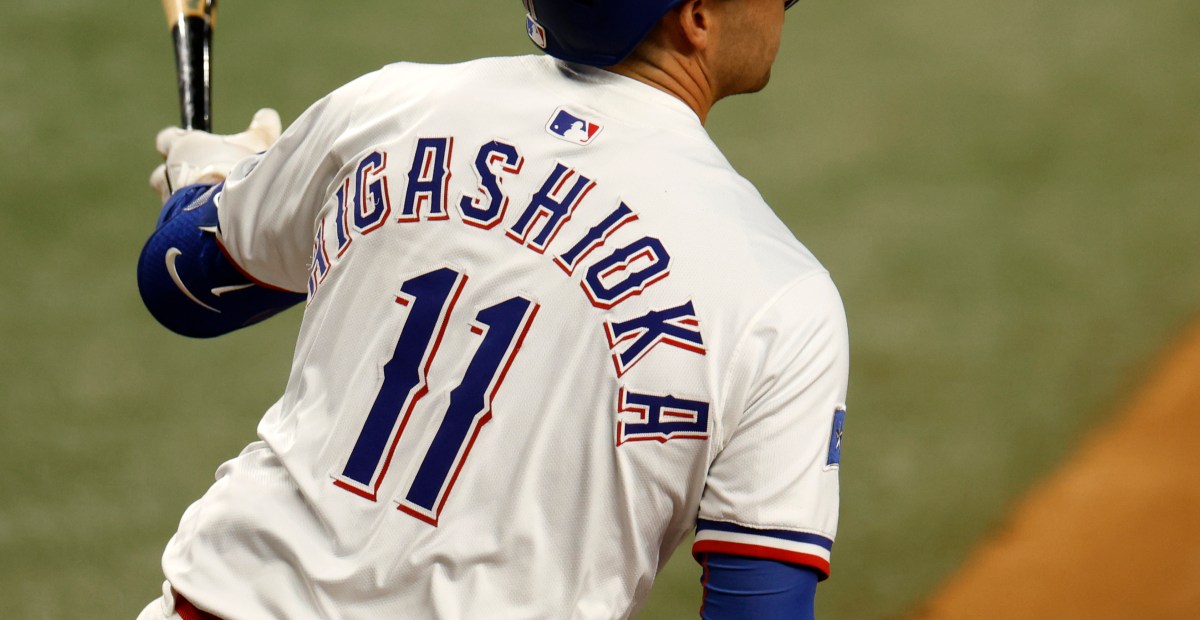
With the 2025 Texas Rangers season having come to an end, we shall be, over the course of the offseason, taking a look at every player who appeared in a major league game for the Texas Rangers in 2025.
Today we are looking at Kyle Higashioka.
Fun fact: Kyle Higashioka got the most guaranteed money of any free agent catcher last offseason.
Seriously. You can see MLB.com’s free agent track from last offseason here. Aside from Higashioka, here’s the catchers who were free agents at the end of 2024 who got major league deals last winter:
Kelly and d’Arnaud, like Higashioka, got two year deals. Everyone else got a one year deal. Jansen did the best in annual value, at $8.5 million, and he will likely get at least that much this season as he dives back into the free agent waters. Higashioka was guaranteed $13.5 million, including the buyout of his 2027 mutual option. d’Arnaud got $12 million on a straight up two year deal. Kelly got $11.5 million, including the buyout of his 2027 mutual option.
A mutual option is generally just a way to some money off until November of the last guaranteed year of the deal, it seems. Occasionally you’ll have a more complicated setup, where if the player declines the mutual option the buyout is lower, and if the team declines the mutual option it is higher, or where one side declining the mutual option gives the other side the right to lock it in at some fixed rate. The mutual options discussed in the previous paragraph are all of the garden variety, however.
The list of catchers who signed minor league deals included somewhat notable names such as James McCann, Martin Maldonado, and Omar Narvaez. Yasmani Grandal was a free agent last offseason and retired, which surprised me because I thought he’d retired a few years ago. Yan Gomes also was a free agent and retired, which is helpful for me, because I tended to get him confused with Yandy Gomez, who isn’t a catcher.
Kelly, who you may recall from his unproductive stint with the Rangers in the final two months of the 2024 season, ended up having the best year of these guys. He had career bests in games (111), plate appearances (421), OPS+ (119), and bWAR (3.6). He also continued his career-long trend up being good in the first half (899 OPS pre-ASB 2025) and bad in the second half (583 OPS post-ASB 2025). Kelly started all eight games in the playoffs for the Cubs and slashed .179/.233/.286 (since, of course, the playoffs are in the second half of the season), though he did have a big go-ahead home run in Game 1 of the Wild Card series.
Jansen put up a 1.9 bWAR for the Rays before being traded to Milwaukee at the deadline for 21 year old infielder Jadher Areinamo, who will probably put up a 3.5 win season in 2028 for the Rays while getting 400 plate appearances all over the infield. He put up a 0.7 bWAR for the Brewers post-trade, ultimately slashing .215/.321/.399 for the season. William Contreras is the Brewers’ regular catcher and started all five games of their NLDS matchup against Carson Kelly and the Cubs — Jansen was the only player on the Cubs’ NLDS roster not to appear in the series.
Stallings, Diaz, Sanchez, d’Arnaud and Hedges all had negative bWARs in 2025. Young had a 0.1 bWAR in 47 plate appearances for the Mets.
As an aside, the above may help illustrate why Jonah Heim may be back in 2025.
Higashioka, as it turns out, was a pretty good signing by the Rangers. Yes, he didn’t have as good a season as Kelly, but he also doesn’t turn into a pumpkin once August rolls around. And he didn’t have as good a season as Jansen, but Jansen got paid a little more than Higashioka last year, and if the Rangers had signed Jansen to a one year deal they’d potentially be in the market for two new catchers this offseason, not just one, so not going to complain about that.
Kyle Higashioka has had an interesting career arc. He was drafted by the Yankees all the way back in 2008 — yes, 2008! How long ago was that? The Rangers drafted Justin Smoak that year. The president of baseball operations for the San Francisco Giants was drafted in the first round that year. Beckhams Tim and Gordon, Eric Hosmer, Yonder Alonso, Andrew Cashner, Brett Wallace, Pedro Alvarez…all were first round picks in 2008.
Higashioka was a slow burn. He became a minor league free agent after the 2015 season, never having been added to the 40 man roster, but re-signed with the Yankees. He finally made it to the bigs in 2017, at the age of 27, and spent the next three seasons as an up-and-down depth guy. Out of options in 2020, he finally stuck as a backup catcher, a role he filled for the Yankees through 2023, backing up former Ranger Jose Trevino his final two seasons in New York. Shipped to San Diego as part of the Juan Soto trade, he had his best season for the Padres, putting up a career high 1.4 bWAR with a 101 OPS+ and 17 homers in 263 plate appearances.
The Rangers, looking for someone to share time behind the plate with Jonah Heim, as well as wanting to increase the amount of power in their lineup, landed Higashioka on that two year deal.
And let me take a moment to note the irony of the Rangers’ decision last offseason to focus on adding power, given the Shed ended up playing in 2025 as the most power-sapping stadium in the majors.
Anyway, Higashioka did more or less what I think we would have expected — hoped, even — for him to do. He put up career highs in games (94), plate appearances (327), and bWAR (1.6). His OPS+ of 102 was the second-highest of his career, behind the 107 he put up in 2020, when he had just 48 plate appearances.
I will note that 22 of his games played — and 16 of his 84 starts in 2025 — were at DH, which, you know, isn’t ideal. But needs must, and all that.
Higashioka got off to a rather brutal start, offensively — his promised power petered out, with just one homer in the first three months of the season. He had a .215/.279/.289 slash line through the end of June. From the start of July on, however, the pop returned, as he slashed .262/.300/.494 with 10 homers in 180 plate appearances.
While there was some talk of Higashioka’s disappointing play and missing power early on, he was overshadowed by the disastrous Joc Pederson start and the really bad Jake Burger start, as well as the overall puniness of the offense in general. Plus he was signed to be, well, not the back-up catcher, but catcher 1B to Heim’s catcher 1A, and expectations aren’t going to be as high.
Higashioka’s 2025 was about what you’d have expected from him, all things considered. His .301 wOBA was right in line with his .305 xwOBA. His slash line of .241/.291/.403 was, in raw number terms, not as good as one would have hoped, but considering the home park he played in, it was perfectly fine, as illustrated by his 102 OPS+. His framing was good, the rest of his metrics defensively were not. He started 68 games behind the plate despite missing some time on the injured list with a hamstring issue that also limited his availability later in the season.
Higashioka represents part of the Rangers’ solution at catcher for 2026, though only part of it, and the smaller part, most likely, at that. At the age of 36, Higashioka isn’t suddenly going to be starting 100 games behind the plate — he’s never even started 81 games at catcher, with the 77 he started for San Diego in 2024 being his career high.
In Higashioka, the Rangers in 2025 had a good backup or 1-B catcher, and probably will in 2026 as well. The Rangers just now have to decide who is going to start the 90-100 games at catcher in 2026 that Higashioka doesn’t start.