
After completing a three-game sweep of Cleveland to finish off a brief road trip, the Yankees returned to the Bronx for a three-game set with the Baltimore Orioles. After two consecutive seasons finishing fourth in the American League East, the O’s had gotten off to a decent start to the new millennium. Although their 15-12 record did not jump off the page, they sat in third place in the AL East and just half a game behind the Red Sox in the Wild Card race — and while it was far too early to be thinking postseason, it was a better place than they had been in since winning the division in 1997.
May 5: Yankees 12, Orioles 10 (box score)
Record: 19-8 (3.0 GA in AL East)
Orlando Hernández retired the side in order in the top of the first to get the game started. From there, everything went completely off the rails — for both pitchers. Ricky Ledée led off the bottom of the frame with a single off Orioles starter Scott Erickson. After he was replaced at first when Derek Jeter grounded into a fielder’s choice, Paul O’Neill singled to put runners on the corners, and Bernie Williams doubled to drive in the future Captain. O’Neill himself scored (and Bernie moved to third) when Tino Martinez grounded out to short, and Posada brought in Williams home on a single through the infield. Just like that, the Yankees had themselves an early 3-0 lead.
Cal Ripken Jr. scratched back one run in the top of the second with a solo shot, before El Duque unraveled in the third. After striking out Mike Bordick to start the frame, the Yankees righty allowed four straight runners to reach base. An E4 and a wild pitch added to the chaos of the inning, combining to plate two and tie the game at three apiece.
The Yankees, however, got those two runs back in the bottom of the fourth. Posada led off the frame with a single, going to third on a Shane Spencer double. A Scott Brosius single up the middle scored Posada, a sacrifice fly off the bat of second baseman Wilson Delgado brought in Spencer, and the Yankees had once again taken a two-run lead.
Unfortunately, that two-run lead lasted less than an inning. The first four runners the Orioles brought to the plate in the top of the fifth scored, courtesy of a pair of singles off the bats of Delino DeShields and Albert Belle and a pair of two-run homers from B.J. Surhoff and Harold Baines. When Joe Torre finally went out to remove Hernández from the game, the Yankees’ 5-3 lead had morphed into a 7-5 deficit.
The Orioles extended their lead in the sixth with a rally against Yankees reliever Jason Grimsley that culminated in a Surhoff double to right field. But the Yankees offense would not go quietly. With Erickson finally out of the game in the bottom of the seventh, they began to tee off against reliever Buddy Groom. Mimicking the first inning, Ledée led off with a single, then was again replaced at first when Jeter grounded into a fielder’s choice. O’Neill singled, putting runners on first and second for Bernie. This time, though, Williams brought in everybody with a big home run that tied the game at eight.
Unfortunately, Mike Stanton handed the game right back to Baltimore in the top of the eighth. Bordick led off with a single, Brady Anderson bunted him over to second, and DeShields brought him home with a double down the left field line. DeShields then swiped third, allowing him to score on a sacrifice fly, giving the Orioles a 10-8 lead.
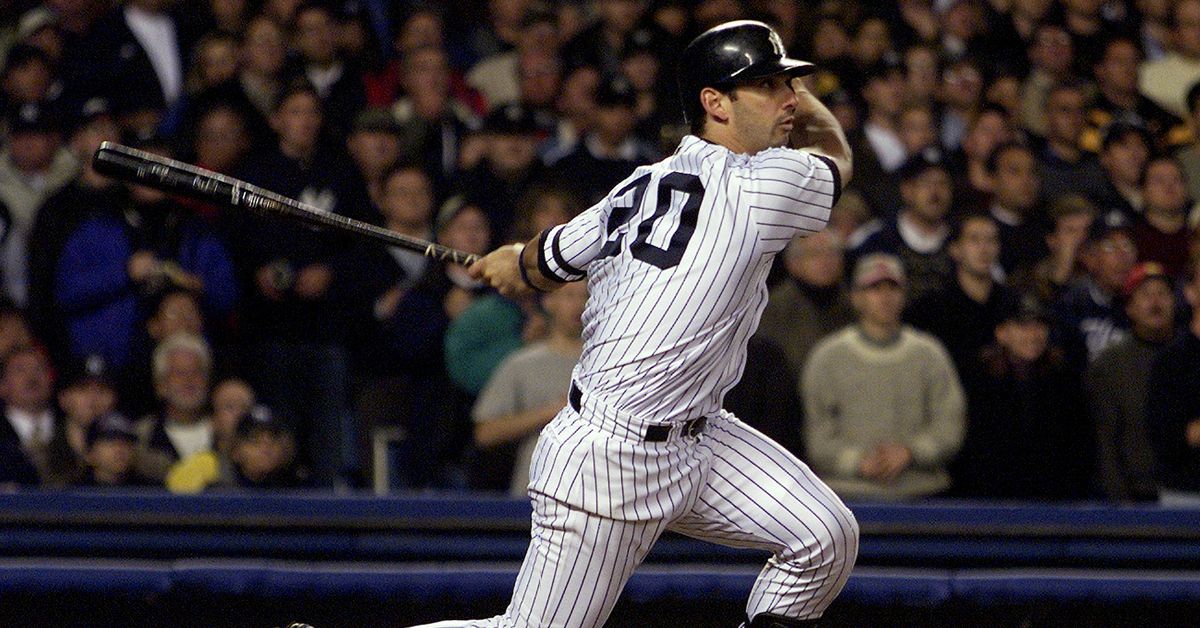
Once again, though, the Yankees offense bailed out their pitching staff. After a quiet bottom of the eighth and top of the ninth, O’Neil led off the bottom of the final frame with a solo shot to cut the deficit in half. Williams then singled to left, and Martinez worked a walk to put the tying run in scoring position. Posada then took the first pitch he saw off future All-Star closer B.J. Ryan and deposited it into the seats in left field to send the Yankees faithful home happy.
It was the first of two walk-off home runs in his outstanding career. There had been pressure on Posada to begin the season, as the Yankees had finally given him the keys to the full-time catching job at age 29. He had ostensibly held this role for a couple years, but with the popular Joe Girardi still around, it wasn’t 100-percent Posada’s job. Now, the onus was on him to succeed, and he was thriving with a 1.068 OPS early on en route to his first All-Star season.
Read the full 2000 Yankees Diary series here.