
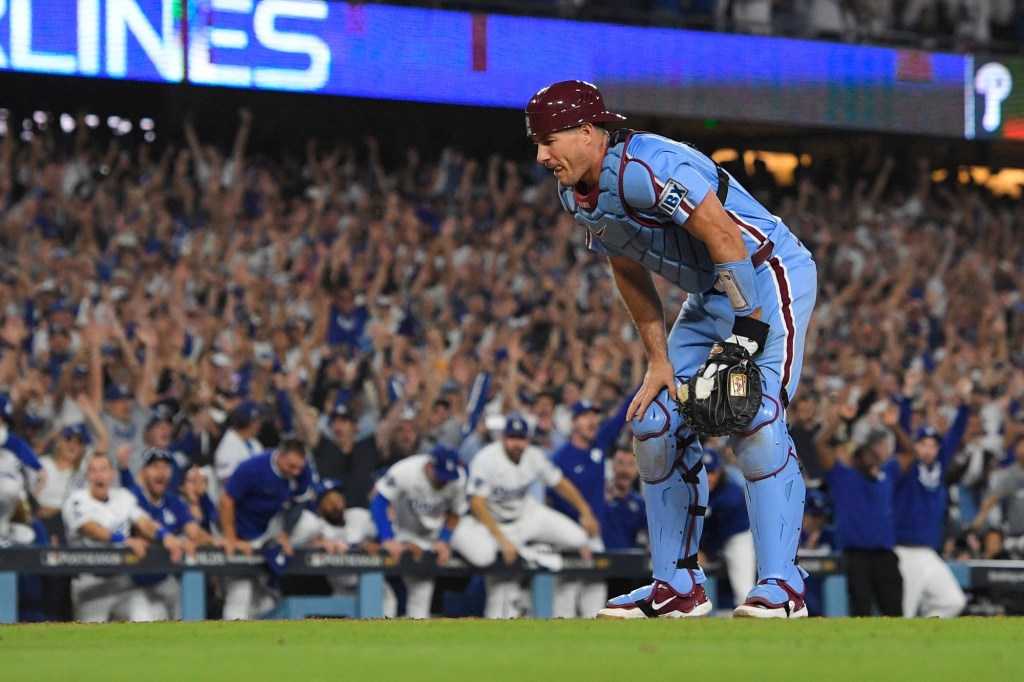
The Milwaukee Brewers this year won more games — 97 — than any other major league team. The Philadelphia Phillies were second with 96. The Toronto Blue Jays and New York Yankees shared the best American League record with 94 victories each. Those numbers were compiled in a season that consisted of 162 games.
In other words, the Brewers were the most successful team, but even they lost 65 games. Their season-long winning percentage was .599.
If my second-grade teacher was telling the truth, that’s less than .600. That’s less than the percentage a team must achieve in order to prevail in a best-of-five playoff series.
Both the Yankees and the Phillies failed to achieve that percentage last week. Both teams were eliminated from baseball’s postseason when they lost a Division Series. That’s a fancy name for the quarterfinals.
That was disappointing for the players, the management and the fans of both teams, but that’s baseball. There were 13 stretches during the season when the Phillies lost three of five. For the Yankees the number was 15.
No one should be shocked that it happened again in the playoffs. It’s time for both of them to start planning for next year.
The biggest question for the Yankees is the health of Aaron Judge’s right arm. The injury severely impacted his throwing ability this year. If that injury is permanent, he can’t remain in right field. He might be able to handle left field but more likely he will have to shift to first base or become a designated hitter — moves that would force them to shuffle the roster in other area,
However, if Judge is going to make a full recovery, the offseason will be less complicated. If that’s the case I would expect them to focus on getting a third baseman, an outfielder and at least two relief pitchers. They’ll find what they need on the free-agent market or on Japanese postings. All they’ll have to do is open their wallet, and they’ve always been good at that.
The Phillies’ circumstances are remarkably different. Kyle Schwarber, J.T. Realmuto, Ranger Suarez and possibly Harrison Bader will be free agents. The Phillies might find a way to keep some of those players, but they certainly won’t keep all of them. They will probably take a long look at their own farm system. After all, three of MLB Pipeline’s top 100 prospects were playing for the Phillies’ Triple-A affiliate at the end of the season.
I would expect outfielder Justin Crawford to be in the opening day lineup next March. Crawford batted .334 and stole 46 bases for the Lehigh Valley team this year.
Pitcher Andrew Painter is still a puzzle. He struck out 111 batters in 106 innings, but he also allowed 119 hits. Tall pitchers (Painter stands 6-foot-7) often take longer to develop and Painter probably needs more time at the Triple-A level.
Shortstop Aidan Miller played only eight games at Lehigh Valley after spending most of the summer at the Double-A level. No doubt, he’ll start the season at Lehigh Valley, but it appears that his arrival in Philadelphia isn’t too far away. That’s a problem.
Trea Turner, the incumbent shortstop, is under contract until 2033. It looks like somebody will have to find a new position, and the Phillies will have to figure that out sooner, rather than later.
***
One of the strangest plays in baseball history unfolded Monday night in Milwaukee. The Dodgers-Brewers Championship Series game was scoreless in the fourth inning when Los Angeles’ Max Muncy came to bat with the bases loaded and one out. Muncy drove a ball off the center field fence and wound up being charged with grounding into an inning-ending double play.
Uh-huh.
The ball first struck the glove of center fielder Sal Frelick, then caromed off the wall and bounced directly back to Frelick. Confusion broke out when the base runners thought Frelick had made a legal catch, which he had not done.
The runner on third, Teoscar Hernandez, tagged and attempted to score. The runner on second, Will Smith, returned to second base, which he thought was still his base.
Somehow the throw to the plate beat Hernandez, who clearly didn’t realize he could be forced at home, which is what happened. Then Smith, who was standing on second, was easily forced at third.
The players were confused, but let’s give the umpires some credit. They weren’t. They were on top of it from the start.
Let’s also give the TV announcers some credit. They weren’t confused either. In fact, viewers were told it was a force play as it unfolded.
Not every TV crew is that good.
Late in Friday night’s 15-inning showdown between the Tigers and Mariners a lot of people seemed to develop mush-brain.
The 14th inning ended with Seattle’s Victor Robles being thrown out attempting to steal second. Normally teams don’t try to steal bases with two out and the number nine batter at the plate because if the attempt is unsuccessful, the number nine hitter will become the leadoff hitter in the next inning,
Yet that’s what the Mariners did and no one behind a microphone had anything to say about it.
As it happened, the strategy gaffe didn’t hurt Seattle at all. J.P. Crawford crossed up the odds and began the bottom of the 15th with a single.
A hit by pitch, a fly ball out and a throwing error followed, leaving the Mariners with runners at second and third with one out.
Let’s emphasize: Crawford was the potential winning run and he was standing on third base with only one out.
When the Tigers intentionally walked Julio Rodriguez to load the bases a television announcer “explained” that the reason for the walk was the Tigers wanted to set up a double play, He didn’t explain why, if they were thinking “double play,” they had all four infielders playing very shallow against Jorge Polanco.
Of course, they were playing to cut off the run.
But then, why were three outfielders playing absurdly deep? Any fly ball hit far enough to be a sacrifice fly will end the game. There’s no point in covering even medium parts of the outfield. Outfielders need to be positioned to cut off dinks and bloops. Maybe one of the outfielders should be put in the infield.
In hindsight, that’s precisely what the Tigers should have done.
Polanco drove a grounder past the drawn-in infielders for a game-winning hit. We’ll never know whether or not a fifth infielder would have prevented that ball from going through.
The game ended and maybe that was just as well.
It was time for a lot of people to go soak their heads.
A FEW STATISTICS (Wednesday’s game not included): On Sunday George Springer of the Blue Jays hit a homer on the first pitch thrown in the bottom of the first. The Jays got only one more hit the remainder of the game. Amazingly, on Tuesday Jackson Chourio of the Brewers homered on the first pitch of bottom of the first. His team got two more hits the rest of the night … Kike Hernandez of the Dodgers had eight doubles all season. He now has four more in eight postseason games … Nathan Lukes of the Blue Jays is 5-for-7 in the postseason with runners in scoring position … Freddy Peralta of the Brewers allowed 21 homers in 33 regular season starts. In three postseason starts he’s permitted five … Vladimir Guerrero, Jr, of the Blue Jays batted .529 and drove in nine runs in four games against the Yankees. He’s 0-for-7 in the first two games against the Mariners … Ernie Clement of the Blue Jays has 10 postseason hits but zero walks … Josh Naylor of the Mariners has nine postseason hits but has driven in only two runs … Alex Vesia of the Dodgers had three holds all season, Now he has three more in the postseason.
Former Hall of Fame voter Jay Dunn has written baseball for The Trentonian for 57 years. Contact him at jaydunn8@aol.com