
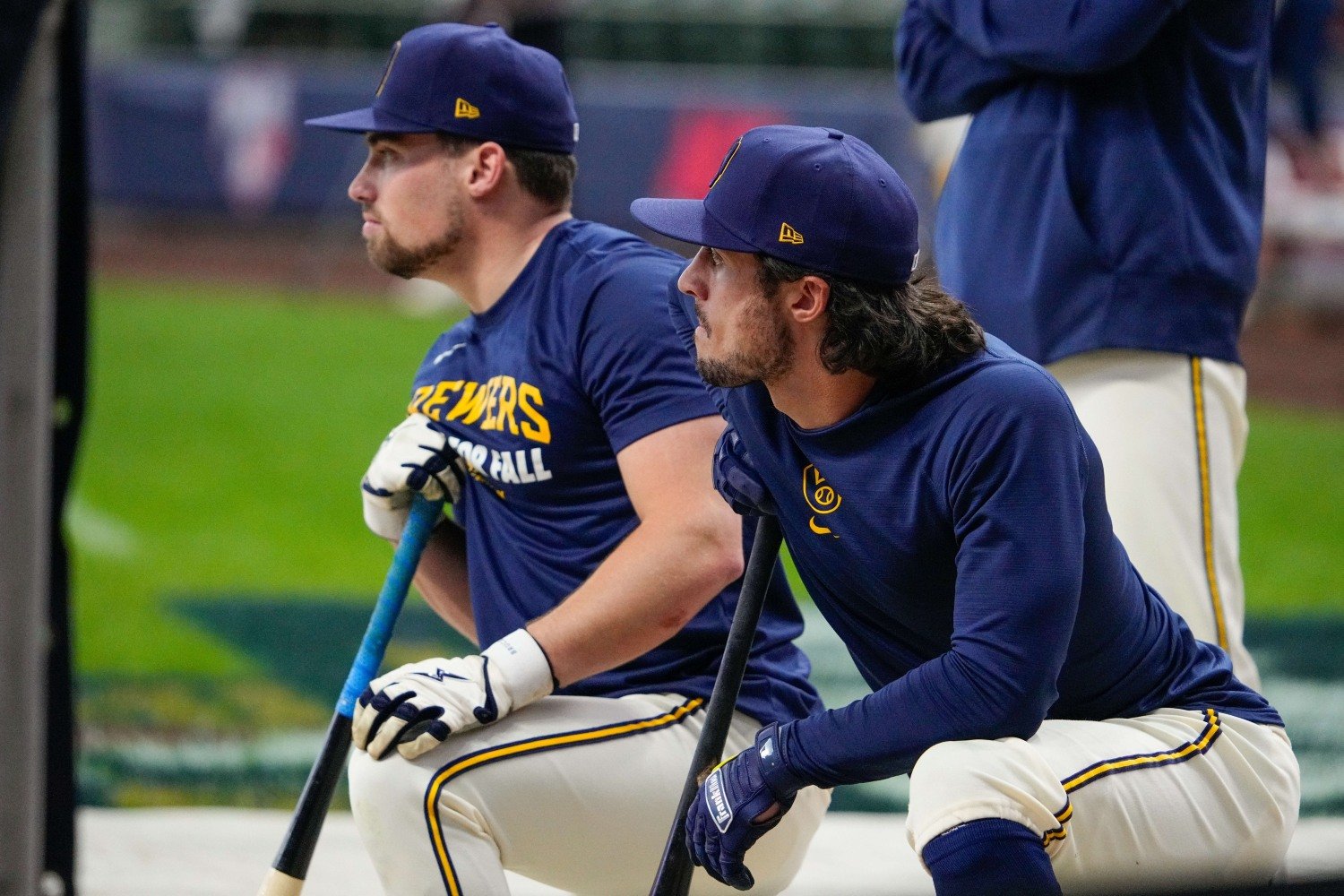
Surprisingly, the pressure really has gotten to these Milwaukee Brewers a bit during their foray into October. True, they’re a young team, but that young team played a relatively poised and representative version of their game even while losing in last year’s Wild Card Series—and they looked much like themselves in Games 1 and 2 against the Cubs this fall, too. Since then, though, they’ve gotten by (or not) with a much less tenacious, intelligent brand of baseball. That’s uncharacteristic, and it’s not going to be enough to get them past the Dodgers and into the World Series.
The Crew failed to score on a rundown play the Cubs didn’t execute properly during the Chicago phase of the NLDS. Freddy Peralta buckled slightly under the pressure applied by a raucous Wrigley Field crowd. In Game 5 of that series back at Uecker Field, even though the Crew won, there were noticeable missed chances or cracks in the armor. A bout of wildness from Aaron Ashby nearly steered the sixth inning off the rails. A sloppy bit of baserunning nearly gave the Cubs an out (and still did miss a chance to produce a run). Abner Uribe whistled through the graveyard a bit for his two-inning save, giving up loud contact because he’s not fully himself right now.
In the first two games of the NLCS, the shortfalls have been even more glaring. At the plate, the team has been utterly unable to string together positive outcomes, leaving their offense in neutral. Much credit has to go to Dodgers pitchers, who have been brilliant, but all year, the Brewers had answers for great pitching staffs: defense-stretching contact hitters, good plate discipline, power and speed. Milwaukee wasn’t able to execute any real game plan against Blake Snell or Yoshinobu Yamamoto, as they hunted fastballs and each hurler refused to throw them one. It was uncharacteristically aggressive offense from the Crew—and it didn’t work. When they did put a runner on early in Game 1, Caleb Durbin (who has looked, alas, very much like a rookie all postseason) ran into an out.
Defensively, they handled the crazy near-grand slam in the middle of Game 1 perfectly, but the rest of the time, they’ve been shaky. Forced into an outfield alignment they only used a couple of times all year (and haven’t returned to in a very long time), they’ve missed chances to make some plays and made others harder than they needed to be. Sal Frelick, whose lack of height and raw leaping ability force him to play a more bruising kind of wall ball when he tries to rob home runs, turned the wrong way and cut off his own jump when trying to rob Max Muncy‘s Game 2 homer. Blake Perkins (or even a healthy Jackson Chourio) probably catches that ball, but with Christian Yelich‘s back balking and Chourio’s hamstring slowing him down, the team is locked into using Chourio in corner outfield spots and can only make room for Perkins in the lineup when facing lefties.
Some teams are great because they have such an abundance of talent and such a variety of ways to beat you that the probabilistic nature of the game favors them all the time. That’s what the mid-century Yankees and the Big Red Machine and the Team of the ’90s Atlanta club were like. It’s what these Dodgers are about. The Brewers are a subtly but importantly different kind of great team. When they play their best baseball, no matter how many future Hall of Famers are stacked on the other team, the Brewers win. When they do all the things the front office constructed them to be able to do, and that the coaching staff worked diligently to ensure that they consistently do, the Brewers win. They beat the Dodgers all six times the two teams played this season, not because the Dodgers weren’t at full strength or because the Crew were simply hot, but because when they’re in their groove, this team can outplay any other team in the world.
They haven’t done that difficult thing over the first two contests of the NLCS. They’ve played the same kind of game most teams play on most days, and though they had a very good chance to steal Game 1, the Dodgers’ talent simply outmuscled them each night. The challenge, as the series changes venue and the sun gets low on the 2025 Brewers, is for the team to remember how good they really are and how badly they’ve wanted to win, all season. They have to play the kind of game that makes them a uniquely great team Thursday night, and again Friday and Saturday. If they don’t, their season will end. If they do, though, they’re still unbeatable.