
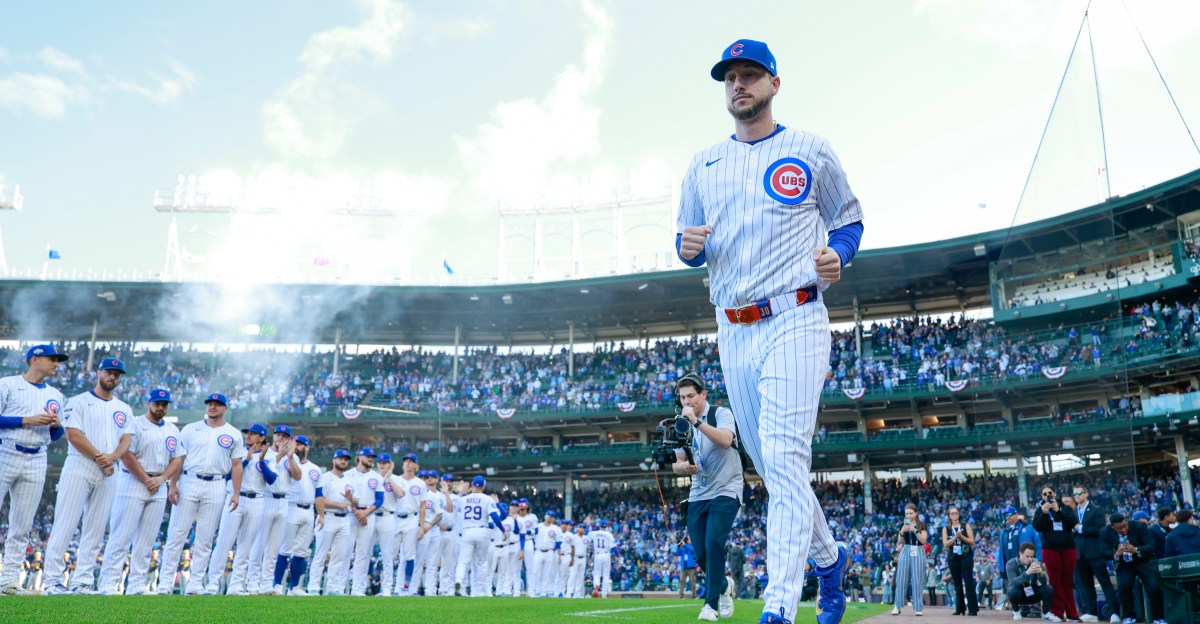
So originally, I was going to write a “Should the Cubs re-sign Kyle Tucker?” article this morning, but I see that Josh already did that in After Dark. So feel free to continue to discuss this topic there.
I wanted to weigh in with my own thoughts about Tucker and also about the Cubs’ payroll in general.
In his season-ending presser, Cubs President of Baseball Operations Jed Hoyer said this about his 2026 payroll:
“As far as the budget stuff, I haven’t had those conversations yet,” Hoyer said. “I think we’ll sit down over the next two or three weeks and go through that. But yeah, I’m confident that we’re going to have enough money to field a good team. That’s the simplest thing I’ll say, but as far as details, I don’t know yet.”
When I cited that yesterday, a number of you said he was being disingenuous. I disagree. Sure, the Cubs, like any other business, likely have a multi-year financial plan, it is almost certainly true that Hoyer and Cubs Executive Chairman Tom Ricketts have not sat down and discussed specifics for the 2026 team payroll.
In Jon Greenberg’s article in The Athletic, linked above, he notes:
According to Spotrac, the Cubs’ total payroll allocation this season was around $211 million, which was 10th in baseball. It’s not chump change, but in a situation like this, where they have a playoff-caliber roster, the Cubs should be around the top five, as they were after the 2016 World Series. I’m realistic that they won’t be spending like the New York teams or the Phillies, and they don’t have the Dodgers’ revenue.
That’s the gist of all of it right there, right? One thing the Dodgers and the New York teams have is huge cash flow coming from their team-owned regional sports networks, particularly the Dodgers. Remember when Cubs President of Business Operations Crane Kenney said that starting their own RSN, Marquee Sports Network, would result in “wheelbarrows of cash” sent over to baseball ops?
Well. That didn’t happen. And it appears that one of the reasons the Cubs dropped to well under the luxury-tax threshold this year is that because of some moves made at the 2024 deadline, they wound up just over that tax line for last year. That did not appear to please ownership, and I believe that’s one of the reasons they wanted to stay under this year.
So they did that. And now it’s time to spend again. The luxury-tax threshold for 2026 is $244 million. There’s no reason the Cubs shouldn’t spend at least that much, and go over it if the right situation presents itself.
Thus the question: Is Kyle Tucker the “right situation”?
Most of you will say “of course,” but I’m … somewhat leery. Why?
First, Tucker has now missed time with significant injuries each of the last two years. The injuries this year appear to have really curtailed his production in the second half. Yes, he had a good year, but posting 4.5 bWAR with an .841 OPS and 22 home runs in 136 games doesn’t scream out “$400 million contract” to me. Really good? Yes. Absolutely. Granted and stipulated.
There are two other things about Tucker that concern me. One, his defense isn’t really that good, at least not by the eye test. In my opinion — and I don’t have metrics to back this up — he appeared to be leery of the brick walls at Wrigley Field. This sort of defense isn’t going to get better as he ages. So if Tucker signs a (for example) 10-year deal, probably half of that will be as a designated hitter. (The same is likely true for Juan Soto in New York, and he’s already not a very good outfielder.)
The second thing is this: Signing Tucker (or any player, really) to a deal like that makes the player the face of the franchise. It puts pressure on the player to produce. Some players can handle that well, others can’t. I don’t see Tucker as that kind of player. That’s not a slam at him, incidentally. He just seems like a quiet sort of guy who wants to go about his business, and to do it well. Which he did in 2025, when healthy. That quietness was noted in this article by Patrick Mooney in The Athletic:
Though Tucker made sincere efforts to connect with teammates and become part of the clubhouse fabric, his low-key personality can sometimes be hard for others to read. Tucker’s agent, Casey Close of Excel Sports Management, also has a reputation for being discreet.
So would I sign Kyle Tucker to a long-term deal? No, I would not. Honestly, I’m not so sure anyone else will, either, given the injury history. What I might do is offer him a Cody Bellinger-type deal: Three years at a high AAV, with two opt-outs. That way if he has a big year, he can go get that long-term deal after 2026, and the Cubs likely do well with that one big year.
Honestly, if the Cubs are going to spend big money on a bat, they should do whatever it takes to bring Kyle Schwarber back to the North Side. Schwarber seems the kind of guy who, as a full-time DH, could be productive into his late 30s. Seiya Suzuki could return to right field, where he played pretty well while Tucker was the DH. And such a signing would not only be good for the team and right a wrong done when Hoyer non-tendered Schwarber after 2021, it would be immensely popular with the fanbase.
Spend money? Absolutely, positively. Make a big splash. And remember this from Hoyer’s presser:
“I did feel like our crowds in the playoffs were unbelievably impressive,” Hoyer said. “It didn’t come out of nowhere. It felt like a natural build of the way the season was. Going back to April and May, ‘Wow, these are unbelievable crowds,’ and people were really into it. Against the Padres and the two home games we had here (against Milwaukee), it was pretty amazing.”
But the fan base reminded everyone how fun things can get on the North Side when there is a winning product on the field. After falling just short of 3,000,000 fans (the Cubs lost two home games due to opening the season in Japan), the team drew an impressive 203,599 over the course of their five home playoff games. And the atmosphere was as intense as anyone who has been in that park over the last two-plus decades can recall.
“I don’t ever remember players commenting on the crowds and the experience right after games the way they did repeatedly,” Hoyer said. “I’d come down here after games and the players would be talking about the energy or talking about the experience, and that was really cool. It was really cool to see. And you know, it leaves you wanting more, right?”
Well. Why did that happen? Because a compelling, winning product was put on the field. The Cubs had their highest average attendance at Wrigley Field (37,259) since 2019, the last fully competitive year for the World Series core. While Wrigley Field has become a destination — I see people with “First Game” certificates at the ballpark every single day — they can’t fill it just because of that.
They have to win. And in order to win, they have to spend.
Get it done, Tom and Jed.