
In an unprecedented propaganda campaign, Major League Baseball commissioner Rob Manfred, who works for the team owners, has been visiting major league locker rooms, hoping to persuade players to accept a salary cap, in anticipation of negotiations with the players’ union over the next five-year collective bargaining agreement. (The current agreement expires on December 1). Soon after he arrived in Philadelphia to speak to the Phillies, first baseman Bryce Harper confronted Manfred. “Get the fuck out of our clubhouse,” Harper told the commissioner.
The MLB Players Association has long opposed a pay ceiling. “We’ve always believed in as free a market system as possible, such that the individual player can realize his value against the backdrop of teams that are interested in his services,” Tony Clark, the MLBPA president, told The Athletic in February. “
To force the issue, owners may instigate a lockout, as they did for 99 days from December 2, 2021, to March 10, 2022, delaying the start of the season. Or the players may have to strike, as they’ve done several times before.
The MLBPA would be wise to educate players about the union’s history, including how powerless and poorly paid their counterparts were before the late 1960s, and how dramatically it has improved pay, pensions, and working conditions.
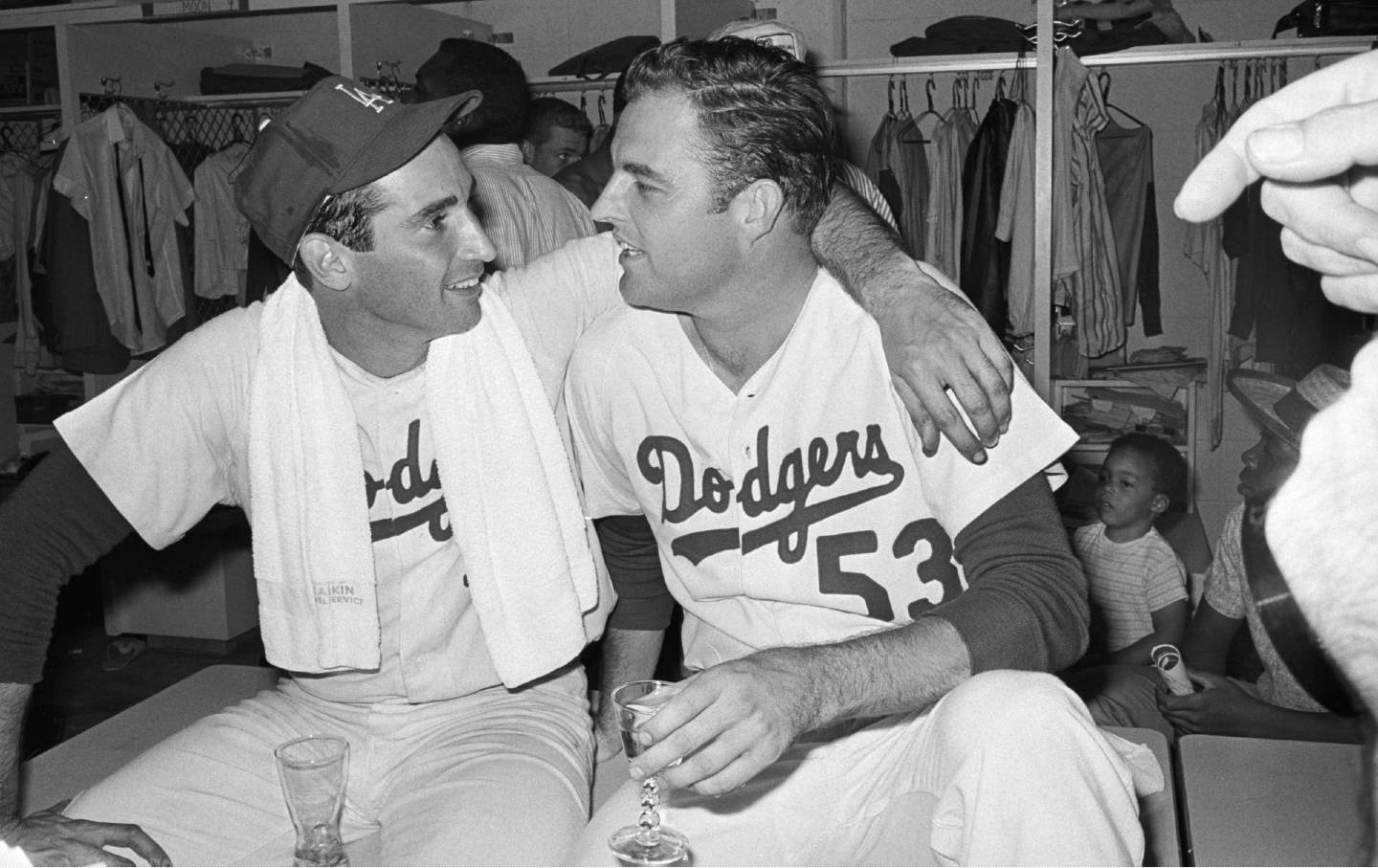
A little-known aspect of that history is the role that superstar pitchers Sandy Koufax and Don Drysdale played in laying the groundwork for the union’s success—achievements that Manfred and the 30 owners (25 of them billionaires) want to dismantle. They are both in the Baseball Hall of Fame, but should also be enshrined in a labor movement Hall of Fame.
In 1966, Koufax and Drysdale joined forces to challenge the Los Angeles Dodgers’ stranglehold over them. Their 32-day holdout was a major turning point in baseball’s labor wars.
Their success made it easier for Marvin Miller, the MLBPA’s first executive director, to turn the union—at the time a paper tiger with no full-time staff and a bare-bones budget—into a powerful force.
Before Miller, who previously had been an economist and negotiator for the steelworkers’ union, players had no rights to determine the conditions of their employment.
Many were grateful just to be paid to play baseball—a step up from working on farms or in factories back home. Whatever their frustrations, they didn’t think they could challenge the team owners without undermining their careers.
Drysdale and Koufax were unlikely coconspirators.
Drysdale grew up in the Los Angeles suburbs, an outgoing golden boy from a middle-class family. He signed with the Dodgers in 1954 right out of high school. After two years in the minors, he was promoted to the Brooklyn Dodgers.
Koufax grew up in a working-class Jewish family in Brooklyn. His hero was his grandfather Max Lichtenstein, a plumber, intellectual, and socialist.
At Lafayette High, he was the basketball team’s captain and leading scorer. Hoping to become an architect, he earned a partial basketball scholarship to the University of Cincinnati, where, though only six-foot-two, he was a known as a “savage” rebounder and could dunk. In the spring, he played baseball. His blazing fastball attracted the attention of scouts. In 1954, after his freshman year, Koufax signed with the Dodgers for $6,000 a year and a $14,000 bonus. He intended to use the money to finish his college education if his baseball career failed. He even took night classes in architecture at Columbia University.
Koufax and Drysdale met at spring training camp and became friends doing Army Reserve basic training at Fort Dix in New Jersey. Koufax came to the Dodgers first, but Drysdale became a starter while Koufax was still struggling, unable to control his fastball. In his first six seasons in Brooklyn and Los Angeles (1955–60), he won 36 games and lost 40. In 1958 he led the league with 17 wild pitches.
As their careers advanced, they remained friends but were not close. Koufax, shy and introspective, was single and mostly kept to himself. He liked to read and listen to music. Drysdale was married, owned a bar, liked the limelight, and would occasionally go to the racetrack with Dodgers general manager Buzzie Bavasi. They both earned extra money by making appearances on locally filmed television shows.
From 1957 through 1962, Drysdale, six-foot-five, was the Dodgers’ ace. In 1962, he won 25 games and the Cy Young Award as baseball’s best pitcher.
Koufax didn’t come into his own until 1961, when, during spring training, Dodgers catcher Norm Sherry suggested, “Don’t try to throw so hard and use more curveballs and changeups.” Sherry’s advice changed Koufax’s career. That season he was 18–13 and led the league with 269 strikeouts.
Popular
“swipe left below to view more authors”Swipe →
By 1963, Koufax had eclipsed Drysdale as the team’s top hurler, going 25–5 with a 1.88 ERA and 306 strikeouts, earning the Cy Young and Most Valuable Player awards. The duo carried the weak-hitting Dodgers to the World Series championship. After the season, Koufax asked Bavasi to increase his salary from $35,000 to $75,000. After a few days of tense negotiations, they agreed on $70,000.
What irked Koufax, however, was a story in the Los Angeles Herald Examiner claiming that he had threatened to quit if he didn’t get $90,000. He believed that the Dodgers had planted that false story to make him appear greedy.
Koufax and Drysdale were powerhouses on the mound, but they felt powerless in their dealings with the Dodgers brass.
A major obstacle was the “reserve clause” in every player’s contract, baseball’s version of indentured servitude, which tethered them to their teams. Contracts, limited to one season, “reserved” the team’s right to “retain” the player for the next season. The players had no leverage to negotiate better deals. Each year, the team owners told players, “Take it or leave it.” The minimum salary was $6,000; the average, $19,000. Most players had off-season jobs to make ends meet.
In 1965, the duo were even more spectacular. Koufax won 26 games, lost only eight, had a 2.04 ERA, struck out 382 hitters (then a record and still the second-highest ever), and earned his second Cy Young award. Drysdale went 23–12 with a 2.77 ERA and 210 strikeouts. He was the Dodgers’ only .300 hitter and even banged seven homers. Together, they started 83 games (over half of the team’s 162 contests) and led the Dodgers to a World Series victory over the Minnesota Twins.
More than 2.6 million fans attended Dodger Stadium that season—the highest in the majors. The Dodgers estimated that Koufax and Drysdale attracted an extra 10,000 and 3,000 ticket buyers, respectively, when they pitched—worth at least $1.1 million in additional revenue. They put big profits in owner Walter O’Malley’s bank account.
The two pitchers expected big raises for the next season. But when they met separately with Bavasi, he offered to raise Koufax’s salary from $85,000 to $100,000 and Drysdale’s from $80,000 to $85,000. They thought they deserved more. After all, the Giants had signed Willie Mays to a two-year contract for $130,000 a year.
One night the two met for dinner, joined by Drysdale’s wife, Ginger. In his autobiography, Once a Bum, Always a Dodger, Drysdale recounted their conversation.
“You walk in there and give them a figure that you want to earn,” Sandy said, “and they tell you, ‘How come you want that much when Drysdale only wants this much?’”
“I’ll be damned,” I replied. “I went in to talk to them yesterday for the first time and they told me the same story. Buzzie wondered how I could possibly want as much as I was asking when you were asking for only this.”
Ginger Drysdale, a member of the Screen Actors Guild, suggested that they join forces. “If Buzzie is going to compare the two of you, why don’t you just walk in there together?” she proposed.
In February 1966, a few weeks before the start of spring training, they asked the Dodgers for three-year contracts totaling $1 million, split equally. That was the equivalent of $166,666 a year ($1.6 million in 2025 dollars), which would have made them baseball’s highest-paid players.
They told Bavasi to talk to their agent, entertainment lawyer J. William Hayes, who represented Koufax in his business dealings outside baseball. No player had ever received a three-year contract or had an agent negotiate on his behalf.
Koufax and Drysdale refused to attend spring training in Florida. They both signed a deal to appear in a Hollywood movie called Warning Shot—Drysdale as a TV commentator, Koufax as a detective—and appeared at a press event at Paramount Studios to show they were serious about their showbiz careers. They also agreed to appear on a TV variety show called The Hollywood Palace.
The news media was hostile to their holdout, helped by leaks from the Dodgers’ front office, depicting them as selfish. The Los Angeles Times, for example, described their demands as a “double-barreled raid on the Dodger treasury.”
In light of the negative press coverage, most fans sided with the Dodgers against the two players. In his 1966 autobiography, Koufax wrote, “It was astonishing to me to learn that there were a remarkably large number of American citizens who truly did not believe we had the moral right to quit rather than work at a salary we felt—rightly or wrongly—to be less than we deserved.”
Maury Wills, the Dodger’s outstanding shortstop and base stealer, also decided to hold out during spring training.
“Mr. O’Malley scared me to death, saying I was in cahoots with them,” Wills recalled. “He said, ‘They might be able to get away with that, but you can’t.’” Wills quickly reported for spring training and signed the contract O’Malley put in front of him. “I didn’t even look at it,” he remembered.
Hayes warned the duo that their holdout would only work if they were willing to carry out their threat and quit baseball if necessary. Koufax was willing—in part because he was ready to retire due to painful arthritis in his pitching arm. He thought the Dodgers had violated his rights.
He told The New York Times:
“The negotiations have reached the point where they came down to basic principles. The ball club is defending the principle that it doesn’t really have to negotiate with a ballplayer because we have no place to go. You might say Don and I are fighting for an anti-principle—that ballplayers aren’t slaves, that we have a right to negotiate.”
Meanwhile, Hayes let it be known that he’d uncovered a legal precedent—a California Court of Appeals ruling that allowed actress Olivia de Havilland to get out of her Warner Brothers contract to pursue film projects with other studios—that could be used to overturn the owners’ cherished reserve clause. He threatened to file suit, which made every team owner nervous. O’Malley and Bavasi softened their stance.
Koufax gave Drysdale permission to negotiate for both. The Dodgers agreed to pay Koufax $125,000 and Drysdale $110,000. Koufax objected. “I thought we’re supposed to get the same thing,” he said. But Drysdale—who had a wife and daughter—didn’t think he could hold out indefinitely and was willing to accept the lower amount. The holdout ended after 32 days.
They didn’t get the three-year contract or the salaries they sought, but they showed other players that the owners weren’t invincible in the face of collective action.
Koufax would later describe his partnership with Drysdale as being “a very small union—just the two of us, Don and myself.”
Bavasi called the holdout a “gimmick” and said it left him with a “blood-stained cashbox.” He and O’Malley really feared that it could ignite a real union drive. Among the owners, O’Malley took the lead in trying to persuade players that a union, and particularly Miller—whom the MLBPA’s search committee had recommended—would be detrimental to their interests, feeding them propaganda about corrupt “labor bosses.”
While the two pitchers held out, Miller was visiting teams at spring training sites because he had agreed to accept the job only if the players voted to hire him.
During his first round of meetings in California and Arizona, most players were lukewarm or hostile to Miller, perhaps because the meetings were conducted by the managers, who insisted that players vote in public by raising their hands yes or no. At his meeting with the Cleveland Indians, manager Birdie Tebbetts constantly interrupted Miller, even asking him, “How can the players be sure you’re not a Communist?”
The first four teams Miller met with opposed him by a 102–17 margin. The Giants players voted unanimously (27–0) against him. It appeared that the owners’ anti-union, anti-Miller smear campaign was working.
Fearing that Miller would face the same hostile reaction in Florida, union leader Robin Roberts, a Phillies pitcher, made sure that the players ran the meetings, that team executives (including managers) were excluded, and that voting was done by secret ballot.
The day after Miller visited the Dodgers training camp, Bavasi called a meeting with the players. Infielder Jim Lefebvre, the 1965 Rookie of the Year, recalled:
Bavasi said, “We can’t have this guy. This means strike. Strike means no money, no food to feed your family.” We all looked at each and said, “He’s in.” Anybody Buzzie was that scared of had to be good for you.
As Koufax and Drysdale pursued their battle with the Dodgers, which made headlines and was a topic of conversation in locker rooms, the players’ attitudes changed. The holdout, Miller wrote in his autobiography, A Whole New Ballgame, was “an important rallying point for the players.”
At the Florida meetings, players voted for Miller by a landslide 472-34, with five teams voting unanimously. In total, the players supported Miller by a 489-136 margin. He officially joined the union on April 12.
The 1966 season was Koufax’s last and best. He went 27–9 with a 1.73 ERA. He struck out 317 and threw 27 complete games, led his team into the World Series, and won his third Cy Young award.
For several years, he had been constantly in agonizing pain with arthritis in his left elbow, his pitching arm. After retiring in his prime, at age 30, he spent a few years as a baseball broadcaster, then for decades worked as a mentor to young Dodger pitchers. Now 89, he keeps a low profile, occasionally attending Dodger games. Drysdale retired after the 1969 season and found his niche as a color commentator. In 1993, while in Montreal to broadcast the Dodgers-Expos series, he died of a heart attack at 56.
In 1968, two years after Miller joined the union, it negotiated professional sports’ first-ever collective bargaining agreement. Minimum salaries increased from $6,000 to $10,000, where it has been for 20 years. Two years later, the union won players’ right to binding arbitration over salaries and grievances.
In 1970, with union support, outfielder Curt Flood filed a lawsuit against Major League Baseball after the Cardinals traded him without his consent, which he claimed violated federal antitrust laws. Ballplayers, Flood said, were “high-paid slaves.” Two years later, the US Supreme Court ruled against Flood, but in 1976, Miller persuaded pitchers Andy Messersmith and Dave McNally to play that season without a contract, and then file a grievance. The arbitrator ruled in their favor, ending the reserve clause and paving the way to free agency, which allows players to choose which team they want to work for, veto proposed trades, and bargain for the best contract.
Since then—a time that has included several owner lockouts and player strikes—the union has won better wages, benefits, pensions, medical treatment, and locker room facilities. In 2022, minor league players joined the players union and the MLBPA joined the AFL-CIO.
The current average salary is $5.1 million. The median salary is $1.3 million, because a few superstars earn a big part of the salary pie, with 18 players currently making at least $30 million. The minimum salary is $760,000, although the typical player only spends only four years in the major leagues; many play for a year or less.
Why should players agree to a ceiling on salaries, when billionaire owners—who mostly made their fortunes outside baseball—don’t have to live with a salary or wealth cap for themselves?
Even the highest-paid players don’t earn close to what the poorest owner makes. That’s Cincinnati Reds’ owner Bob Castellini, whose wealth comes from owning one of the nation’s largest fruit and vegetable wholesalers. He purchased the team in 2006 for $270 million. It is now worth $1.3 billion. Castellini’s personal wealth is estimated at more than $400 million.
The richest owner, Steve Cohen of the Mets, made his fortune with SAC Capital, a hedge fund. His annual compensation has climbed from $428 million in 2001 to $3.2 billion with his new incarnation, Point 72 Asset Management. His current net worth—$21.3 billion, according to Forbes—makes him the country’s 30th wealthiest person.
For decades, baseball’s owners have warned that players high salaries undermine the sport’s basic economics. But owning a baseball team is a very profitable endeavor. MLB’s revenue last year was a record $12.1 billion. The 30 teams are worth an average of $2.6 billion—an all-time high—according to Forbes. The five “small-market” teams—Miami, Tampa Bay, Kansas City, Pittsburgh, and Cincinnati—are all worth over $1 billion, but have a smaller fan base and less television revenue. Annual team payrolls range from $67 million (Marlins) to $323 million (Mets).
The solution to that disparity is to increase the current self-imposed “luxury tax” on teams with the largest payrolls and redistribute the revenue to the small-market teams so they can compete for players.
Koufax’s grandfather Max might have favored a socialistic tax on baseball’s billionaires.
Peter Dreier teaches politics at Occidental College and is author of several books including Baseball Rebels: The Players, People, and Social Movements That Shook Up the Game and Changed America, published in April, 2022.
More from The Nation
The former Paris Review editor was ostracized over sexual harassment allegations. Now he’s editing a divisive, right-wing Jewish magazine. What’s going on?
Elon Musk’s car from space offered a vision for a sustainable and autonomous future. All along, it was as awkward, easily bruised, and volatile as the entrepreneur himself.
/
The SEIU’s Dave Foley and Dr. A. Naomi Paik on how worker solidarity can overcome Trump’s war on immigrants.
The influential group of lawmakers has damaged its reputation as “conscience of the Congress” by staying silent on the Gaza genocide.
/
Arguably no American journalist wielded as much influence as Walter Lippmann did in the 20th century. But what did he do with that power?
/
Asad Dandia sued the NYPD after it spied on his family and community. Now he uses people’s history to reclaim the streets from the systems that surveilled him.