
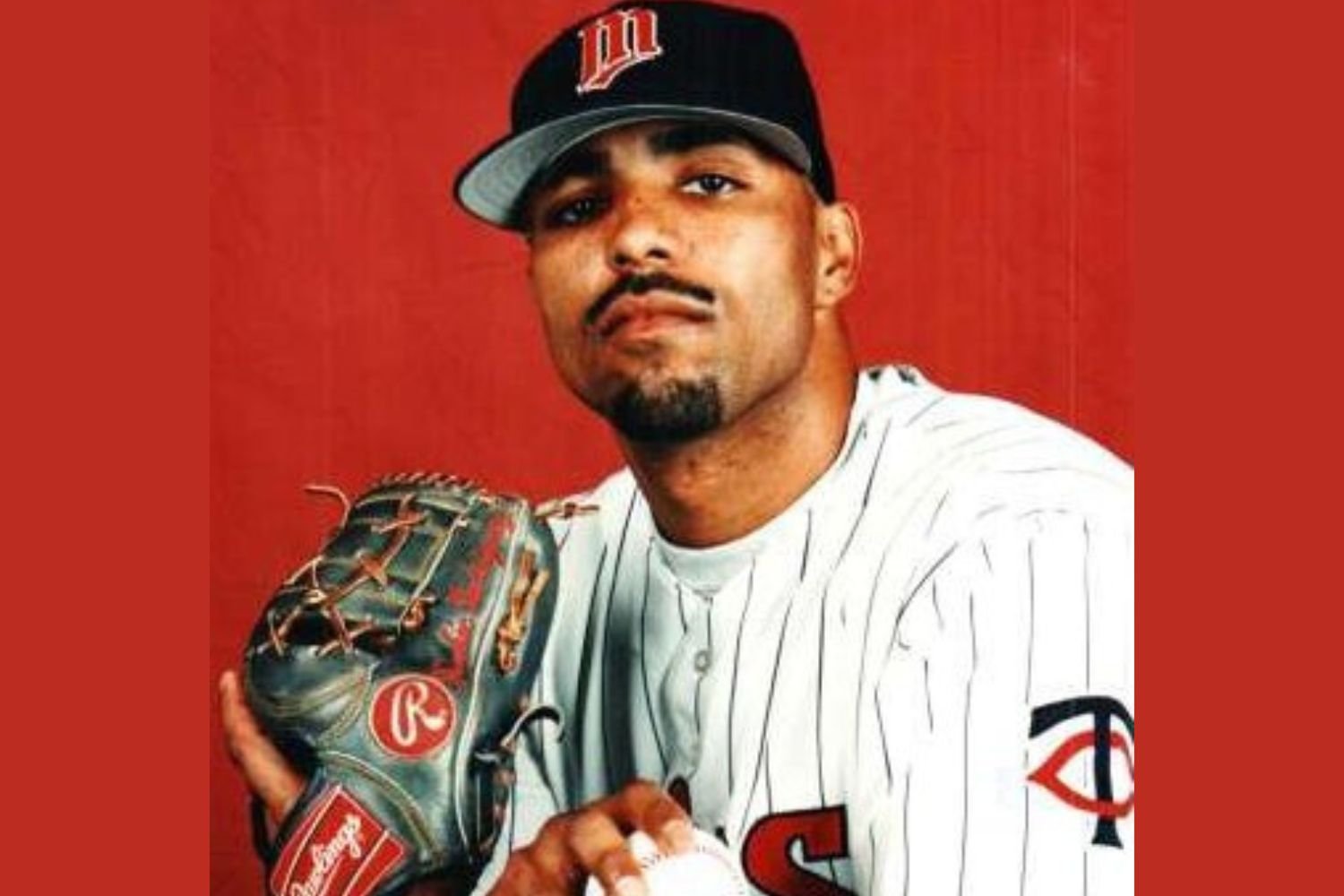
Frank Rodriguez won the Dick Howser Award in 1991, which is given annually to the best player in college baseball. He won the award despite playing for Howard College, a JUCO program in Texas. This makes him one of only two non-NCAA Division I players to win.
We all had goals growing up as a kid, and one of my goals was to play professional baseball. So everything that I did aligned with that. That’s what I’m trying to do with my daughter now in softball. She’s just starting out. It was always a goal for me. Not really that particular award, but put myself in position to make it to the professional level. And part of that was the college route. It helped me grow up and mature within the game. Just getting better every day.
The Boston Red Sox drafted Rodriguez in round two. He pitched just 15 ⅓ big-league innings for them, before getting traded to the Minnesota Twins for All-Star closer Rick Aguilera.
The trade happened when [the Red Sox] were in Minnesota. I got called in from the bullpen, and I had to go meet Terry Ryan in the office. He goes “I’m gonna send you down and see how you develop down there.” And I’m like “Terry, respectfully, at this point you have a minor-league team up here. So why can’t I develop up here?” He seemed to like that, and I was starting two days later against the Red Sox.
Aguilera was only a rental piece for the Red Sox, and he came back to Minnesota that winter as a free agent. Aside from being traded for each other a year earlier, Rodriguez had grown up cheering for Aguilera when he pitched for the New York Mets.
It’s a crazy joke. I grew up a Mets fan in Queens, so I told my mom to mail me our souvenir ball from the ’86 World Series. I was like “Rick, would you sign this ball?” I told him I was only 15 when [the 1986 World Series] happened. And now I’m sitting here next to him, so it’s a blessing. He goes “no way, you just made me feel so old. I’m not going to talk to you.” And then he didn’t talk to me for a week on purpose.
Twins legend Kirby Puckett was hit in the face by a pitch on September 28, 1995. He had to leave the game, and it was ultimately his final major-league plate appearance. Puckett retired months later after developing glaucoma.
I was actually starting that game, and we almost got into a brawl with the Indians. Dennis Martinez let a couple of sliders go. He hit [Chuck] Knoblauch to start the game, because his hands were over the plate. He was always notoriously getting hit. That wasn’t a big thing. Then Dennis just hung a slider and hit Kirby right in the face. He went down, and that was the last time he was in uniform. TK [Tom Kelly] pulls me into the tunnel. I’ll say this nicely. I’ll leave out all the curse words. It was pretty much “you better hit somebody or I’ll take your whole check.” And I had to hit Albert Belle.
Kelly was great with young players such as Rodriguez, as he tried to lay the foundation for the Twins future.
Tom Kelly was a great mentor to me. For me, I’ve always had respect for myself and what I’ve needed to do to get better. And he respected that in me, because he always saw that I was trying that every day on the field. We’d always have a couple of words like “how’s things going” and “how can I help?” I’m thankful for this. I can say this with my head held up high. I’m thankful for the moments that he gave me. He always came up to me and acknowledged my work ethic.
Rodriguez is back in New York, and has served as an assistant coach for Division III SUNY Maritime and Division II Mercy University.
I started out by helping a good friend of mine, [SUNY Maritime head coach] Charlie Barbieri, at Maritime College. And then I went to Division II, hoping to get the Division II head job at some point. It just sort of didn’t work out. The travel was taking time away from my family. So it was time for me to shut it down. Now, I work with some friends doing security for a private company and just play a lot of golf.
Rodriguez shared his coaching philosophies in regards to getting the most out of Division II and Division III kids.
You’ve got to figure out the right things to say to the right guys. You always want to be upfront with everybody. I’ve found the best way to coach is to manage personalities. Everybody understands the game. Everybody has some sort of talent. So you want to bring out that best talent from each kid. Everything we work for, even in Division III and Division II, was always preparing them for their moment. Once they understood the work that goes into being ready for their moment, they really were mentally prepared.
Are you interested in Twins history? Then check out the Minnesota Twins Players Project, a community-driven project to discover and collect great information on every player to wear a Twins uniform!