
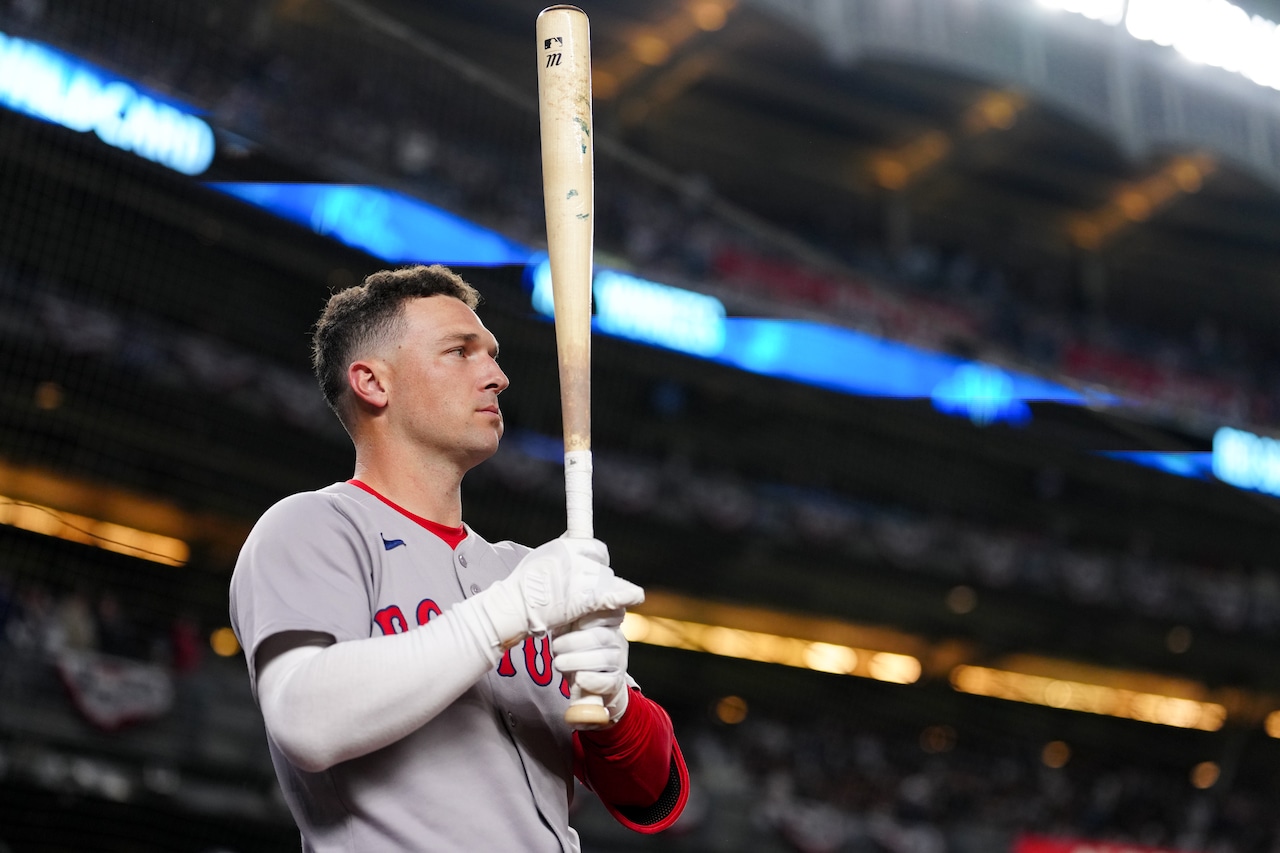
It will be weeks — if not months — before the Alex Bregman situation resolves itself this offseason.
But even before Bregman officially opts out of the remainder of his deal with the Red Sox, we know these two things to be true:
First, if the Red Sox wish to retain him, they’re going to have to give him a much longer contract than they did eight months ago — perhaps even twice as long.
Second, there’s going to be competition — and plenty of it. If Kyle Tucker is deemed the top free agent position player on the market this winter, then Bregman probably isn’t too far behind in terms of value.
Last winter, Bregman attracted interest from at least three other teams beyond the Red Sox. And that was with a qualifying offer attached, which likely scared off other potential suitors.
Now, because players can’t be given qualified offers more than once, Bregman comes with no compensation which, in theory, should expand the field of interested clubs.
Here are the teams who could be players for Bregman:
Chicago Cubs: A year ago, the Cubs reportedly made Bregman a four-year, $130 million deal and that was deemed insufficient.
The Cubs reached the playoffs this year, but were knocked out by the Milwaukee Brewers in the Division Series. They may well look at Bregman as the missing piece they need to advance further in the postseason.
But the Cubs have other issues, too. First, they need to make a call on Tucker, who is several years younger than Bregman more athletic, and undoubtedly, more expensive.
But the Cubs’ spending has been somewhat limited in recent years, much to the consternation of their fan base. According to Cot’s Contracts and Fangraphs, they were 11th among the 30 teams in spending last season.
Another issue: the Cubs have a young homegrown third baseman in Matt Shaw, a Massachusetts native. Shaw was highly-touted last year, but struggled so much early in the year that the team had to return him to the minors. He had an .839 OPS in the second half of the season, so the Cubs could well decide to go with a far cheaper alternative at the position and spend the money elsewhere — or not at all.
Detroit Tigers: Like the Cubs, the Tigers were players a year ago, and like the Cubs, they reached this postseason before flaming out in the Division Series.
The Tigers’ offer – six years, $175 million — was more generous than the Cubs, and combined with the presence of former manager A.J. Hinch, probably tempted Bregman. Ultimately, the shorter-term deal from the Red Sox, which offered an AAV of $40 million and included opt-outs after each of the first two seasons, proved too tempting.
How much more the Tigers would be willing to spend this time around, however, is up for debate. They’re going to be preoccupied with figuring out what to do with Tarik Skubal, who has just one year of control remaining. A number of people expect the Tigers to listen on trade proposals this winter rather than risk losing the ace lefty to free agency with only a draft pick to show for it after next season.
Could the Tigers trade Skubal and then turn around and spend big on a soon-to-be 32-year-old infielder? Doubtful.
Los Angeles Dodgers: There’s nothing concrete to suggest that the Dodgers will be in the market for Bregman. But then again, the Dodgers, with their profligate spending and seemingly unlimited resources, can’t be ruled out on anybody.
One potential roadblock: Bregman’s association with the Astros’ sign-stealing in 2017, which the Dodgers’ fan base still believes cost their team another title. Could they be counted on to forget all of that?
New York Mets: Like the Dodgers, don’t ever dismiss owner Steve Cohen and his willingness to spend.
It’s more likely that whatever the owner does this winter will be more focused on starting pitching or maybe retaining Pete Alonso.
It could be that Bregman and his winning pedigree could be welcome in Queens, given the level of dysfunction the franchise has experienced. Then again, the Mets are probably a long shot due to other more pressing needs and priorities.
Toronto Blue Jays: The Jays expressed interest in Bregman for much of last winter, but didn’t get around to making an official offer, perhaps because they were more focused on extending Vladimir Guerrero Jr.
Now that the Jays have locked up Guerrero, they might be in better position to make another run, although now, they’re in danger of losing shortstop Bo Bichette to free agency.
They have other options (Ernie Clement, Addison Barger) for third, but because of their financial resources, shouldn’t be ruled out altogether.
Seattle Mariners: The Mariners aren’t typically top-of-the-market spenders, but if they lose in the ALCS, they could be motivated to go after a big piece like Bregman.
He would provide some leadership to an otherwise fairly young team but it’s more likely that the Mariners try a shorter-term extension with fellow free agent third baseman Eugenio Suarez, whom they acquired at last July’s deadline.
__________________
It’s clear that whether they re-sign Bregman or not, the Red Sox could use additional righthanded power this winter.
In that sense, free agent Pete Alonso would, on paper, make some sense. Alonso has averaged almost exactly 40 homers over the last four years and his righthanded pull power would play well in Fenway even if the left field wall might limit his homer totals. (Statcast estimates that instead of hitting 158 homers the last four years, he would have hit just 127 playing full-time at Fenway.)
But there are two elements to consider here. For one thing, Alonso is a well-below average defender at first base. He had -9 defensive runs saved last year and his OOA (outs above average) was similarly alarming, also at -9, placing him in the bottom two percentile ranking among all players.
And that brings up the potential risks of giving Alonso the kind of contract — seven or eight years in length at minimum — he’s said to be seeking.
Over the last 20 or so seasons, some of the worst contracts in the game have been given to first basemen in their 30s.
“Those contracts become a problem in a hurry,” said a talent evaluator with another club. “You start battling injuries, the production falls off and there’s nowhere else to put them.”
The standard bearer for bad deals probably belongs to Albert Pujols. Pujols, who was a free agent just before his age 32 season — Alonso will begin next year at 31, for perspective – and landed a 10-year, $240 million deal with the Angels.
That proved disastrous for the club. In eight of his last nine seasons with the St. Louis Cardinals, Pujols amassed a WAR of 7.5 or greater each season, including seven seasons in which he posted a WAR figure of 8.0 or greater; with the Angels, he had a WAR total of 5.3 in his first year in Anaheim, then never came close to that again over his final nine seasons.
Miguel Cabrera was another cautionary tale. Like Pujols, he was a dynamic righthanded hitter who could hit for both average and power. But after agreeing to an eight-year, $248 million extension with the Tigers in 2014, Cabrera’s effectiveness dipped in a big way. Over his final seven seasons in Detroit, he was in the red when it came to WAR, never accumulating even a 1.0 season.
Not only did neither player come close to providing equal value for their contracts, they also hamstrung their respective teams. Because the Angels and Tigers had so much committed to their aging and overpriced first basemen, they were limited in what they could spend to improve the roster elsewhere.
The problem with those type of players is that they’re effectively anchored to first base. They can’t play elsewhere in the field and only the hiding spot for them is at DH. And even then, their one elite trait — power — tends to disappear as players age.
There are other obvious examples around the game: Baltimore’s Chris Davis (seven years, $161 million) and Detroit’s Prince Fielder (nine years, $214 million).
Even if Alonso were to handle first base for the next couple of seasons, it wouldn’t be long before he had to become a full-time DH — and a lumbering DH at that. Already, in his age 30 season, Alonso tracks as one of the slowest players in the game. Statcast had him in the fourth percentile in baserunning run value last year with his sprint speed in the eighth percentile. That’s not likely to get any better as he ages.
Would Alonso upgrade the lineup and provide a boost to the production at first base? Undoubtedly – in the short run.
The problem, though, will be the length of the contract. Alonso is looking for a seven- or eight-year deal that will take him into his late 30s.
The Sox could try to tempt Alonso with a far shorter deal at a higher AAV, not unlike the one that landed them Bregman last February. (The two players are both represented by Scott Boras).
But like Bregman, Alonso took one of those short deals with an opt-out, figuring that he could rebuild his value in 2025 and go back onto the market without the albatross of having compensation attached this time around. It’s impossible to imagine he would do so again, since such a track would have him back on the market for his age 34 season — where no players wants to be.
If you purchase a product or register for an account through a link on our site, we may receive compensation. By using this site, you consent to our User Agreement and agree that your clicks, interactions, and personal information may be collected, recorded, and/or stored by us and social media and other third-party partners in accordance with our Privacy Policy.