
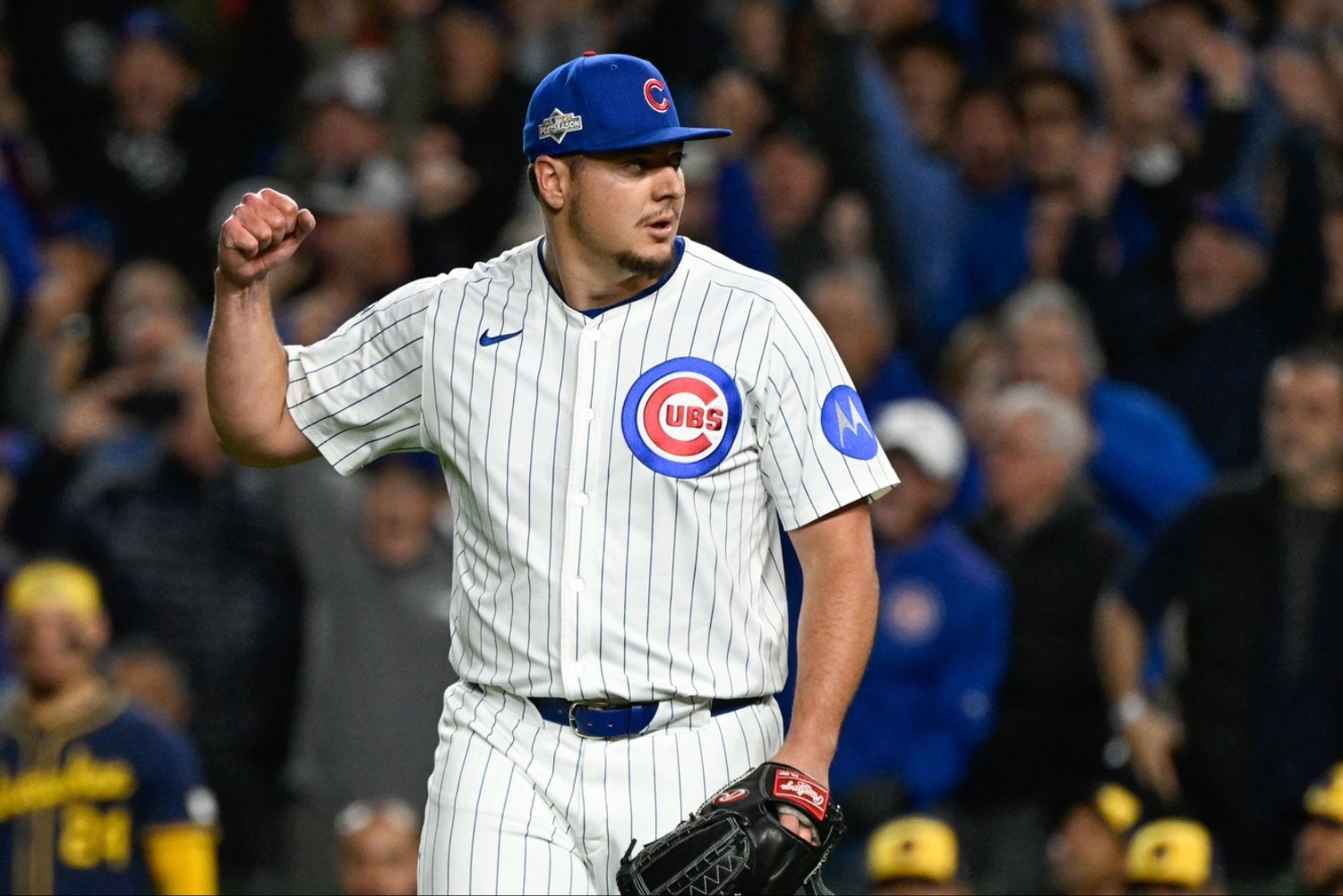
Pitching out of the bullpen is one of the more difficult things to quantify because they have the smallest sample sizes of almost any player, allowing for more wild swings in data, both year to year and month to month. There are also scoring rules that can hide poor performance, or instead, magnify struggles; if you surrender a run, but the previous pitcher put him aboard, your ERA isn’t affected. Relievers of all kinds come and go, and even the best have odd years here or there.
Entering the 2025 season, the Cubs had a mandate to fix an ailing bullpen. Down the stretch last season, the Cubs pen was seemingly a player short due to a handful of injuries and poor play. It wasn’t a terrible bullpen, ranking 12th in ERA despite ranking 17th in xFIP and 19th in fWAR, but it was one that, over the last month of the season, just wasn’t strong enough to hold together.
To combat this, the Cubs added a few new faces, trading for Astros closer Ryan Pressly, Dodger’s right-handed reliever Ryan Brasier, and Guardians’ middle reliever Eli Morgan. They also signed veteran relievers like Caleb Thielbar. Those guys were added to returners such as Porter Hodge, Julian Merryweather, Tyson Miller, and Nate Pearson. To highlight how odd bullpens can be, the Cubs finished the season fifth in reliever xFIP despite the fact that only a single reliever who made the Cubs’ Opening Day roster in Tokyo was also on hand against Milwaukee Brewers in the National League Division Series.
So, with the volatility of relievers clear in our minds, let’s analyze how the Cubs’ relief corps performed in 2025.
Ungraded due to injury: Eli Morgan, Ryan Brasier, Tyson Miller, Michael Soroka
I combined the three who were added to the Cubs’ Opening Day roster (Eli Morgan, Ryan Brasier and Tyson Miller) but barely made an impact for the Cubs, as they would combine for just a fraction over 33 innings on the season. Morgan would spend most of the year on the 60-day IL, Miller would suffer an early-season left hip impingement and was then released mid-year, and Ryan Brasier would battle injury after injury and never really got his feet under himself. Brasier did post a .366 xFIP over 26 innings on the year, but his ERA was considerably higher.
Michael Soroka was added to be a swingman at the trade deadline with the goal of helping both in the rotation and the bullpen, but almost immediately got hurt, pitching just two innings before suffering a strain. He had a rough outing in the NLDS, but I just don’t think he was ever right.
F: Ryan Pressly, Nate Pearson
This is a harsh grade for someone who at times looked like he might turn a corner, but for what he was brought in to accomplish, I can’t give him anything else. Pressly was almost immediately removed from the closers’ position after struggling early. Perhaps his most memorable moment was imploding against the San Francisco Giants, surrendering nine runs and securing no outs in an extra-inning affair in early May. By the trade deadline, the Cubs released the veteran reliever who had a -0.3 fWAR on the year. This one just didn’t work out.
Nate Pearson had a really interesting second half of the 2024 season. While relievers such as Jose Cuas were thrown to the wolves in September, the former Blue Jay looked like an interesting multi-inning weapon headed into the 2025 season. Sadly for the Cubs, Pearson would only log 14 innings, walking more than he struck out, posting a terribly 7.27 xFIP and being worth -2. fWAR. Bullpen life can be cruel.
D: Julian Merryweather, Porter Hodge
Julian Merryweather, after a lost 2024 campaign, looked like there might still be some juice to squeeze early on, posting a 1.74 ERA over the course of his first 10 innings. Then, the wheels fell off: A 14+ ERA over his next 5 2/3 inning would do the reliever in, and the Cubs released him. I hesitated to give him a full F as he provided some value and, unlike Pressly, wasn’t tasked with fixing the back end of the bullpen, but if you wanted to move him down a grade, I think that’d be fair.
Porter Hodge had a terrible, no-good year, but I also chose not to dump him into the F tier because I think an early injury derailed him. I also chose to grade him over Ryan Brasier because he was healthy at times down the stretch portion of the year and the Cubs chose to option him. Hopefully, a full offseason and rehab returns the 2024 version of the righty to Chicago.
B : Aaron Civale, Chris Flexen, Taylor Rogers
Civale just wasn’t with the Cubs long enough, but he gave them some good innings when they needed him. He didn’t blow anyone away, but in 17 innings with the Cubs, he posted an ERA under 2.00. I don’t want to give him too much credit—most of his workload was in low-leverage situations—but they were valuable contributions.
Chris Flexen was added mid-season and was shockingly good for his first 29 innings, posting a 0.69 ERA over that span. I’d give him a bump,. but there were always signs that this was pixie dust; during that initial stretch, he had a shockingly low 14 K% and a 4.69 xFIP. In other words, the wheels were always going to fall off. When that happened, it got ugly, as Flexen was knocked around over his last 14 innings, surrendering 13 runs. He too was released, but those first 29 innings were useful, even if they were a little lucky.
Taylor Rogers was acquired mid-season but never really ingratiated himself to the Cubs enough to be used in an important role. His 5.00+ ERA makes it seem like he was terrible in his short stint, but a 3.49 xFIP suggested otherwise. Seven of the lefties’ 10 total runs surrendered with the Cubs came in back-to-back appearances in late August and early September. The southpaw was left off the NLDS roster, which showed where he truly was in the pecking order.
A: Daniel Palencia, Andrew Kittredge, Caleb Thielbar, Drew Pomeranz, Brad Keller
No one in this group could be graded as anything other than an A, and you could make an argument for almost every one of these as an “A+”. The reason the Cubs bullpen was as good as it was in 2025 was because these five relievers were simply amazing. More amazing is that only Caleb Thielbar was on the Cubs’ Tokyo Series roster proper (Palencia and Keller were announced as a part of the taxi squad originally).
Keller, Thielbar and Palencia all broke the 1.0+ fWAR barrier on the season—a truly amazing feat when you consider the circumstances. Thielbar and Keller were nothing but castoffs looking for a home where they could rebuild value, and while Palencia always flashed a fun fastball, 2025 saw him refine his control and develop a true secondary offering. By the end of the season, these were some of the most reliable relievers the Cubs have had in years.
Drew Pomeranz should be considered one of the best stories in baseball this year. Having not pitched in Major League Baseball since a stint in 2021 with the Padres, the lefty found new life after a mid-season trade from the Mariners to the Cubs. No one thought much of the acquisition, and yet, Pomeranz posted a 28% strikeout rate to go with a 2.17 ERA. Just an unreal year and a superlative comeback.
Lastly, the Cubs acquired Andrew Kittredge at the deadline. While Mason Miller, Jhoan Duran, and David Bednar were likely bigger names, the former Oriole outpaced every reliever in the league after the deadline who wasn’t Miller. With the Cubs, who adjusted some of his offerings, Kittredge posted a 3.32 ERA, which probably hid his 1.45 xFIP and 39% strikeout rate, (a 15% increase from his time in Baltimore). Oh yeah, don’t forget, he also threw an immaculate inning.
Overall: B+
This is a hard year to grade. On the surface, the bullpen originally announced for the Tokyo Series was ultimately a failure, with only Thielbar and Colin Rea (who I believe should be graded with the starters, and was thus left off the list) making it onto the NLDS roster. Many pitchers were hurt, but many failed outright. Along the way, the Cubs threw some spaghetti at the wall, with players such as Luke Little, Jordan Wicks, and Gavin Hollowell getting looks.
But, the Cubs should get credit for savvy pickups along the way. Chris Flexen gave the Cubs all he had for a bit, and Aaron Civale pitched well enough after being released to make the playoff rosters. Their best relievers were scrapheap pickups, like Brad Keller, Caleb Thielbar, and Drew Pomeranz. And there was some real internal development with Daniel Palencia.
In the end, the Cubs finished with a bullpen that out-pitched its xFIP a bit, probably didn’t strike out enough hitters all the time. Still, it was an unquestionably good group, and that’s all that really matters. For every Ryan Pressly who failed, a pitcher like Andrew Kittredge transformed the pen into a formidable unit. It was the bullpen who carried a bulk of the pitching in the playoff, after all.
I think there were just enough who underperformed right off the bat to keep this grade from being an A, but I cannot imagine having this much internal turnover and getting any closer to one—credit to the Cubs for identifying useful arms and getting just the right amount of luck. The Cubs don’t beat the Padres without this unit.