
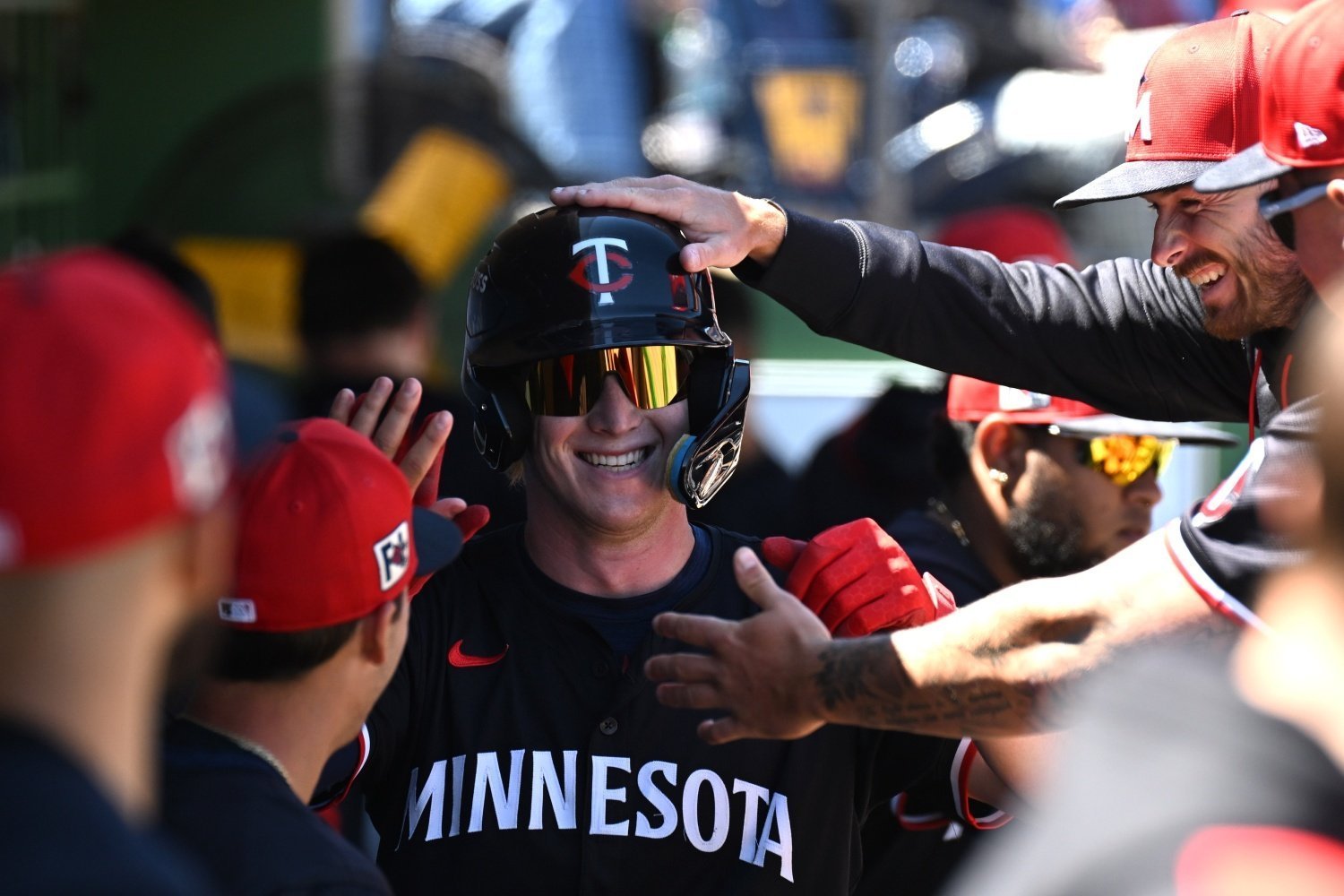
When the Twins selected Brandon Winokur in the third round of the 2023 MLB Draft, they knew they were betting on upside. The California prep star came with plenty of athleticism, raw strength, and projection, but also a fair share of uncertainty about where he’d eventually fit on the diamond. Two years later, that description still feels accurate.
At 6-foot-6, Winokur is one of the most physically imposing athletes in the Twins’ system. His combination of power, speed, and arm strength makes him a standout during any workout. What remains to be seen is where he will use those tools most effectively. Since turning pro, he has split time between shortstop, third base, and center field, all while showing flashes of potential at each spot.
“Third base, short, center—it doesn’t really matter to me,” Winokur said recently. “As long as I’m in the lineup, I’m happy. It’s actually kind of fun to look up before the game and see which spot I’m playing that day.”
While many evaluators assume that a player of Winokur’s size will eventually move off shortstop, he isn’t ready to give up on that dream. “There’s no reason I can’t play shortstop or third base long term,” he said. “If I keep working and improving, I think my size can actually help me make plays that smaller guys can’t.”
That kind of confidence isn’t misplaced. History has shown that taller infielders can thrive with the right combination of athleticism and work ethic. Cal Ripken Jr. (6-foot-4) redefined the shortstop position for bigger players, while Corey Seager (6-foot-4) and Elly De La Cruz (6-foot-5) have continued to prove that height doesn’t have to be a disadvantage on the dirt. If Winokur’s defensive instincts and footwork continue to develop, he could follow a similar path.
At the plate, the 20-year-old’s raw talent is just as intriguing. During his first full professional season, he launched 14 home runs, stole 23 bases, and posted a 118 wRC+ as a teenager in the Florida State League. This past season with High-A Cedar Rapids, those totals climbed to 17 homers and 26 steals, but his wRC+ dropped to 97. He was over two years younger than the competition at his level and faced older pitchers in all but 18 of his plate appearances.
Even so, the Twins and Winokur know there’s room to grow when it comes to consistent contact. In his pro debut, he had a 32.4 K% which he improved to 28% during the 2024 season. Last season, he made even greater improvements by posting a 24.8 K% in a career-high 529 plate appearances. After hitting .204 with a .670 OPS through June, he rebounded to .258 with a .727 OPS the rest of the way, cutting down his swings and misses in the process (23.1 K%).
“Reducing strikeouts was a big focus going into the season,” Winokur explained. “The Twins really pushed me to put the ball in play more, especially with two strikes. That work definitely paid off as the year went on.”
This fall, Winokur is suiting up for the Peoria Javelinas in the Arizona Fall League, where his attention remains on refining his swing mechanics and unlocking more of his raw power. His combination of size, athleticism, and competitive drive continues to make him one of the more fascinating prospects in the Twins organization. Currently, Twins Daily ranks him as the organization’s 12th best prospect.
Whether his long-term defensive home ends up being shortstop, third base, or the outfield, the tools are there for Winokur to make an impact. For now, the Twins will let him keep exploring all his options, and that’s exactly how he likes it.
What will be Winokur’s long-term defensive home? Can he stick on the infield even at his height? Leave a comment and start the discussion.
Interested in learning more about the Minnesota Twins’ top prospects? Check out our comprehensive top prospects list that includes up-to-date stats, articles and videos about every prospect, scouting reports, and more!