
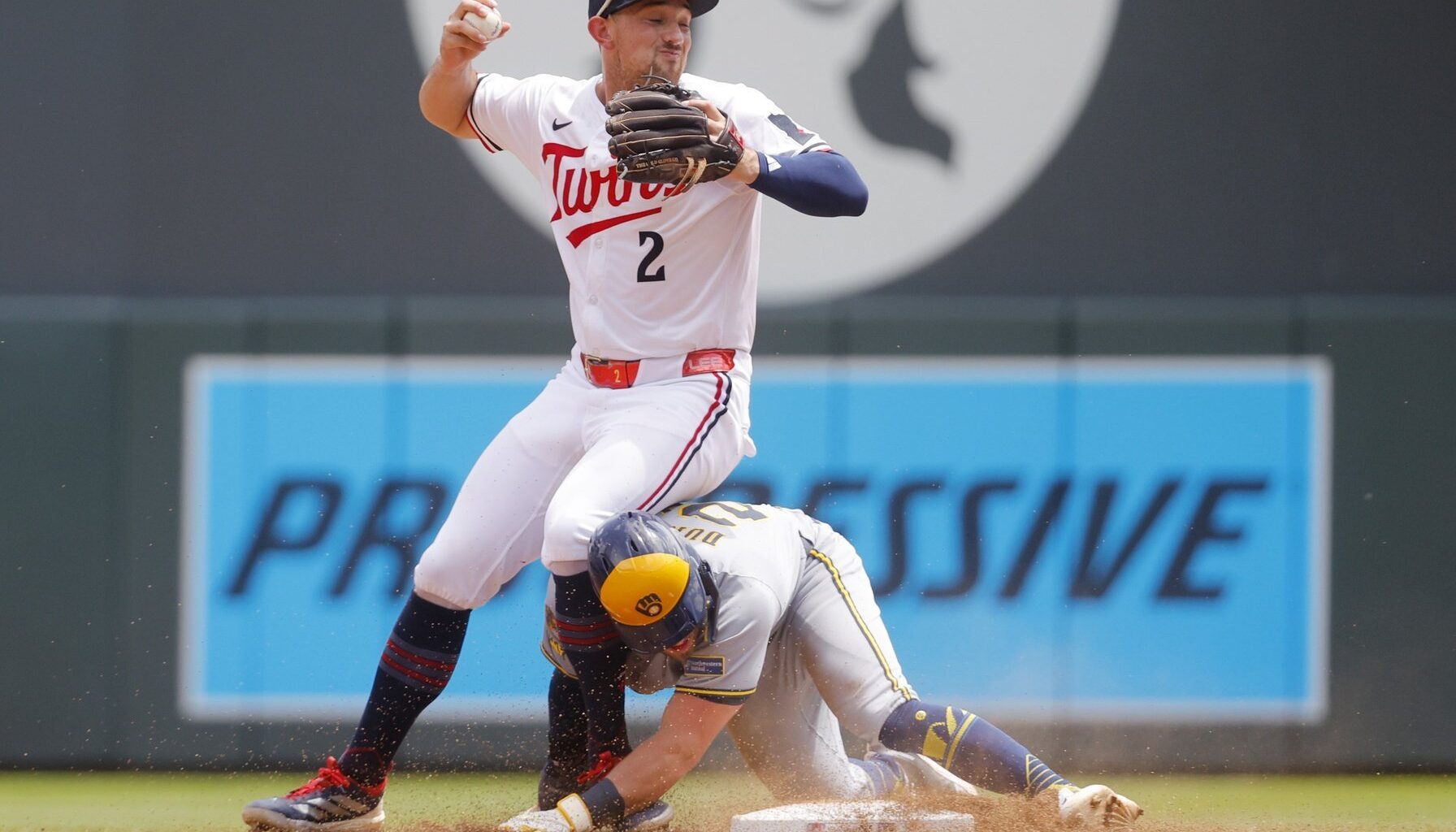
The Milwaukee Brewers have long been viewed as one of baseball’s most efficient small-market organizations. They win more often than they should, find value where others don’t, and remain competitive despite limited financial resources. However, their success does not stem from the conventional “draft and develop” model often associated with smaller franchises. In fact, the Brewers are among the least homegrown teams in baseball.
Of the 26 players who were on Milwaukee’s NLCS roster, only five would fit the traditional definition of being drafted and developed by the organization. That ranks among the lowest totals in the majors. The team’s first-round track record over the last decade has been surprisingly underwhelming, with only Brice Turang managing to provide meaningful long-term value. Even he has produced just six career WAR, a modest total that points to the challenges of drafting and developing players in an organization
By contrast, the Minnesota Twins have far more drafted-and-developed players contributing at the big-league level. Their roster to close out the season included Byron Buxton, Trevor Larnach, Luke Keaschall, Matt Wallner, Ryan Jeffers, Royce Lewis, Brooks Lee, Joe Ryan, Bailey Ober, Zebby Matthews, Kody Funderburk, Cole Sands, Cody Laweryson, and Pierson Ohl. The Twins’ internal pipeline has consistently supplied usable depth, though the ceiling of that group remains uncertain.
For the Brewers, homegrown success has been fleeting. It has been nearly two decades since the organization drafted an All-Star who reached that level while wearing Milwaukee colors. The last example came in 2018 when Jeremy Jeffress made the Midsummer Classic as an injury replacement, 12 years after being drafted. Across the past 20 years, only five Brewers draft picks from the first five rounds have produced six or more WAR for the team: Ryan Braun, Corbin Burnes, Devin Williams, Jonathan Lucroy, and Turang.
Minnesota’s record over that same stretch is even worse. Only Buxton, Jeffers, Kyle Gibson, and Eddie Rosario have cleared the 6-WAR threshold in a Twins uniform. That low return rate underscores how difficult it is for any team, even one that drafts well, to rely solely on internal development for sustained success.
Milwaukee has instead leaned heavily on trades to keep its roster competitive. Nearly half of the Brewers’ 40-man roster was acquired through deals, ranking fourth-most in baseball behind Tampa Bay, San Diego, and Seattle. They rarely engage in waiver claims and seldom chase top-tier free agents, instead focusing on finding undervalued players who fit their system. This strategy of polish-over-prospect has become their defining trait and a model for sustained relevance.
Sure enough, just one day after the Brewers were eliminated, rumors are already floating about their willingness to shop starter Freddy Peralta.
The Twins appear poised to mirror that trade-heavy approach in the coming seasons. While the front office still hopes recent high draft picks will emerge as stars, the organization knows that relying solely on prospects is risky. Like the Brewers, the Twins may increasingly depend on trades to maintain roster depth and offensive balance.
On the field, Milwaukee’s success also offers a potential blueprint. Despite finishing with the 12th-best slugging percentage in baseball and ranking near the bottom in Hard Hit rate, the Brewers still scored the third-most runs in the majors. They achieved this by emphasizing aggressiveness on the bases and manufacturing runs rather than waiting for home runs.
Minnesota embraced a similar offensive style during the final months of the season. Players were more selective at the plate, more willing to take extra bases, and less reliant on sheer power. The results were promising, and the organization seems ready to double down on that strategy next year.
If the Twins can blend their emerging young core with Milwaukee’s brand of creativity and controlled aggression, they may carve out a path to sustained contention. The Brewers have shown that there is more than one way to win as a small-market club. Now it is up to the Twins to prove that Milwaukee’s playbook can work just as well on the other side of the Mississippi.
Can the Twins follow in the Brewers’ footsteps? Leave a comment and start the discussion.