
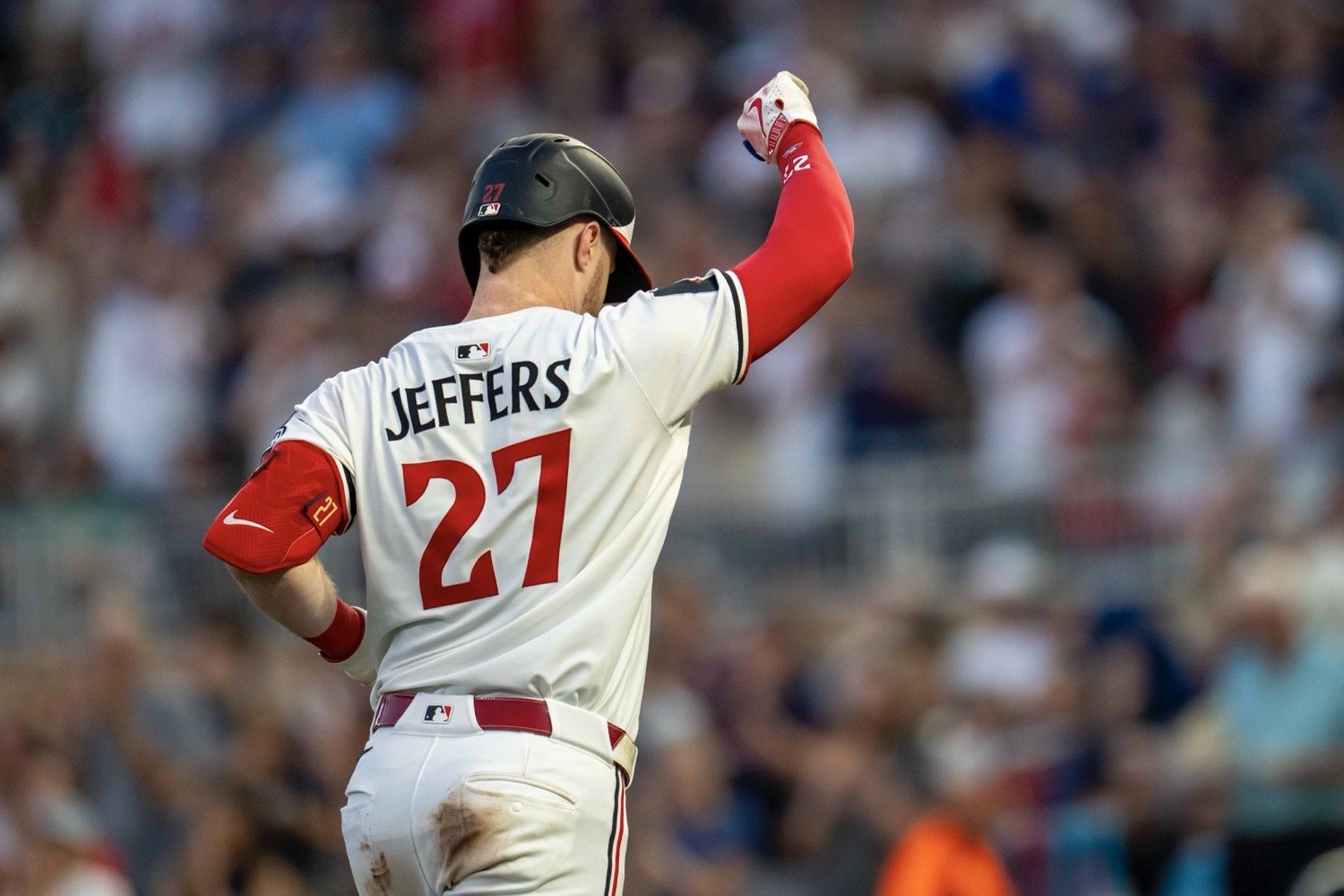
Last week, MLB Trade Rumors released their arbitration projections for the 2026 season. Ryan Jeffers stands to be the Twins’ highest-paid arbitration-eligible player, with a projected salary of $6.6 million in his third and final round of arbitration. In his first two rounds, he made $2.425 million and $4.55 million, respectively. While his home run power seemingly disappeared in 2025, it stands to reason that Jeffers’s projected arbitration salary for 2026 will be a bargain.
The backstop’s 2025 season was largely productive, ranking as his second-best with a .752 OPS and a 113 wRC+, meaning he performed 13% better than the average hitter. He also posted career-best rates for walks (10.8%) and strikeouts (19.6%). The primary issue was a significant power regression, as he hit only nine home runs—a steep drop from 35 combined dingers in the previous two years—resulting in a career-low isolated power (ISO) of .131. That stemmed from a decline in quality of contact, evidenced by a career-low 6.3% barrel rate, despite an above-average hard-hit rate (42.1%).
Jeffers altered his approach, adopting a deeper, more open stance to target the inner part of the zone and generate pull-side power. This change, however, was unsuccessful; his bat speed dropped (from 73.9 mph to 72.3 mph), and he pulled the ball less while hitting to the opposite field more. That led to lower exit velocities and fewer pulled fly balls. Again, I don’t want to dismiss or minimize the fact that he was still an above-average hitter in 2025, but the under-the-hood metrics suggest that a return to the more balanced approach seen in his 2023 season is necessary to maximize his future value.
Defensively, Jeffers continues to display poor framing, blocking, and throwing skills. Three years under the tutelage of teammate Christian Vázquez has technically resulted in improvement in these areas, though he continues to produce a negative run value behind the plate. At this point in his career, it’s pretty safe to say that Jeffers will continue to be a below-average catcher moving forward. However, the implementation of the Automated Ball-Strike System (ABS) in 2026 may mitigate the defensive struggles. While it’s hard to be sure, we can speculate that the challenge system will reduce the impact framing has on the game, thereby improving Jeffers’s defensive value.
So, should the Twins tender Jeffers a contract? Of course—if for no other reason, then because the Twins don’t have another player in their organization ready to take over primary catching duties at the big-league level. Moreover, they don’t have anyone ready to serve even as a backup catcher. However, it’s not just a matter of Hobson’s Choice at work. Jeffers has been one of the most productive and durable catchers in baseball. There’s no reason to suggest that will change in 2026. Even if the Twins (read: Pohlads) wanted to shed his salary, they would be remiss to non-tender him, instead of tendering and then trading him.
Multiple projection systems predict that Jeffers will sustain his productivity in 2026. We’ll be watching to see if Jeffers continues to evolve his plate approach after his last three seasons, and what his 2026 productivity looks like. Will he return to his more powerful production from 2023 and 2024, or will he continue to trade power for contact and patience like in 2025?
However he approaches 2026, Jeffers will be one of the easier arbitration decisions for the Twins to make. Tendering him a contract is an absolute no-brainer.