
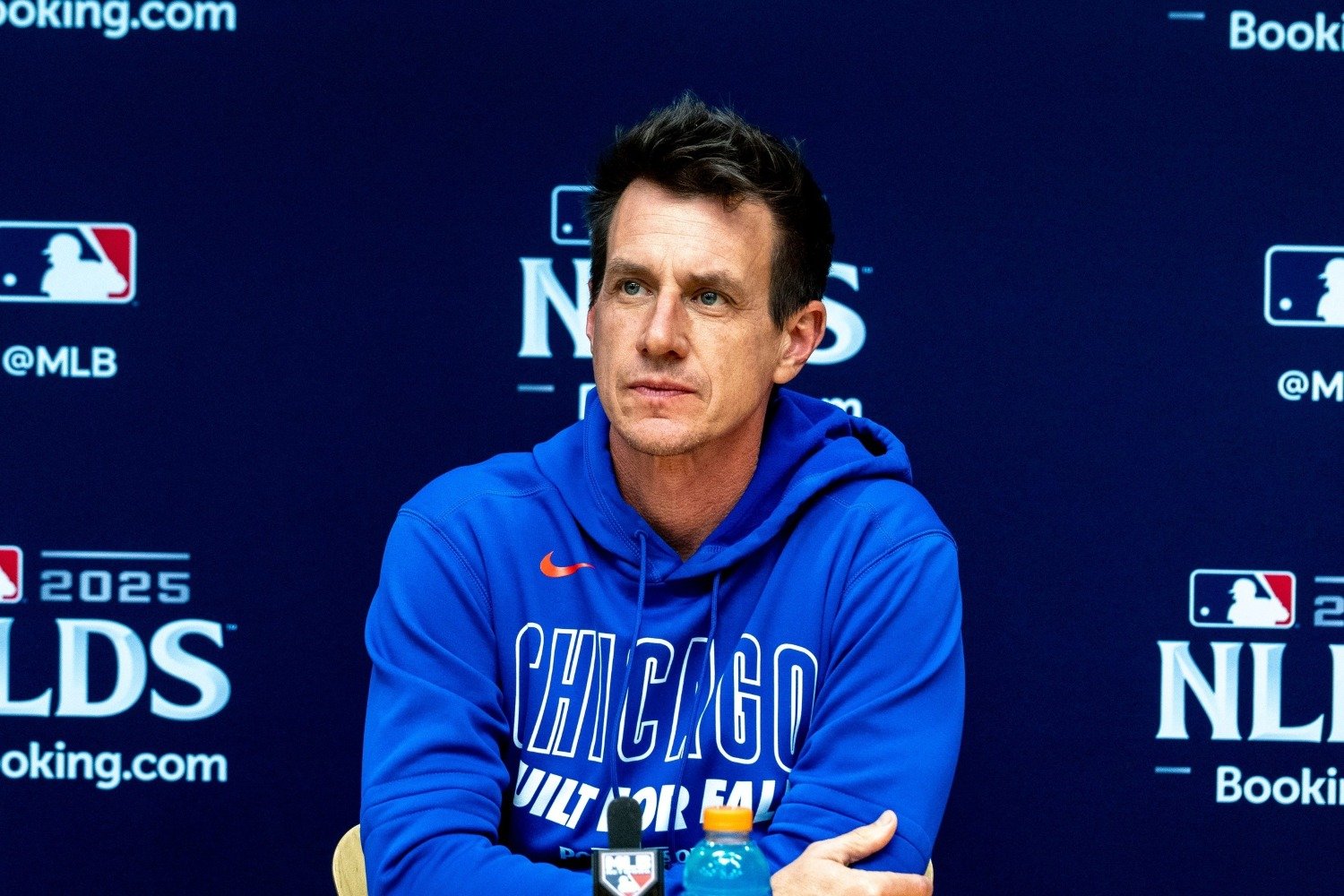
Over the last week, Cubs fans got to enjoy the humbling of the Brewers, capped by Shohei Ohtani playing the greatest single game of baseball ever. However, that is a small consolation prize. Milwaukee sent the Cubs packing, after the North Siders were unable to carry the energy of Games 3 and 4 of the NLDS back to Milwaukee last Saturday. While Colin Rea pitched well in the 3-1 loss, the offense could not get it going, only notching four hits—which, alas, was par for the course this postseason. We can sit here and point fingers at the hitters, who averaged under 3.0 runs per game across eight playoff games, and say they didn’t provide their overworked pitching staff enough support. The offense we’ve seen this postseason should have been a shock to nobody, though, as the thumping first-half offense seems like a faint memory at this point. The pitching staff impressed, but it felt like a group that was running out of gas. What could have been, if Cade Horton was healthy, is a hypothetical that is best left undiscussed. The Brewers were the younger, better team, and Game 5 proved it.
The 2025 Cubs players should be celebrated. This was a team that lost its ace in April, and finished with the ninth-best team ERA in baseball. Journeyman starter Mathew Boyd playing the best baseball of his career; Carson Kelly propping up the backstop with his younger would-be time-sharer shelved by injury; and the career resurgence of oft-injured reliever Drew Pomeranz were just a few of the feel-good stories that came from this pitching staff. On the offensive side, we saw Pete Crow-Armstrong look like an MVP candidate for half the season, Seiya Suzuki hit a new career high in home runs, and Michael Busch emerged as a star. Craig Counsell did what he was supposed to do: get the most out of the players on the roster that was given to him by Jed Hoyer and Carter Hawkins. Instead of asking questions about why the players came up short, we can ask if general management did enough to put the Cubs in the best position possible for the 2025 playoffs. Maybe this series was lost way before October. Maybe it was lost at the end of July, when the deadline came and went with no moves that signaled this team intended to do more than tread water.
Willi Castro, who was the default “big” acquisition, hit .170 and accumulated -0.5 WAR in 34 games. The veteran pitching staff needed reinforcements, especially with Boyd throwing the most innings since his 2019 season, and a need to not overuse Horton. What they got was reliever Andrew Kittredge, who was statistically the best acquisition; Taylor Rogers, who was traded twice; and a mere handful of innings of Michael Soroka. There was an apparent strong pursuit for MacKenzie Gore, which hit an insurmountable roadblock when Washington asked for Matt Shaw and Horton as part of the return package. They were also connected to Edward Cabrera of the Marlins, but could not get a deal done. Neither of those players ended up being traded, and for the purpose of this exercise, I am only going to focus on players who were traded. Here is a rundown of some players who would have been perfect fits for the 2025 Cubs, but ended up going somewhere else.
Good. but Not Great, Reliever Tier
The Cubs bullpen was a strength for most of the season, but they relied heavily on veteran arms and guys without strong track records of success. We saw Kittredge, Daniel Palencia, Pomeranz, and Brad Keller pitch nearly every game in the playoffs. Another experienced reliever would have gone a long way in terms of bullpen depth for October, and the following players are prime examples of missed opportunity:
(We do have to acknowledge, of course, that a lof of these guys struggled mightily or got hurt in their new homes; maybe they wouldn’t have helped either. But one more arm would have been good for this team, even if they were out of the mix by the time the postseason rolled around.)
Starters Who Would Have Gotten the Ball in the Playoffs
The Cubs ran Boyd out there to start three of the eight playoff games. Kittredge was used as an opener for another, and Shota Imanaga had an 8.10 ERA across his two playoff appearances. More than the bullpen, the starting rotation was criminally neglected at the trade deadline. The pursuit of Gore is not an excuse to not make a move for one of the following starters:
The caveat with this crew is that they would have been crowded out of the rotation at various points in August and September. It’s hard to imagine the team that refused to trust Javier Assad gleefully handing the ball to Houser instead. Still, once Horton went down, it became clear that more reinforcement could have helped.
Jhoan Duran: Traded from Twins to Phillies
Duran and David Bednar were the crown jewels of available relievers at the deadline. He has been one of the better relievers in baseball for the last few years, but took his game to an elite level in 2025. He finished the season with a 2.06 ERA and 32 saves, thanks to the addition of a sweeper that made him a frankly unfair at-bat. The 9th inning has been a revolving door for the Cubs since Héctor Rondón locked it down for two and a half years, over a decade ago. The Ryan Pressly trade in the offseason did not work out, as he was grandly slammed onto the waiver wire at the end of July. The job went to Palencia after Pressly, but after he suffered an injury in September, it fell to Keller. The Phillies did give up two highly-regarded prospects, in Mick Abel and Eduardo Tait, to get him, but when you can get one of the best controllable relievers in the game and have a dire need for a shutdown closer, that’s the cost of doing business. Plus, how sick would this entrance be in Wrigley?
Merrill Kelly: Traded from Diamondbacks to Rangers
The Rangers are an example of a team who did not make the playoffs, but who had a stronger deadline than the Cubs. Although Chicago was briefly in on Kelly, who had a 3.22 ERA at the time of the trade, he ended up somewhere else. Down the stretch, when Boyd was running out of gas and Rea and Imanaga were dealing with their own levels of volatility, Kelly would have stabilized the rotation nicely. Considering the package Arizona received, the Cubs may not have had the pitching in the system to match the offer from Texas (he was acquired for a trio of pitching prospects), but the Cubs have a better farm system overall. The inability to get a deal done can make one skeptical on how serious the Cubs’ pursuit of Kelly ever was.
Eugenio Suárez: Traded from Diamondbacks to Mariners
Shaw had a stronger hold on the third base job in 2025 than he ever should have had. Outside of a few hot streaks, Shaw was largely a disappointment offensively. In the postseason, he tallied two weak hits in 23 plate appearances, and was held hitless in seven of the 8 games. The problem is, the Cubs didn’t have any other good options. It is worth questioning whether Counsell should have benched Shaw for Willi Castro, or even Justin Turner, at some point during the series with Milwaukee. Shaw has been a strong defender, but third base has been the only position in 2025 where the Cubs needed a significant offensive upgrade.
Rental Eugenio Suárez was acquired for a package centered around Mariners No. 9 prospect, first baseman Tyler Locklear, who has a .532 OPS across 47 big-league games. The Cubs might have been able to get him for a package centered around Jonathan Long and James Triantos, who do not have a clear path to playing time on the North Side. Although Suárez struggled early in his return to Seattle, he still hit 13 home runs, and finished the year with a career-high 49 home runs. He hit 2 key home runs (including this grand slam) in Game 5 of the ALCS versus the Blue Jays, and it makes one wonder what kind of spark he could have provided to a struggling Cubs offense.