
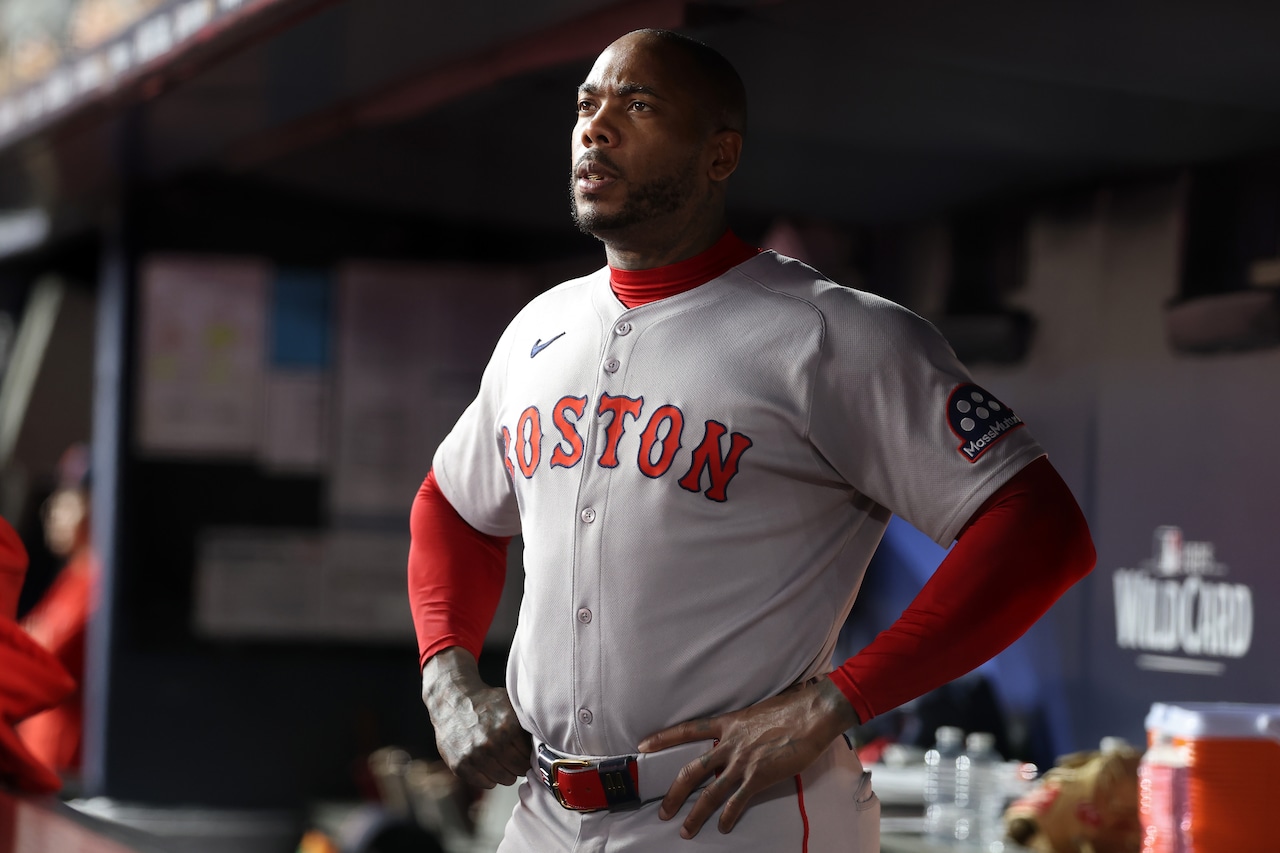
With the 2025 Red Sox season over and an important offseason approaching, it’s time to break down each part of the Red Sox’ roster entering what should be a busy winter for chief baseball officer Craig Breslow. All week, we’ll be running a five-part series analyzing each part of Boston’s roster. Next up is a look at Boston’s bullpen entering 2026:
WHERE DO THINGS STAND?
The Red Sox, as a team, had the second-best bullpen ERA in baseball in 2025 (3.41). The club was 71-4 when leading after seven innings. By all metrics, it was an area of the roster that took a tremendous step forward, largely due to the otherworldly season of Aroldis Chapman and a nearly-as-excellent final few months from Garrett Whitlock, who emerged as the setup man and dominated.
*** READ Part I of our roster analysis series, on the starting rotation, here. ***
By extending Chapman over Labor Day weekend, the Red Sox locked in their 1-2 punch in the back end of the bullpen for 2026 and will go to spring training with their setup and closer roles filled. That’s quite the luxury for Alex Cora. Veteran lefties Justin Wilson and Steven Matz are free agents who might sign elsewhere, but the Red Sox still have a lot of traditional, big league relievers who are under control for 2025. Righties Justin Slaten, Greg Weissert and Zack Kelly remain on the 40-man, as do lefties Brennan Bernardino and Chris Murphy. Righty Jordan Hicks is under contract, and barring the Red Sox giving up (and eating the big money remaining on his contract) will be given the chance to figure things out during spring training. Luis Guerrero is a depth option, too.
A large part of the bullpen puzzle might depend on which starters behind Garrett Crochet and Brayan Bello crack the rotation. Breslow and the pitching department will do everything in their power to keep young arms like Payton Tolle and Connelly Early stretched out as starters, but if a few good options emerge as camp, could someone (Kutter Crawford? Richard Fitts?) take on a relief role. The Sox have the depth to figure that out as things progress.
WHAT’S COMING FROM THE MINORS?
It all depends on who the club identifies as who is best-positioned to make an impact as a starter. For example, the Red Sox used Tolle as a reliever while pushing for a playoff spot because they thought his pitch mix would play in those situations. At the beginning of a long season, he’ll start.
David Sandlin is a high-octane arm who some profile as a reliever but the Red Sox tried him in the bullpen in Worcester late last season with disastrous results. Luis Perales could probably be a dominant late-game option in 2026 but they’ll make every effort to keep him stretched out as a starter. Tyler Uberstine had a good year in Worcester and could be in the mix for a 40-man spot. Alex Hoppe and Noah Song are other notables in the relief mix.
The hard thing about projecting relief prospects is that the best relievers are, with some exceptions, usually failed starters. Matt Barnes and Whitlock are the best recent examples. Teams understand the value of having their best pitchers toss the most innings possible and will act accordingly. From there, it’s about covering the rest. One of the big organizational stories to watch in the coming years as who from the deep group of talented young pitchers emerges as a starter — and who joins the bullpen.
WHICH MOVES MIGHT THE RED SOX MAKE?
The Red Sox have spent (relatively) big on their bullpen in free agency in recent years, signing the likes of Chapman, Kenley Jansen and Chris Martin to short-term deals to fortify the back end. The need for a high-dollar back-end add simply isn’t there this time around with Chapman and Whitlock locked in. That doesn’t mean the group is a finished product.
The way the roster is constructed means it’s relatively unlikely Breslow makes a big push for a top free agent reliever like Edwin Díaz, Robert Suarez, Raisel Iglesias, Ryan Helsley or Devin Williams, unless he wants to shorten games with a super bullpen. What the group needs is veteran depth that can pitch in the sixth or seventh innings of games. A shrewd move or two like the addition of Wilson last November would fit the bill. Free agent options in that realm, of course, are a dime a dozen and wouldn’t break the bank, which is important considering the need for a No. 2 starter, a power bat and improved infield defense. The list of mid-tier free agent veterans is long — and includes Kirby Yates, Luke Weaver, Kyle Finnegan, Wilson, Matz and many, many others.
Adding one veteran righty and one veteran lefty on one-year deals might be it. The big bullpen move is already done with Chapman having signed his one-year, $13.3 million extension in September. It’s always a group that can be fortified at the trade deadline, too.
FINAL ANALYSIS / PREDICTION:
The Red Sox have many areas of need this winter. High-octane bullpen help, while a luxury for all teams, is not one. Depth will be the goal for Breslow as he looks to augment a group that will be headlined by Chapman and Whitlock.
The prediction here is that the Red Sox sign two arms — a righty and a lefty — but don’t break the bank for either. There are many trustworthy options internally (including some projected as starters) who can be counted on, too. Wild guess? Wilson and Luke Weaver.
If you purchase a product or register for an account through a link on our site, we may receive compensation. By using this site, you consent to our User Agreement and agree that your clicks, interactions, and personal information may be collected, recorded, and/or stored by us and social media and other third-party partners in accordance with our Privacy Policy.