
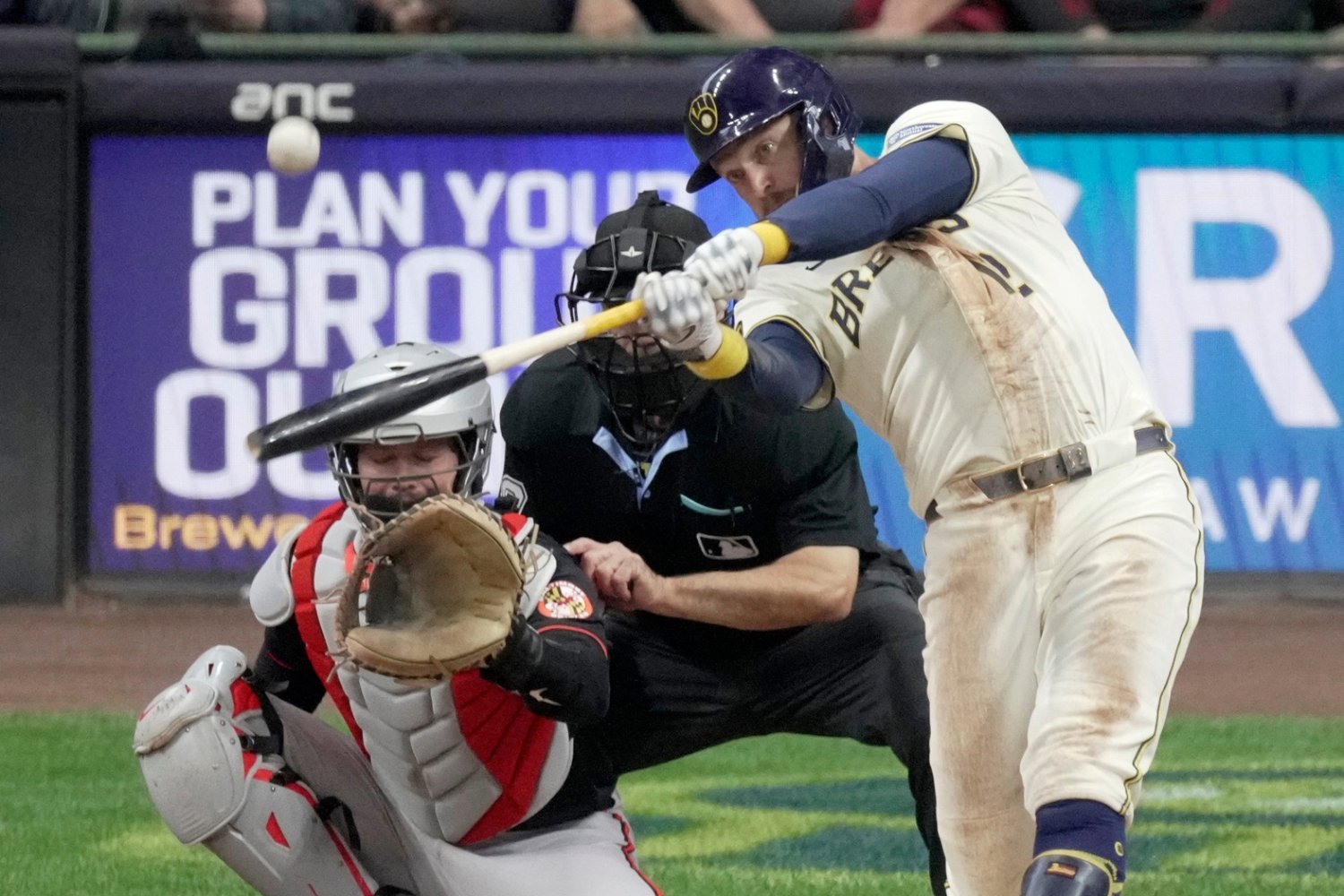
I’d love a Lavender Lamborghini. Unfortunately, my current financial situation doesn’t allow for one. I have priorities and expenses to consider. Most of the time, you have to choose practically over what you want. That’s reminiscent of what the Red Sox are going through in deciding which free agents to pursue this offseason.
In 2025, the revolving door of Red Sox first basemen posted 0.5 total fWAR, 22nd in the league. For the second consecutive season, Triston Casas (.182/.277/.302, 56 wRC+, -0.6 fWAR) suffered a catastrophic injury, leaving the team with a hole at first and the lineup devoid of a power bat—one that desperately needed thump following the Rafael Devers trade.
The Red Sox’s woes at first base were brought to light in the postseason. While Romy González (.305/.343/.483, 123 wRC+, 1.5 fWAR) and Nathaniel Lowe (.280/.370/.420, 114 wRC+ split with the Red Sox) posted competent offensive metrics in the regular season, they went a combined 0-16 during the American League Wild Card series. González should be a bench player, but was forced into an everyday role due to injuries. In mid-August, Lowe was designated for assignment by the Nationals, went unclaimed on waivers, and signed a one-year deal with the Red Sox. He committed a costly error in the winner-take-all final game of the Wild Card series.
With Alex Bregman opting out of his contract and (hopefully temporarily) coming off the Red Sox’s 2026 payroll, the team’s projection drops to $218.92 million. This leaves them $25.08 million to spend before the first competitive balance tax threshold of $244 million in 2026.
Going back to my opening metaphor, Pete Alonso represents a Lavender Lamborghini in the Red Sox’s offseason. Alonso (.272/.347/.524, 141 wRC+, 3.6 fWAR) is expected to opt out of his contract with the New York Mets and is reportedly seeking a seven-year deal in free agency. To his credit, he has remained healthy throughout his career. Over the past two years, Alonso has played complete 162-game seasons at first base. Barring the shortened 2020 pandemic season, he has never hit below 30 home runs. He’s also improved dramatically on his strikeout problems since a high rate in his rookie year (26.4%).
Alonso is a pull-heavy (41.1% career pull rate) powerful righty whose swing would fare well at Fenway. His batting profile suggests he won’t regress at the plate in the future. His 93.5 mph average exit velocity (seventh in MLB) and 89 barrels (third in MLB) were the highest of his career. On the field, Alonso’s defense is subpar. His -9 outs above average in 2025, the worst figure of his career, was in the second percentile.
Alonso’s asking price is steep. He has every right to hold himself to a high standard, but it’s unusual for him to be seeking such a lengthy contract, especially since he’ll be entering his age-31 season next year. Matt Olson’s 8-year, $168 million contract would be the closest comparable to what Alonso is asking for. However, Olson signed the deal at age 28. In 2019, Paul Goldschmidt, then 31, signed a 5-year, $130 million extension with the Cardinals. Olson is an athletic first baseman (as was Goldschmidt in his prime), and he (two) and Goldschmidt (three) had won multiple Gold Glove Awards before their extensions.
Shelling out anything similar to a one-dimensional player is a waste of resources. This is just my personal opinion, but when you’re signing position players to multi-year, high-AAV contracts, they need to be at least average defensively. Consider Rafael Devers, Nick Castellanos, and Juan Soto’s contracts—all are great hitters, to be sure, but they don’t have a high floor to fall back on when their bat wanes through slumps. While Alonso would add much-needed power to the Red Sox’s lineup, I’d rather see the team focus its resources on re-signing Alex Bregman and acquiring a No. 2 starter.
Thus, I come to you with the notion that Rhys Hoskins is a cheaper option that the Red Sox should pursue at first base. Hoskins signed a two-year contract with the Milwaukee Brewers and has an $18 million mutual option for the 2026 season. Given Andrew Vaughn’s surprising turnaround with the Brewers, the team is expected to decline Hoskins’ option. Vaughn enters his third year of arbitration this offseason and will earn less than Hoskins’ mutual option in 2026.
Hoskins’ career slash line at Fenway is .300/.600/1.112 OPS (197 wRC+). With a 32.6% pull air rate (ranked third among right-handed hitters since 2024), his swing is perfect for the Green Monster. I created the following visualization of Hoskins’ home runs hit at home over the past two years with an overlay at Fenway Park. Had he played with the Red Sox, he would have added approximately 19 home runs, bringing his total to 57 home runs, which would be tied for third with his old teammate, Bryce Harper.
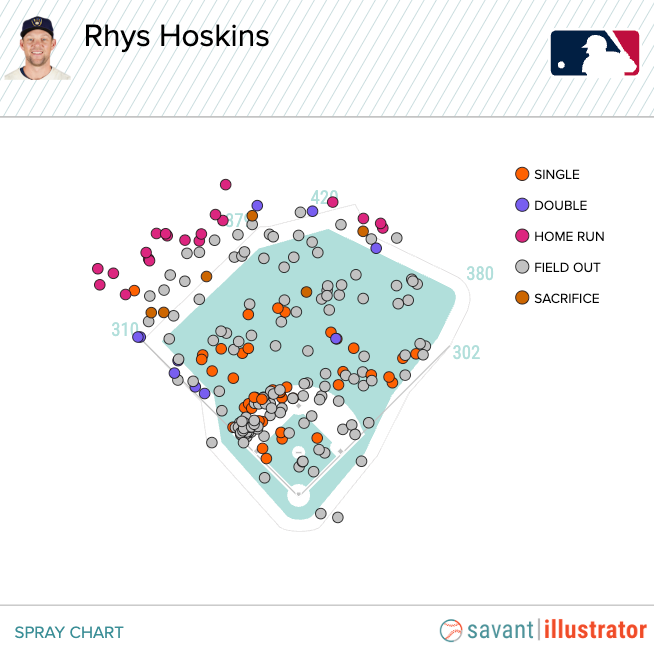
Hoskins was injured this year, so he shouldn’t come with a crazy asking price. He also isn’t a defensive wizard like Matt Olson. He posted one OAA through 670.2 innings this season. His career total is -13 OAA. [For reference, Alonso’s is -32.] The catch is that the Red Sox wouldn’t be tied to his defense on a lengthy, high-AAV contract.
Then there’s the Triston Casas question. His future remains uncertain due to his injury history. In 2024 and 2025, the Red Sox were forced to scramble early in the season to find a replacement for Casas. To avoid a similar situation, they should conduct thorough due diligence in the offseason. If Casas is healthy at the start of the 2026 season, Hoskins would likely serve as a right-handed platoon bat, but that’s a big “if”. Plus, the Red Sox already have a right-handed platoon bat in Romy González. I like González, and his defensive versatility has been invaluable to the team. However, despite his elite exit velocity and hard hit rate, he’s only hit 15 home runs in the past two seasons. The team needs power, and González still has not proven he can unlock that potential.
The depth of the Red Sox’s bench has been a key to their success, but I wonder if a shakeup is needed to propel them further in the postseason next year. Nick Sogard posted the seventh-highest WPA of 0.16 in the Wild Card round of the 2025 postseason. As a switch-hitter with defensive versatility, he’d likely be a permanent bench piece on almost any other team. It might be time to promote Sogard to a full-time role on the bench and move on from González, who could be packaged in a trade for a No. 2 starter.
The easiest route for the Red Sox to add power to their lineup presents itself at first base (Munetaka Murakami is another high-profile player that the Red Sox could pursue). On top of acquiring a No. 2 starter, whether by trade or in free agency, re-signing Alex Bregman should be a priority for the Red Sox. The organization possesses the financial means to keep Bregman and make significant upgrades at first base and in the rotation, but recent offseasons suggest they may not be willing to splurge heavily. Signing big-name free agents isn’t the best strategy for long-term financial health and roster construction; just look at the Phillies’ current predicament. Alternatively, Rhys Hoskins is an affordable first-base option who provides a strong middle-of-the-order presence with the kind of right-handed power the Sox are seeking.