
Following Garrett Crochet‘s domination of a perplexed and overwhelmed New York Yankees lineup in Game 1 of the AL Wild Card series, the Boston Red Sox needed just one more good start to get into the ALDS and guarantee a home playoff game at Fenway Park.
Then, Brayan Bello collapsed, failing to get out of the third inning in Game 2 as Alex Cora yanked him after just 28 pitches. Connelly Early dazzled to start the decisive Game 3, but one bad inning for the southpaw was all the Yankees needed behind rookie sensation Cam Schlittler to send the Red Sox home early. A much-maligned rotation proved to be Boston’s downfall, leaving the front office with a lot of questions to answer.
Now, not all of the blame falls on the roster construction here. Lucas Giolito was the team’s No. 3 starter all year long before suffering an elbow injury in September that prematurely ended his season. Dustin May was acquired at the deadline as a high-upside dart throw, but underperformance and injuries rendered his Red Sox tenure unremarkable. Tanner Houck was billed as the No. 2 starter on Opening Day following his All-Star turn in 2024, but his performance on the mound was cataclysmic before an arm injury mercifully ended his season. The same fate also befell Richard Fitts, Hunter Dobbins, Kutter Crawford, and to the extent that he did not return from his preexisting injury in time, Patrick Sandoval.
That’s a lot of injuries on the pitching side of things, and very few teams have the depth to remain afloat amidst such a flood of misfortune. The team’s depth will have to be addressed to some extent this offseason, but that the Red Sox were able to make the postseason at all is a testament to the depth they already have.
Instead, what really demands the front office’s attention this winter is that spot between Crochet and Bello atop the rotation. As great as the latter was in 2025, he’s clearly punching above his weight as a No. 2, at least right now. Houck was meant to occupy that role, but even the best laid plans of mice and men often go awry. Simply put, there’s an ace-sized opening in the rotation, and Crochet needs his right-hand(ed) man now more than ever.
Such pitchers rarely hit the free-agent waters, and this offseason is no different. Dylan Cease, Framber Valdez, Michael King, and Shane Bieber represent the cream of the crop, and each comes loaded with their own questions (not to mention that some will be attached to the qualifying offer). In the second tier of available starters, you’ll find recognizable names like Ranger Suárez, Zac Gallen, Merrill Kelly, and (potentially) Jack Flaherty, though none are sure to be better than Bello in 2026, who will be far cheaper than any of his free-agent counterparts.
Thus, the trade market will soak up the bulk of the attention of teams looking for aces this winter, and does it ever deliver. Tarik Skubal—the soon-to-be two-time reigning AL Cy Young Award champion—of the Detroit Tigers is rumored to be available, mostly thanks to a jaw-dropping chasm between the money he seeks and the money the Tigers are offering in negotiations. Hunter Greene joins him in the rumor mill, armed with both a triple-digit fastball and three years of cheap team control, plus a $21 million option in 2029.
Those résumés are impressive—perhaps too impressive for the Red Sox. Both pitchers are on the shortlist of the best starting pitchers in MLB, and thus, will cost an eye-watering amount of talent via trade. Skubal will also cost hundreds of millions of dollars via an extension.
That won’t necessarily scare Boston off; they performed the exact same trade-and-extend maneuver with Crochet one year ago. But that deal with the Chicago White Sox depleted their farm system coffers a good amount, and Crochet now soaks up the largest luxury tax space on the team sans Alex Bregman. It may be feasible, but it may not be wise to further torch the farm system and cap sheet for another elite starter.
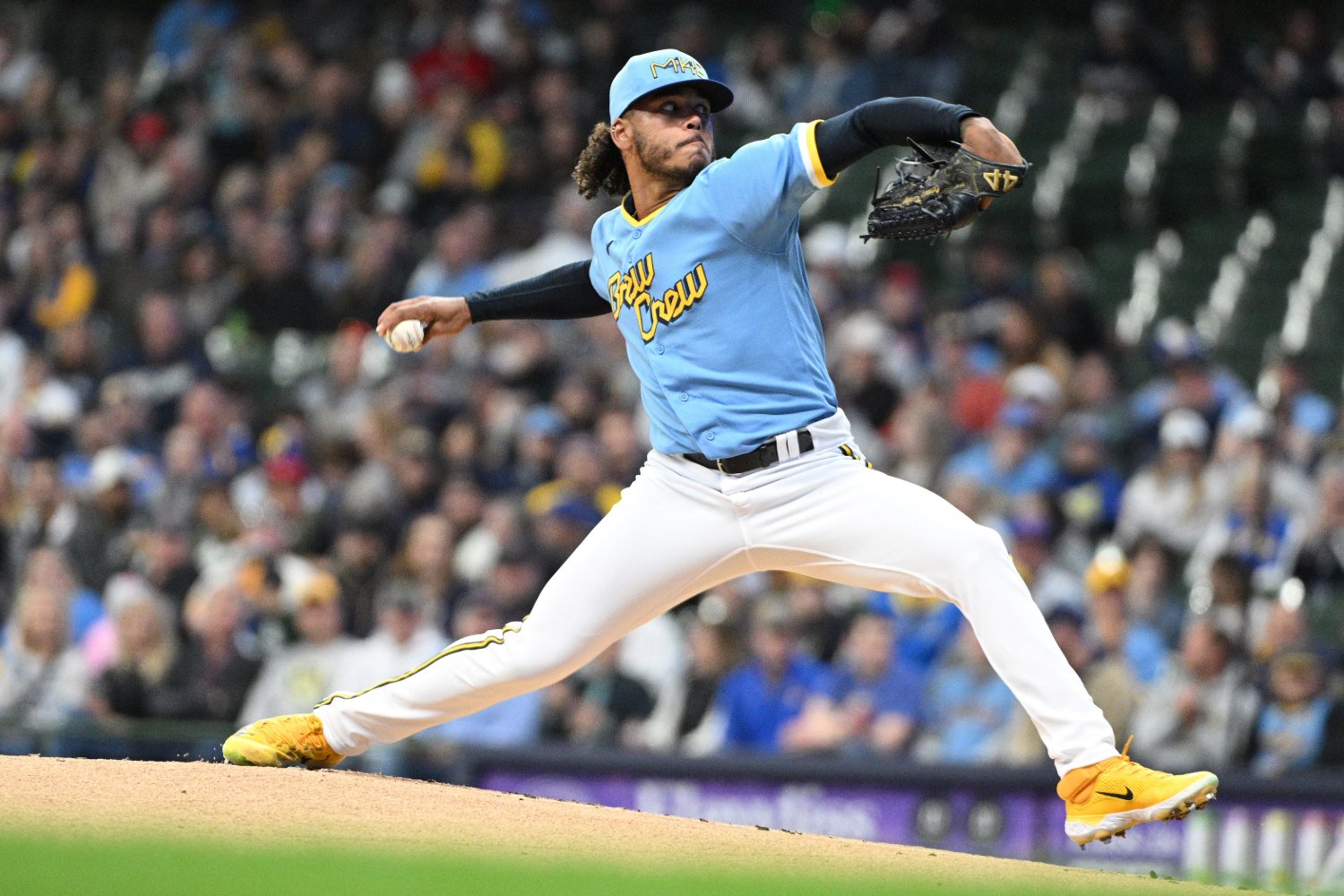
This excessively long preamble is all here (there was more before a few rounds of edits) to inform you, dear reader, as to why Freddy Peralta is the ideal starter for the Red Sox to target in a trade this winter. Like Skubal and Greene, the Milwaukee Brewers’ No. 1 starter is rumored to be available, and despite his own laundry list of accomplishments, he’ll cost scraps compared to the other two aces.
Peralta isn’t quite the same caliber of pitcher as Skubal, but his track record is undeniable. He’s thrown at least 165.0 innings in each of the past three seasons, and his ERA hasn’t climbed above 4.00 since 2019. The 2025 campaign was the best of his career, as the 29-year-old recorded a 2.70 ERA in 176 2/3 innings, good for 3.6 fWAR. He’s one of the best pitchers in baseball at “pitching backwards”, as all three of his non-fastball offerings (changeup, curveball, slider) yielded a wOBA below .250 from opposing hitters in 2025. His postseason pedigree is also impressive, as Peralta has a 4.32 ERA and 1.02 WHIP in 33 1/3 playoff innings.
We could stop there, but I want to highlight something Peralta excels at that the Red Sox have valued quite highly under Andrew Bailey and Craig Breslow: pitch-tunneling. The concept is basic enough on the surface—a pitcher tries to hide the type of offering he’s throwing as long as possible, while heaps of late movement force batters to adjust their eye level as the pitch travels to the plate. In practice, it’s a very difficult skill for a pitcher to learn, and it’s why Peralta has become so effective in the pitching factory in Milwaukee.
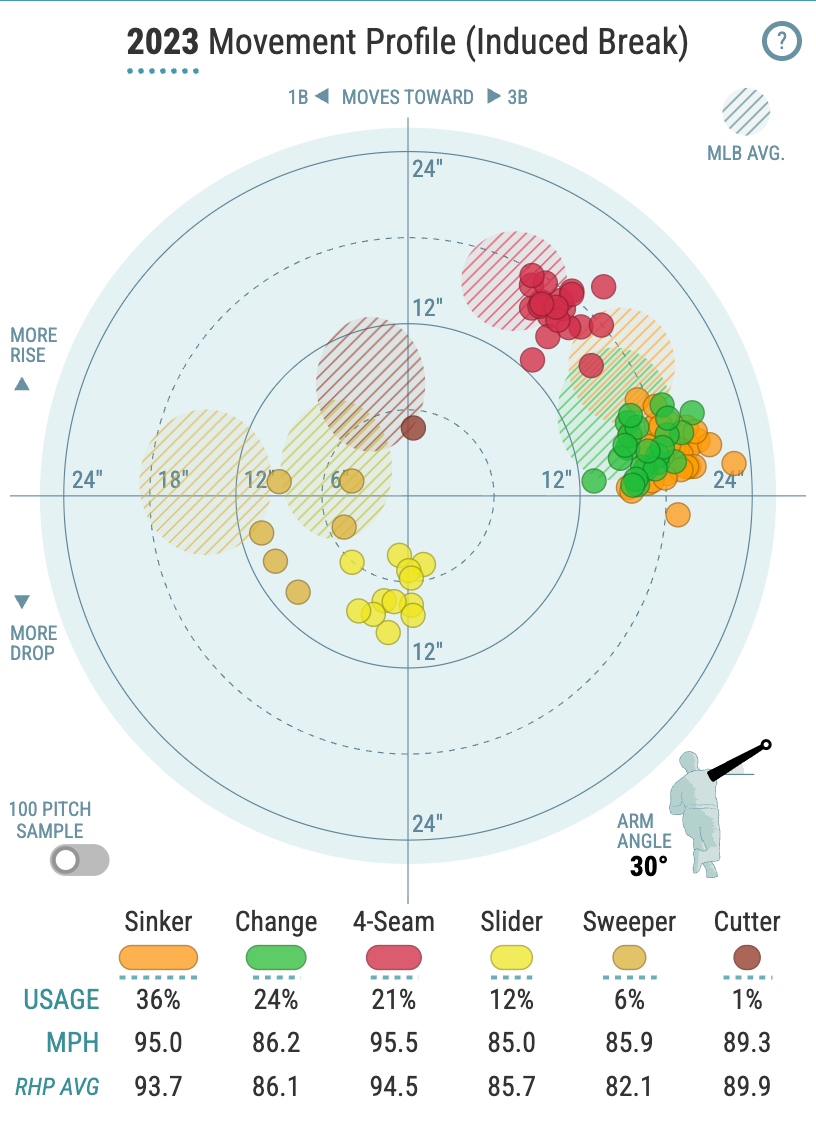
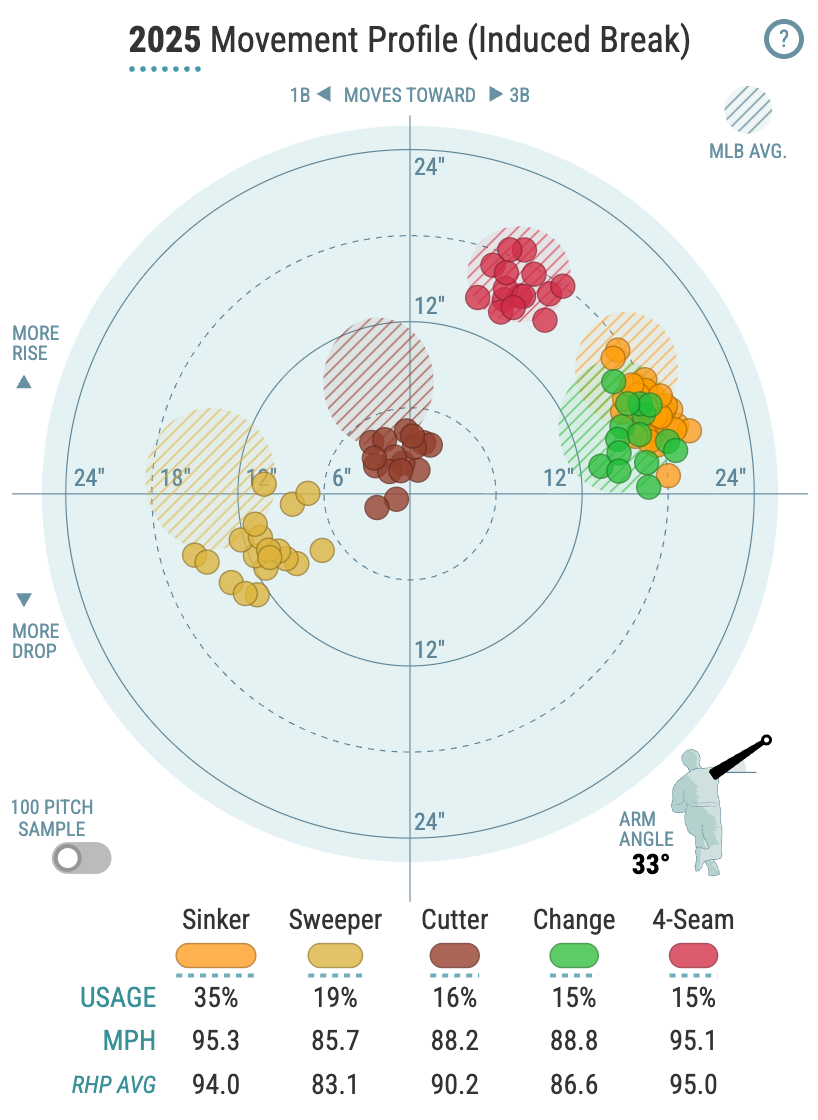
For an example, look at Brayan Bello’s movement profile between 2023 (his first full season in the majors) and 2025. There has been a very real and very conscious effort to get his pitches to differentiate in terms of movement, primarily achieved through more rise on his four-seamer and the introduction of a cutter in place of his flat slider.
Peralta is one of the kings of this concept. Beyond his ability to change speeds—each of his pitches has a roughly 5.0 mph difference separating it and the next closest offering in his arsenal—Peralta excels at keeping his pitches in a tight cluster. His movement is reliable and repetitive, and each pitch is so different from the next that hitters are frequently forced to guess at what he’s throwing as he’s throwing it.
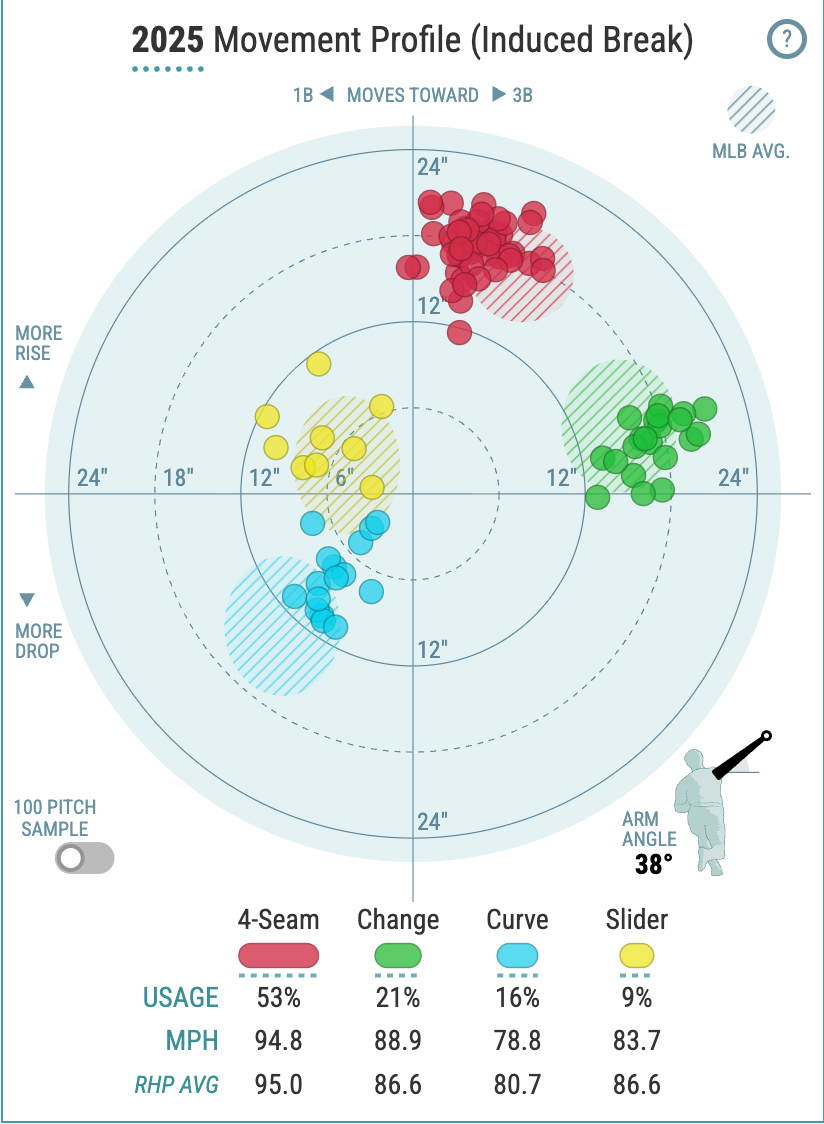
You can be sure that the Red Sox already know this about the right-hander, and you can be sure that it’s a reason they’ll try hard this winter to get Peralta into their building. There’s some tweaks to be made—his four-seamer was hit around at times in 2025, perhaps due to its gargantuan usage rate—but Peralta is as much of a “finished product” as you’ll find in a starting pitcher around the league. He’s got a diverse arsenal that he not only uses well, but knows well. You can sort of think of it like an esteemed golfer who knows his yardage amounts to the exact number. Peralta’s ability to avoid prolonged cold stretches on the mound is a direct result into the work he’s put into learning and growing his game.
Skubal has the reputation, accolades, and now the postseason success to put to bed any questions about his status as the best pitcher in baseball, save for maybe Paul Skenes. Greene has the velocity and flair to paralyze batters and electrify crowds, and his team control would make him an asset for years to come. Then, there’s Peralta, who has neither the Cy Young awards nor the team-friendly salaries (he’s a free agent after 2026) to justify a farm-system-depleting blockbuster trade. And yet, his talent and pedigree is unquestionable, which makes one question why the Red Sox wouldn’t prioritize adding him this winter.