
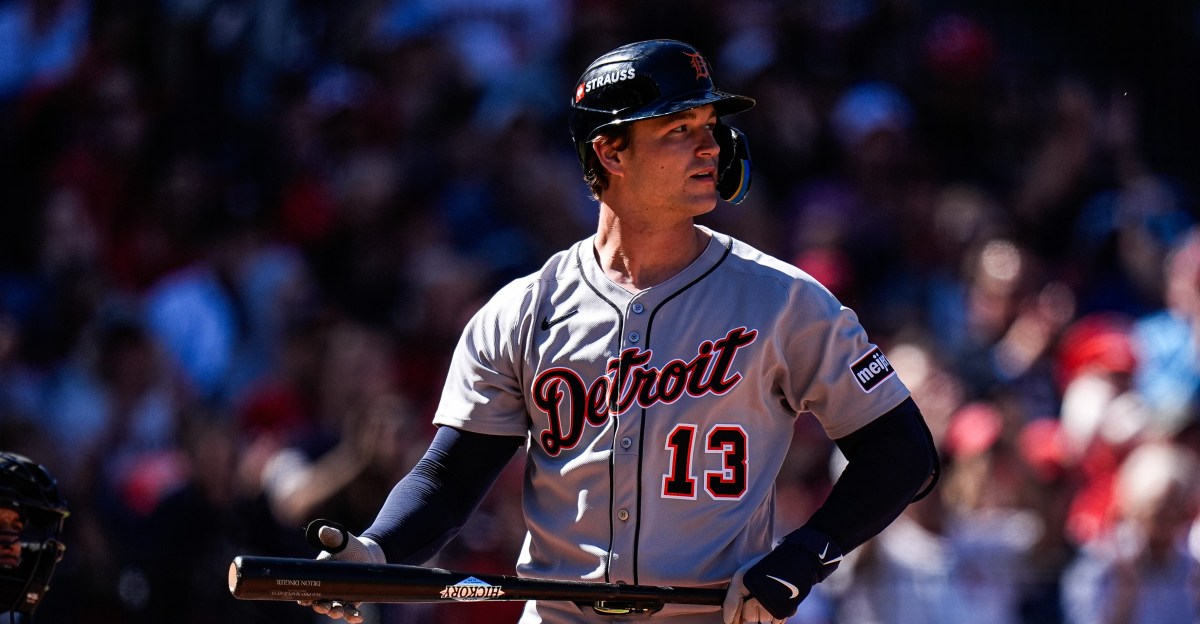
There are positives from the Detroit Tigers’ 2025 season that might be fleeting. Others look more foundational. One development in particular solidified the roster at the key position on the field for years to come. Dillon Dingler stepped up in a big way in his first full major league season, and the catcher position now looks to be in good hands for the long haul. The question is whether this was peak Dingler, or whether there may be a little more offensive production yet to come.
Dingler was the Tigers’ second rounder back in 2020 out of Ohio State, the same year that Spencer Torkelson was drafted first overall in the shortened COVID season draft. He quickly developed into a fine defensive catching prospect, and his raw power and fastball hitting ability excited prospect watchers as he quickly reached Double-A in 2021. Then he spun his wheels there for two seasons. The better command and better breaking stuff he saw really tied him up at the plate, and his production stagnated against the better competition at that level.
Entering 2024, positive scouting reports on Dingler had cooled. There was no question about his defense. His pop times were good and his arm strength and accuracy were checking in near elite levels. His framing and blocking were crisp, and he’d developed into a team leader trusted by his pitchers. The struggle to improve his swing decisions was the problem Dingler didn’t have an answer for despite hitting for some power. A tough introduction to Triple-A late in 2023 didn’t calm any fears.
The breakthrough started in 2024, when Dingler finally showed a major improvement in recognizing breaking stuff and started mashing his share of sliders, sweepers, and curveballs in the zone, while laying off more of the breaking balls down and away that pitchers had been working him over with the past two seasons.
His wOBA at the Triple-A level went from a .169 wOBA with a 46 percent whiff rate against breaking balls in 2023, albeit in a small sample, to a well above average .374 wOBA with a 30 percent whiff rate against breaking stuff in 2024. Along with his continued success against fastballs, this was Dingler breaking out just as prospect followers really started to worry that he never would. Called up for his major league debut two months before his 26th birthday after the Tigers traded Carson Kelly at the 2024 trade deadline, Dingler was a bit of a late arrival and he got off to a rough start against major league pitching. There was little to suggest how completely he would take over the starting catcher role in 2025.
It was already well established that Dingler was a very good defensive catcher. Even at the Double-A level he stood out above even the best backstops in the upper levels of the minor leagues. The questions were always about the bat. It’s interesting to see how prospect reports projected his future value now that the defensive metrics all hold Dingler in such high regard. He drew 45/45+ future value (FV) grades almost exclusively over the last few years. He was valued as a future part-time catcher with a little power and solid defensive abilities. As it turns out, Dingler is proving to be an average or better player just on the basis of his defense alone. All he had to do was hit enough to be playable on a regular basis.
This season he finally added the offense. Jake Rogers’ early season injury opened the door, and Dingler walked through it and didn’t look back. He posted a 109 wRC+ with 13 home runs while handling the brunt of the workload behind the plate and playing 126 games. Per FanGraphs WAR calculation, Dingler was the fourth most valuable catcher in baseball this season. He was the 11th most valuable hitter among catchers with 400 plate appearances or more.
That was all very positive for the Tigers. Dingler put up 4.1 fWAR in value. He caught three-quarters of the Tigers games this season and held up well, putting up a decent postseason at the plate with some key hits despite hitting just .167 in October. His 13.9 percent walk rate in the playoffs showed him actually putting the Tigers’ mantra about controlling the strike zone into practice on the game’s biggest stages. Let’s hope he can do that more during the regular season next year, because better swing decisions are his key to sustainably above average offensive production.
All this was capped off by Dingler’s first nomination as a finalist for a Gold Glove award last week. We won’t find out if he takes home the award until November 2. Alejandro Kirk and Carlos Narvaez are the other AL finalists at the position.
Dingler was tied for third in the major leagues in blocks above average this year. He and Cal Raleigh were tied at 5th best in framing. And the Tigers’ backstop continues to do a fine job controlling the running game. He was tied for eighth in caught stealing above average, as well, and the Dingler to Javy Báez connection cutting down runners at second base was a lot of fun to watch.
So it was a very positive season for Dillon Dingler. The Tigers have one of the best defensive catchers in the game, and he held his own very well in the batter’s box as well. Dingler won’t be arbitration eligible until 2028, when he will be 29 years old. He won’t be a free agent until 2031. It’s too bad that it took him so long to break through, as the Tigers may only going to get a few prime years out of him before he gets into his 30’s, but his defensive ability should continue to provide good value throughout the length of his team control with the Tigers.
Now the trick is building on 2025, because there are still some underlying signs that his offensive jump this season will be difficult to sustain.
Dingler improved his walk rate to 4.9 percent this year, after a truly grisly 3.4 percent mark in 2024. That’s still a long way from the consistent 10-11 percent walk rates he posted in the minor leagues. He chased out of the zone 30.4 percent of the time this year, while the league average rate was 28.1 percent. He also took a higher percentage of called strikes than league average, though again only two percent worse than league average. Those marks are going to have to improve a little for this level of production to hold up. Dingler’s swinging strike rate was league average, so he’s not just up there flailing, but the swing decisions have to keep getting better to sustain his 2025 offensive production.
They key indicator that there is still work to be done comes from his batting average on balls in play. Dingler took advantage of a .345 BABIP mark this year that helped him to a .278 batting average. That countered the lack of walks to produce a roughly league average on-base percentage of .327, but that isn’t very sustainable. The league batting average on balls in play was .291 in 2025.
Dingler does have some traits that can sustain a consistently above average BABIP. His hard hit rate was 4.7 percent above average using Statcast’s hard hit rate metric. He also typically hits a league average or better amount of line drives, which go for hits far more often than ground balls or fly balls. His 28.2 percent line drive rate is well above the league average of 19.7 percent, and he also produced less ground balls than league average by a significant margin of 5.9 percent, which helps his case. It doesn’t hurt that he can run either, putting up roughly average sprint speed marks.
For some context, batting average on all ground balls in the major leagues this season was .249. On line drives, that league batting average was a whopping. 628 batting average. On fly balls, with pop-ups on the infield excluded, league batting average was .261.
So, Dingler’s hard hit rate and batted ball distribution argues that he should run higher than average BABIP marks, but only if he can continue putting up those high line drive rates. That may prove difficult, and it will take time to see if it plays out that way or not.
So, expect some modest regression in the batting average department next season. The trick is to take his walks more often while continuing to hit for a good amount of power. He’ll sustain a very solid on-base percentage and hit for a good amount of extra base hits and home runs again. If he can take that step forward with his swing decisions, he should also start hitting for a little more power. Those will balance out a likely decline in batting average.
At this point, I think Dingler is basically a lock to be a 2-3 fWAR catcher for the next few years. The defensive skills give him an extremely strong floor to work with. There are still some weak points in his offensive game that were smoothed over in 2025 by a BABIP that will probably decline somewhat in 2026, but even so he hits the ball hard and a lot of his contact is on a line or in the air, giving him the best chance of hitting for good average and power numbers.
Dingler was essentially a rookie this year. He’d never caught more than 100 games in any minor league season, but this year that mark rose to 118 games behind the dish. That’s a big jump in workload at the game’s highest level, and he carried it through with a very strong performance in eight postseason games. There’s a learning curve at each successive level of the game, and at each level there is an increase in workload as well. Dingler handled it all very well and there was an awful lot on his plate in his full season debut. If there’s a reason for further optimism, it’s that he should finally be settled in at the major league level and more familiar with the pitching and with teams plan of attack against him now.
So, if Dingler’s swing decisions improve a little and he can take a few more walks, he should be able to counteract any drop in his BABIP. That would keep him in 4 WAR territory going forward, and the Tigers will be in outstanding shape at the catcher position for at least the next few seasons. If he can’t? Well he’s still one of the most valuable defensive catchers in the league, and the drop in offensive production shouldn’t be too steep.
It took a long time to get here, but Dillon Dingler finally seized the reins at the catcher position in 2025. His emergence solves a key roster question for the foreseeable future, and gives the Tigers a foundational piece to continue building the team around.