
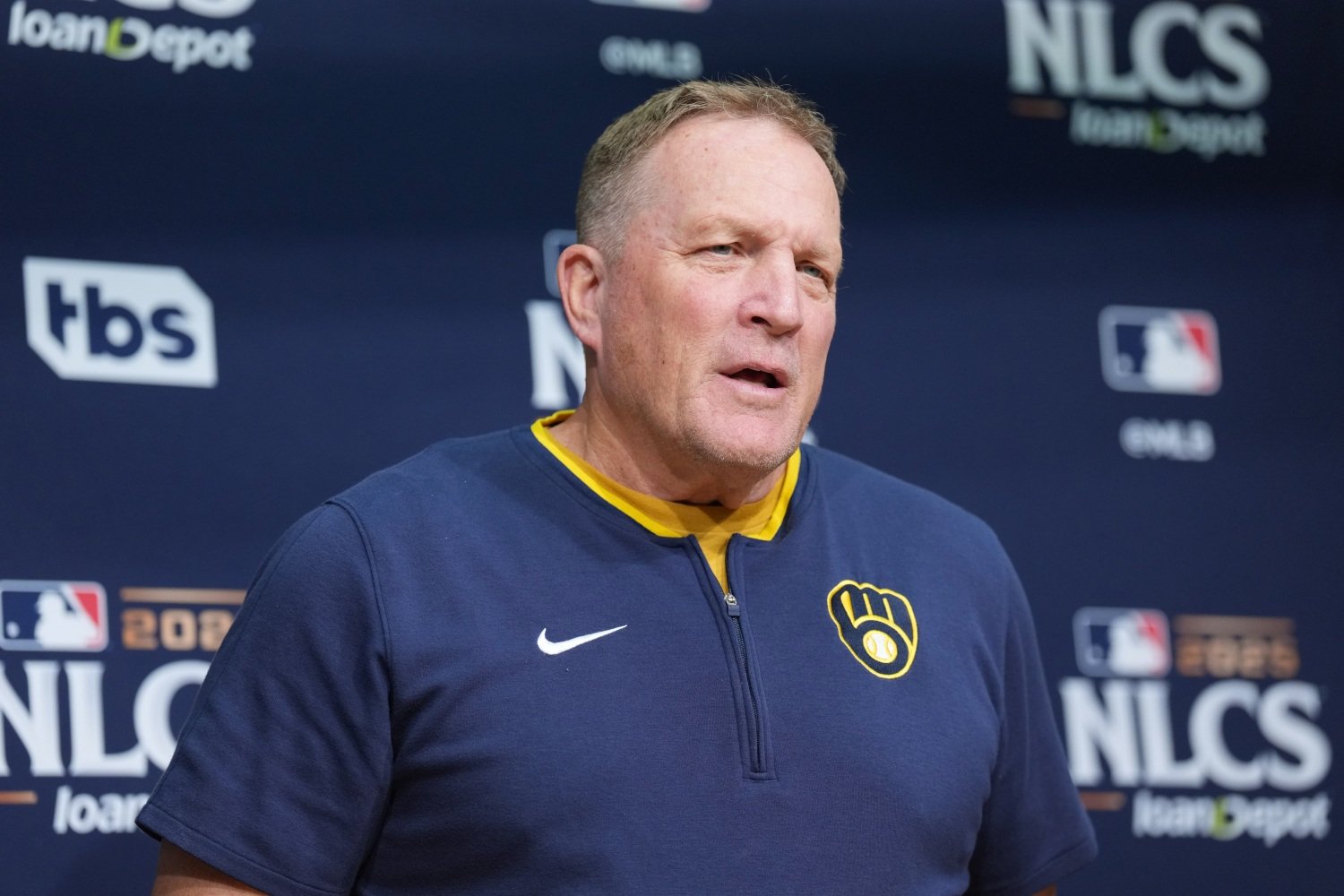
A week after their season ended with the Dodgers unceremoniously sweeping them out of the NLCS, Pat Murphy and the Brewers are in the reflection stage.
“There’s definitely things to take note of,” Murphy said at a season-ending press conference on Thursday. “The day that we lost in Los Angeles, that was my first day of notes—‘postseason recommendations,’ like, ‘what are things that are apparent here?’”
Most apparent was that Milwaukee didn’t just lose the series, but rarely looked competitive throughout those four games. Even though Dodgers starting pitchers would have been tough on any offense, the Brewers could have averaged more than one run per game. Instead, they bore little resemblance to the scrappy group that clawed its way to October’s top seed with the best regular season in franchise history. They looked overmatched, but what’s more, they looked worn out.
“We didn’t put our best foot forward,” Murphy said. “But there’s all sorts of things to learn from it about, how do we get them playing consistent?”
One of those potential lessons—and a topic the Brewers must at least discuss over the winter—is enforcing stricter workload management.
There were signs that the group was wearing down in the regular season’s final weeks, mainly on the positional side, but also in the bullpen. Several Milwaukee hitters saw their average bat speed decrease in September. Abner Uribe, who was one of eight relievers to pitch in at least 75 games this year, lost a couple of ticks of velocity.
Timely home runs and big pitching performances by Jacob Misiorowski and Chad Patrick carried the Brewers through the NLDS in five games, but Murphy acknowledged before the series finale that his players were “pretty drained,” both physically and mentally. While no team is playing at 100% nearly 170 games into the year, he said on Thursday that it continued into the next round.
“I think the Cubs series just emotionally took so much out of them, and then to have to come back the next day and play was difficult on the guys,” Murphy said. “But that’s another learning situation for us, so here we go.”
While he made more attempts to ease workloads leading into the playoffs, Murphy has been unafraid to push the envelope to win the game in front of him each night, including early in the season. When William Contreras and Sal Frelick fought to remain in the lineup each night while battling hand and knee injuries, he typically obliged. The same was true of Uribe, Nick Mears, and later Aaron Ashby, even as they racked up appearances and innings at unsustainable rates.
“Do we know for sure that if Contreras caught 10 [fewer] games, we would have been better [in the playoffs]?” Murphy asked rhetorically. “No. But it speaks to the fact of how big of a grind it is, especially when you play like we play.”
To his point, it’s impossible to say how much those earlier workloads affected the Brewers come October. The reality, though, was that the well ran dry nearly two weeks before the World Series, the endgame of the franchise’s competitive aspirations. The way they play and how much they play throughout the regular season seemed to be contributing factors.
“We have a bunch of guys that are, for lack of a better term, overachievers, guys that play above their physical talent,” Murphy said. “Is there something about that that crushes them after a while? They play so hard. A [Caleb Durbin], a [Brice Turang], a Sal—is there something to that, that we need to protect them, that they’re a little bit fragile while they’re young? Do we need to schedule the off days differently?”
Murphy’s answer to that question suggested that he remains wary of toning down the aggressive approach that led the Brewers to division titles in each of his first two seasons at the helm.
“I hate to lose that ‘win tonight’ mentality, or show them any signs of not trying to win tonight,” he said. “I think that hurts your team more, and you could end up sitting at home because you’re going to rest guys when they’ve got a lot of fuel left in the tank.”
There must be enough fuel left in October, though. It’s a challenging balance to strike, but part of the job nonetheless. Whether the adjustments are physical, mental, emotional, or all of the above, the Brewers must leave their players better equipped to play deep into the fall next year.