
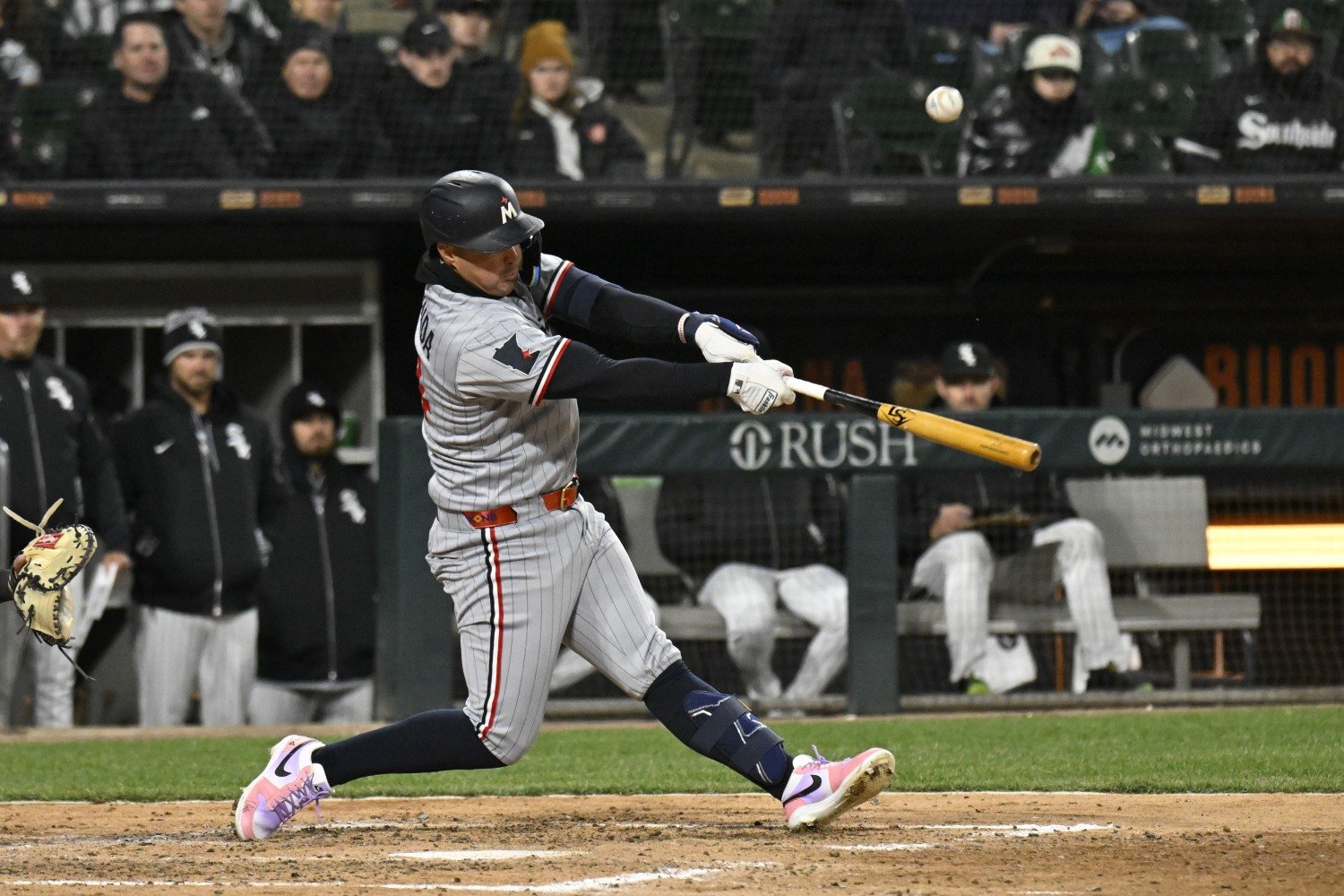
He’ll be out of options next spring, and the 40-man roster carousel might toss Jose Miranda off and into the waiver-wire Tilt-o-Whirl soon, anyway. However, one common mechanism of offseason roster churn won’t affect the Twins infielder: arbitration eligibility, and the mid-November non-tender deadline.
Miranda, 27, finished the 2025 campaign with 2 years and 135 days of official big-league service time, according to Cot’s Contracts. That’s almost exactly the likely cutoff for Super Two eligibility this winter, based on a Twins Daily review of eligible players. However, Miranda himself can’t benefit, even if he noses over the line. No matter where the cutoff line falls, Miranda won’t have been part of the calculation thereof, and he won’t be eligible for arbitration this winter.
As a quick refresher, all players with between three and six years of MLB service time (who haven’t already signed multi-year contracts) are eligible for salary arbitration each offseason. In addition to that group, 22 percent of the players with at least two but less than three full years of service (a full year, for the purposes of this question, constitutes 172 days on a big-league roster) also qualify, under what’s called Super Two status. Those players get a fourth year of arbitration eligibility, should they stay under team control throughout that entire span.
However, there’s an important second qualifying factor to become Super Two-eligible, or even to be considered in the class of players from which the Super Two players are drawn. It’s not all players between two and three years of service who qualify, but all those who also got at least 86 days of service during the previous season. That turns out to be an important caveat. There are roughly 180 players who sit between two and three years of service heading into this offseason, but only about 160 of them meet the second criterion. The Super Two cutoff will be determined by looking only at that group of 160—and anyone who didn’t get at least those 86 days (half a year) of service in 2025 will neither be eligible for arbitration nor part of the denominator that decides who is.
Thus, Miranda is on the outside looking in, even if the cutoff line falls below 2.135 years of service. He only got 17 days of his total service time this year, in that calamitous start to this season. After that, the Twins optioned him to Triple-A St. Paul, where he subsequently got hurt and played so badly that he never made it back to the big-league team. The Twins will have the option of renewing his contract for 2026.
On balance, this isn’t likely to keep Miranda with Minnesota. He still used up his final year of optionability in 2025, so to keep him into next season, the team would have to carry him on the big-league roster. That decision could theoretically be delayed until next Opening Day, but the team has to add several players to their 40-man roster next month to protect them from the Rule 5 Draft in December, and Miranda could easily lose his spot during that churn. What it does mean, though, is that the team will have no financial incentive to jettison Miranda, and that keeping him is one extremely low-cost, relatively low-friction way to go into spring training with one more option to evaluate at first base.
Two other members of the 2025 Twins (although not ones who overlapped with Miranda on the major-league roster) are affected, in some way, by the same rule, and by Miranda’s exclusion from the sample of players who could be Super Two-eligible. Thomas Hatch, who spent the final two months with the team and has 2 years, 98 days of service to his name, didn’t get over the 86-day threshold, either. He wasn’t all that closer to qualifying for Super Two status, but the fact that he only got 66 days of service in 2025 means he won’t be one of the players in the pool from which Super Twos are culled.
Kody Clemens, by contrast, got a full year of service in 2025 and enters the offseason with 2 years, 134 days in total. That will likely flirt with the line, but fall just short of it, according to the same review of eligible players. Miranda missing out helps the cause of the man who replaced him, but there are more guys like Hatch (with relatively low numbers of days beyond the two-year threshold) than like Miranda in the pool of players who are eliminated by not having gotten enough experience in 2025. Three players (Lucas Erceg of the Royals, and Patrick Bailey and Ryan Walker of the Giants) have 2 years, 136 days of service; the line is likely to fall right below them and cut Clemens out of the money.
That would be a nice (if small) break for the Twins, who would save just under $1 million on Clemens’s salary if he doesn’t qualify for Super Two status. It doesn’t change the fact that Clemens is also out of options, and the team could still elect to part ways with him this winter, but it would make it much easier for the team to keep him, even under extremely tight payroll constraints from ownership. Right now, though, it’s just a projection. If the line does fall at 2.135 years of service, it would hold with a trend from last year, when the cutoff came in at an unusually high 2.132—but it would also be the highest the line has been since 2012, when the rules made fewer players eligible.
One way or another, it’s likely that Miranda ends up on some other team (or playing in Asia or Mexico) next spring. When looking ahead at the team’s offseason, though, it’s helpful to know that the Twins won’t have to weigh the question of whether to tender him a deal for the purposes of arbitration. If he does return to Fort Myers in February, it will be on a contract worth something very close to the league-minimum salary.