

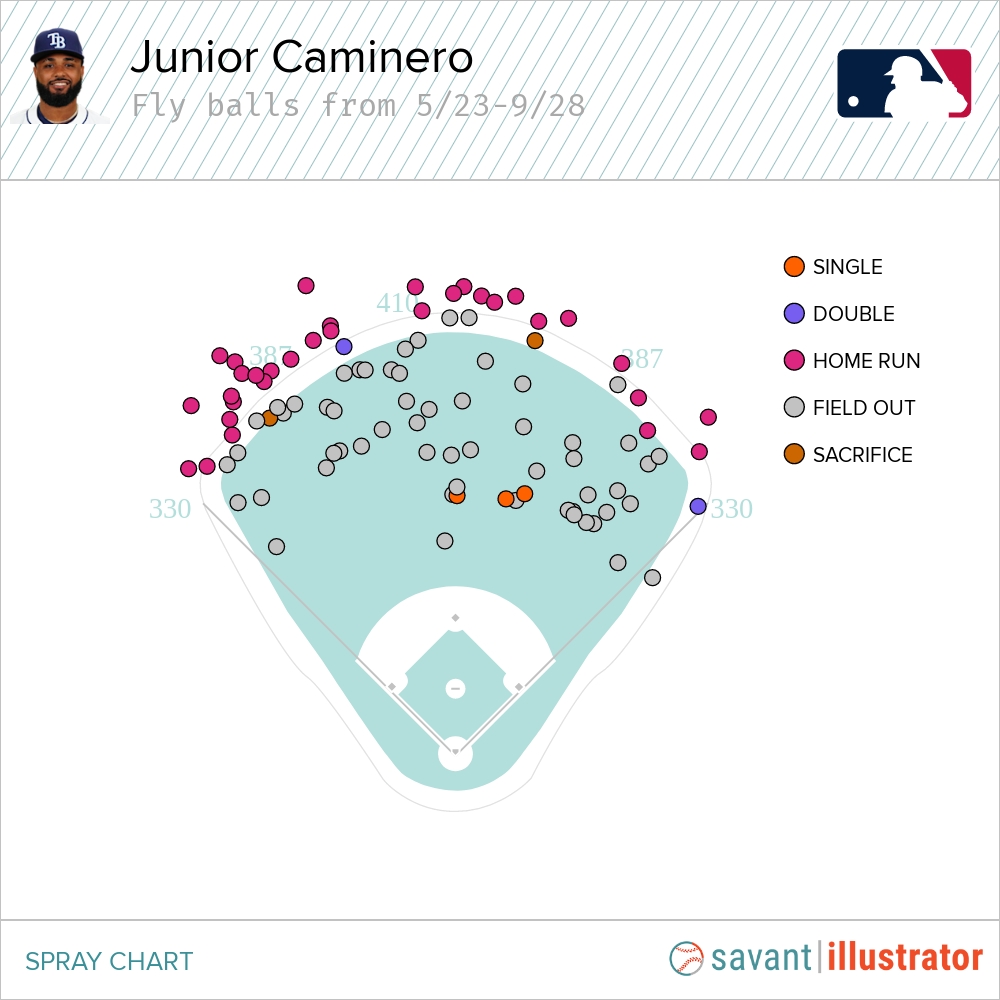
 via Baseball Savant
No matter how much power you have, pulling the ball always matters. Caminero’s average exit velocity went from 95.4 mph before May 23 to 97.1 mph after. His pull rate on fly balls went from 27.6% to 37.5%. The latter of those two numbers played an essential role in his near 10% increase in HR/FB% before and after this span.
Across Major League Baseball, any fly ball that is hit to the pull side is 30% more likely to be a home run than a fly ball hit straightaway or to the opposite field. Although Caminero is capable of hitting for power to all sides of the field, he too benefits from pulling the ball in the air as much as possible.
The changes he made to his stance throughout the season allowed for this increase in pulled air rate, propelling his numbers to where they ended up.
No Easy Path for Pitchers
With the widespread attention Caminero received as a prospect, the book was out on him very quickly. In 2024, he was thrown more sinkers than four-seam fastballs. This isn’t usual, but Caminero didn’t make it hard to see why.
Caminero by Pitch Type (2024)Pitch %AVGSLGWhiff %Run Valuesinker24.2%.175.20022.7%-6four-Seam Fastball21.1%.361.77822.1%4
To see more sinkers than four-seamers is uncommon. For a hitter to whiff more against sinkers is near unheard-of.
Caminero had no answer for the two-seamers he was seeing, reflected both in his numbers against them and in his high ground ball rate. He did, however, crush four-seamers. His dominance against them made it inevitable that he would not only see that many sinkers, but that those sinkers would be so effective.