
Monday night, there were nearly seven hours of baseball displayed before us to enjoy, get wrapped up in, and contemplate its analogies to real life.
There’s something uniquely un-American about baseball, which is ironic when you consider that the sport always billed itself as “America’s Pastime.”
Twenty-first-century America is not about contemplation or anticipation. It is about action. And the more decisive the action, the better it is. A jump shot from 10 feet out may be worth just as many points as a dunk, but LeBron James coming down from the top of the key and jamming it home will make the ESPN highlight reel.
The line on baseball, especially since the 1960s and 70s, is that it lacks drama. Or to be more specific, it lacks the immediacy that other sports, such as basketball, offer. In its own way, baseball is more like, I shudder to say, soccer than it is anything American.
What’s the main complaint about soccer? That there’s aimless running around and passing back and forth with no visible reward for all that expended activity? Baseball has two guys throwing a combined 200 pitches with maybe 10 or 11 hits and four or five runs given up between them. There’s not a whole lot of reward in that, either.
I’m told that’s not the point in soccer. And it’s definitely not the point in baseball — a sport that is rich in drama, but drama that is often harder to find and even harder to define.
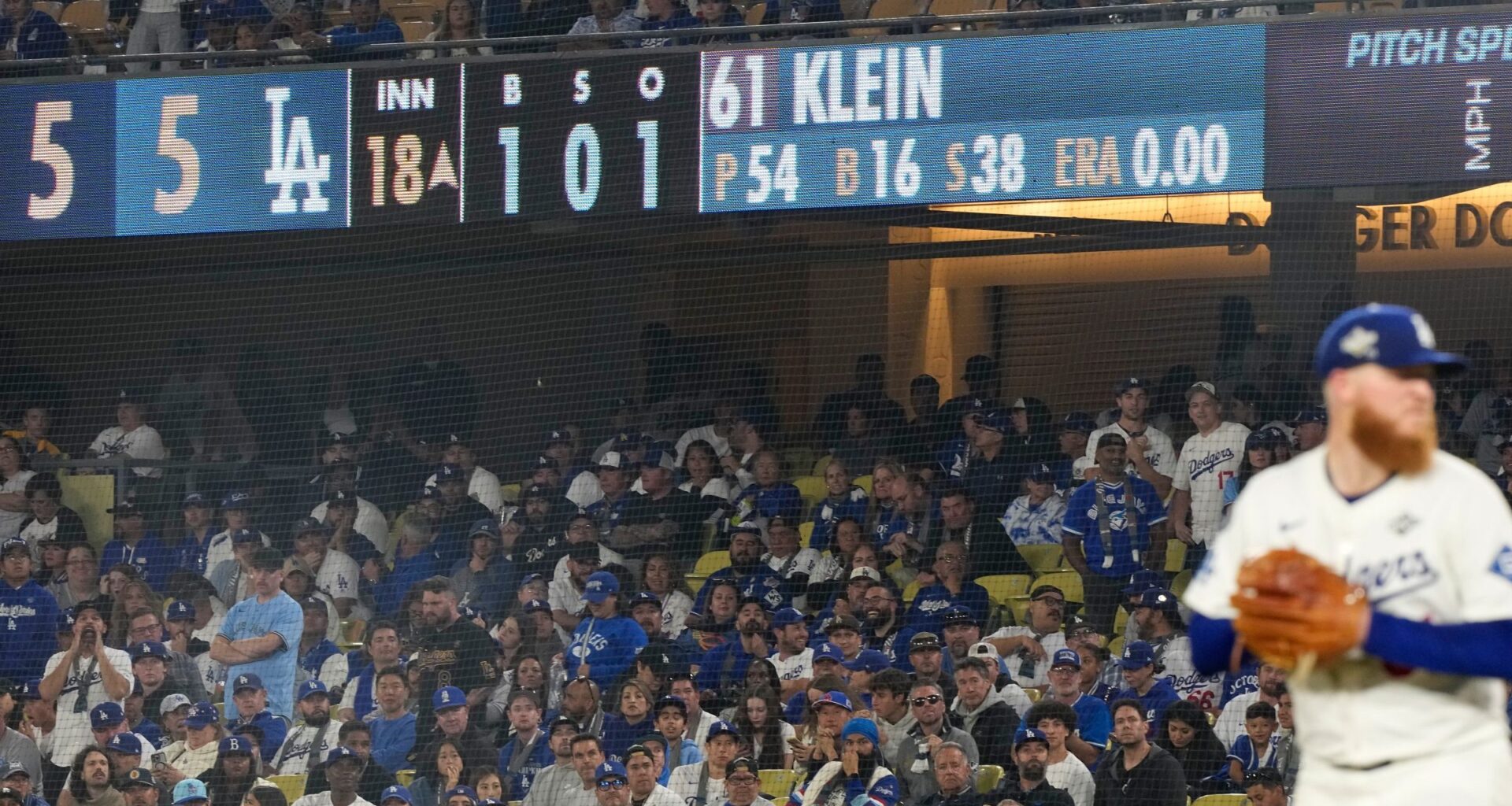
In baseball, the drama is in the anticipation rather than the action. It’s often in the buildup, especially in a game such as Monday’s 6-5 18-inning World Series game that the Dodgers’ Freddie Freeman won with a walkoff homer. There were so many subplots to that game you could have tied yourself up in knots coming up with them.
Easy one: Teams don’t have an inexhaustible supply of pitchers, and pitchers do not have rubber arms. Both the Dodgers and Blue Jays were stretched thin by the 18th inning despite the day off Sunday. Los Angeles was down to its last reliever and the Dodgers were warming up Yoshinobu Yamamoto, who had thrown a complete game Sunday, to pick up Will Klein, who had gone four innings and thrown 78 pitches, both exceeding his limit.
Harder: Shohei Ohtani, who was on base nine times and hit two homers, was supposed to pitch Tuesday. THAT is a unique situation in Major League baseball, where the gap between every-day player and pitcher is not breached. How long was manager Dave Roberts going to let Ohtani stand up and accept intentional walks before he would be allowed to call it an “early” night and rest up for the next game?
What baseball may lack in slam dunks and bone-crushing collisions, it more than makes up in the suspense it often produces. If watching the NFL on Sundays is like seeing a slasher movie, watching baseball can be like viewing an Alfred Hitchcock thriller. There’s far less gratuitous gore, but it still leaves you on the edge of your seat.
The disconnect is that we’ve lost the patience in this country to stay with novels where the stories present themselves in more than hundreds of pages. Oh, we want to hear those stories. Novels still exist, and do very well. But studies have shown that longer, more involved texts are losing out to books that do not include details one might consider superfluous. You wonder, in today’s market, how “Moby-Dick” would have done. Never mind all that description about how to produce whale oil. Just tell me what happens to Ahab.
Perhaps I am old-fashioned. It’s quite possible that I’ve read too many John Irving novels. Irving compares himself with the likes of Charles Dickens as one whose novels are leisurely reads and that include the passage of time. They have many complicated subplots that are generally tied up neatly at the end. You cannot miss a detail in Irving’s books. That might be what I like most about them.
That’s baseball. Monday’s game ended, and all the anticipatory drama contained within it reached a wholly satisfying conclusion.
Especially since the Dodgers won.

Steve Krause is the Item’s writer-at-large. He joined paper in 1979 as a copy editor and later created a music column, called Midnight Ramblings, which ran through 1985. After leaving the paper for a year, he returned in 1988 as a reporter and editor in sports. He became sports editor in 1998; and was named writer-at-large in 2018.
Krause won awards for writing in 1985 from United Press International; in 2001 from the Associated Press; and again in 2020 from the New England Newspaper & Press Association. He is a member of the Harry Agganis Foundation Hall of Fame, a past winner of the Moynihan Lumber Scholar-Athlete Community Service Award, and was the 2012 recipient of the Jack Grinold Media Award for MasterSports, an organization that conducts high school and college coaches’ clinics. He lives in Lynn, is active on Facebook, and can be found on Twitter @itemkrause.