
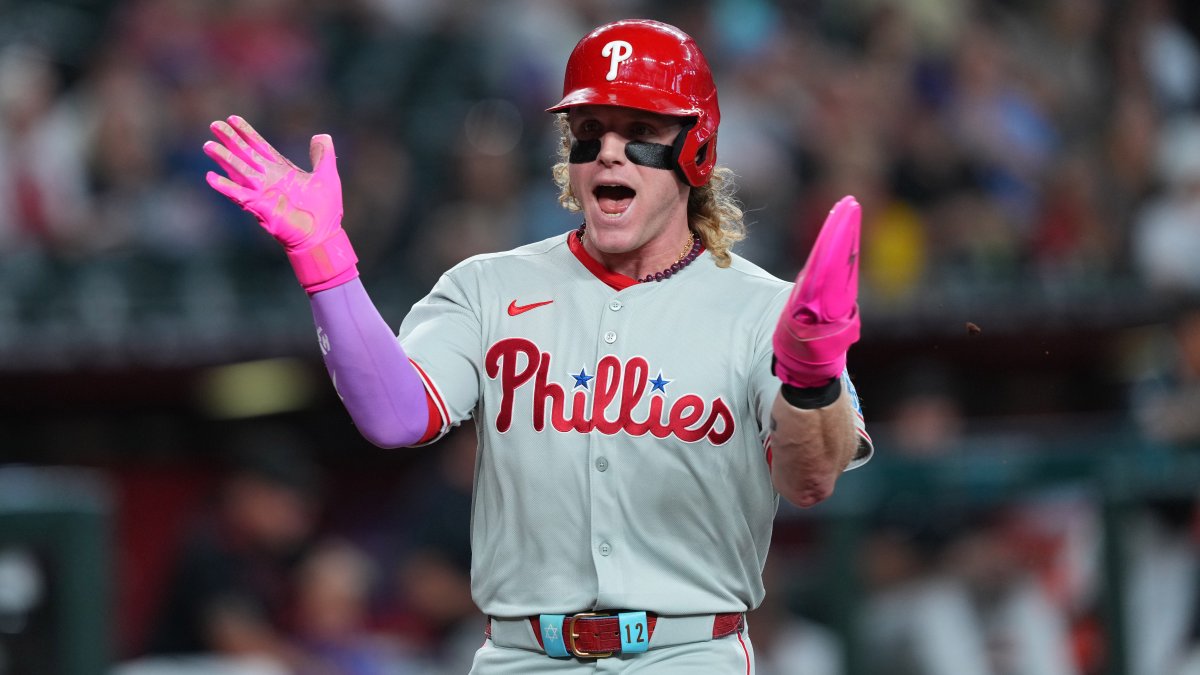
Kyle Schwarber, J.T. Realmuto and Ranger Suárez will dominate the Phillies’ offseason headlines, but Harrison Bader belongs in that same conversation.
After arriving at the trade deadline, Bader became a jolt of energy in a clubhouse already built to contend — turning in one of the best stretches of his career and forcing Philadelphia to think hard about its future in center field.
His (short) tenure in Philadelphia
The Phillies had one of the most productive Trade Deadlines in baseball, adding Jhoan Duran and Bader in separate deals with Minnesota.
And Bader’s impact was strong on both sides of the ball.
His 2025 campaign ranked among the most complete of any outfielder: 4.2 WAR (13th best among OFs), career highs in batting average (.277), on-base percentage (.347), slugging (.449) and OPS (.796), along with 17 homers and 54 RBIs.
After the trade, Bader starred in red pinstripes. In 50 games with the Phillies, Bader hit .305 with a .361 OBP and .463 slugging, giving Rob Thomson a reliable spark atop the lineup — especially when Trea Turner missed time — and steady defense in center.
“I think he made some adjustments prior to this year, and that gave him a better offensive year,” Phillies manager Rob Thomson said at the end-of-season media availability. “I’m banking on him continuing to maintain or even get better.”
Phillies fans might remember Hunter Pence’s 2011 stint when he was traded over from Houston. Bader’s success was certainly reminiscent of Pence’s .324/.394/.560 slash line in Philadelphia that season.
The defense also remained elite in his ninth professional season. Bader posted 7 Outs Above Average (92nd percentile), sat in the 84th percentile in arm strength, and he continued to be one of the fastest players in baseball (85th percentile).
“Harrison Bader did a really nice job for us, too,” President of Baseball Operations Dave Dombrowski said. “He’s been exceptional in center field.
Unfortunately, Bader’s postseason was cut short after he experienced a groin injury in Game 1 of the NLDS, limiting him to pinch hitting opportunities.
Offseason outlook
The market for a player like Bader is certainly up for debate. While the peripheral numbers in 2025 jump off the page, the underlying metrics tell a different — and more negative — story.
Expected Batting Average (xBA): .229 (9th percentile)
Expected Slugging Percentage (xSLG): .383 (23rd percentile)
Average Exit Velocity: 87.2 mph (12th percentile)
Chase Rate: 32.5% (20th percentile)
Whiff Rate: 29% (22nd percentile)
Strikeout Rate: 27.1% (12th percentile)
The most concerning stats are the expected numbers, which are mostly calculated based on exit velocity and launch angle. Bader’s expected average finished 48 points lower than his actual, and his slugging finished 68 points fewer. The common evaluation based on actual and expected numbers, in Bader’s case, is that he experienced good luck at the plate. These are the numbers that front offices will use to judge Bader’s season.
His .796 OPS in 2025 was a sharp jump from his career .714 mark. One area of improvement was plate discipline — a 7.8 percent walk rate, his highest since 2019, but only in the 44th percentile of hitters.
It’s worth noting how his splits flipped too. From 2017 through 2024, Bader hit .239 with a .670 OPS against righties. In 2025, those numbers soared to .300 and .845. Thomson’s observation coinciding with Bader’s offseason training regimen aligns with that surge.
“He was really good — actually better against right-handed pitching than left,” Thomson said.
Postseason experience is hard to quantify in contract dollars, but Bader has that to his name. In 34 postseason games, the outfielder has posted an .818 OPS with five homers — each of those coming in the 2022 postseason.
The 31-year-old opted out of his mutual option to test free agency. Among this winter’s available center fielders — Cody Bellinger, Trent Grisham, Cedric Mullins and Luis Robert Jr. (if his option is declined or he’s traded) — few bring Bader’s right-handed bat and defensive floor. His volatility makes a long-term deal unlikely, but a two- or three-year contract is realistic.
Prediction
Bader ultimately signs a two-year, $26 million deal with the Angels, solidifying center field alongside Jo Adell and Taylor Ward. This gives Los Angeles more time to develop their top outfield prospect Nelson Rada — the youngest player in Triple-A baseball last year at 19-years-old. The Phillies’ hesitation to offer a second year at a higher average annual value becomes the deciding factor.
That leaves Dombrowski and his front office evaluating internal options — Brandon Marsh, Johan Rojas and prospect Justin Crawford — or exploring a trade for another right-handed option such as Luis Robert Jr. Either way, Bader’s likely short stay in Philadelphia left its mark — and raised the bar for whoever mans down center field in 2026.