
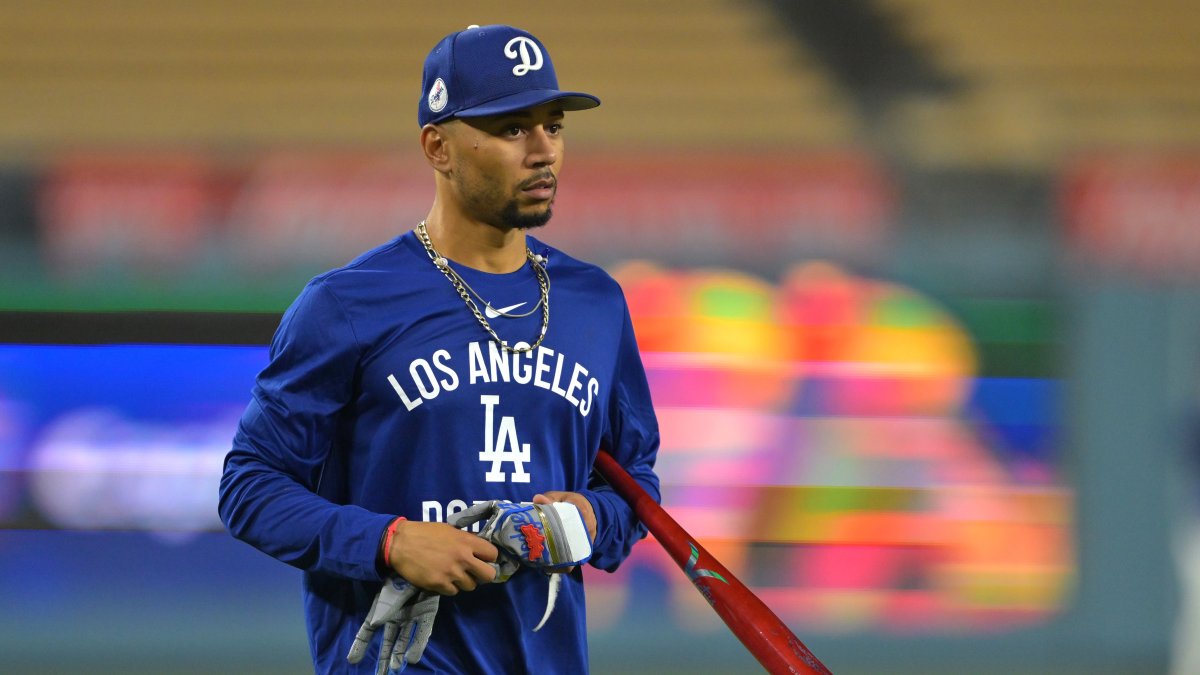
Look, there are some stories that nobody wants to write. There are some questions that nobody wants to pose. There are some topics that nobody wants to revisit.
Yet … there is one question that needs to be asked amid this World Series playing out between the Toronto Blue Jays and Los Angeles Dodgers. And it’s a simple one:
Is Mookie Betts cooked?
Some harsh phrasing, no doubt, but the man who could lay claim to being one of the very best all-around baseball players on Earth over the past decade is currently capping off the worst season of his career by looking worse than ordinary in the playoffs.
After posting a career-low .732 OPS in the regular season, he had a strong Wild Card Series (6-for-9, 1.700 OPS) before posting a .631 OPS in the divisional round and a shocking .478 OPS in the NLCS. He currently has a … surely this can’t be right … hang on … calculating … calibrating … a .361 OPS in the World Series.
He has three singles and three walks in 26 plate appearances, with no extra-base hits and no RBIs. He’s struck out five times, and one of his three walks was intentional.
In a series where Shohei Ohtani has a 1.395 OPS and Vladimir Guerrero has a 1.136 OPS and Addison Barger (who?!) has a 1.147 OPS, Betts is down with Isiah Kiner-Falefa and teammate Andy Pages as the least productive hitters.
You may have noticed the Blue Jays intentionally and “unintentionally” walking Ohtani five times in the 18-inning marathon in Game 3, a decision that brought Betts to the plate with at least one man on every time (except for when the Jays also intentionally walked Betts), and Mookie never made it hurt. That had been the case all night.
Betts came up in the first inning after an Ohtani leadoff double … and popped out to right field. Betts stepped to the plate after an Ohtani solo shot in the third and flew out to left. After an Ohtani RBI double in the fifth, Betts flew out to left. After Ohtani’s game-tying homer in the seventh, Betts struck out swinging. Ohtani walked in every plate appearance thereafter, and here’s how Betts followed: inning-ending foul popout, ground-ball single, intentional walk, fly out, and another inning-ending foul popout.
A cold streak? Maybe. An unfair five-game or even nine-game sample size? Maybe. A to-be-expected offensive drop-off after becoming a full-time shortstop for the first time in his adult life? Maaaaaybe.
Here’s what is known: Mookie Betts turned 33 years old three weeks ago and is turning in the worst offensive season of his MLB career. He also has seven years remaining on his contract at an average salary of about $28 million per year.
(His defense has been great, but the Dodgers didn’t give him $365 million to play solid defense at shortstop.)
All of which brings us to this uncomfortable question: Did the Red Sox actually get it right on Mookie Betts?
Of course — OF COURSE! — that is not to discount the previous five seasons, when Betts was a four-time All-Star, a two-time World Series champion, a four-time Silver Slugger, a two-time Gold Glover, and a two-time MVP runner-up. The Red Sox sure looked stupid during those seasons, as was expected.
And of course — OF COURSE! — this is not to excuse the return package in the infamous Betts trade of 2020, which was doomed from the get-go due to the inclusion of half of David Price’s remaining salary in the deal. There can never be any logical way to justify the return of Alex Verdugo, Jeter Downs and Connor Wong. (The fact that the return initially included Brusdar Graterol, who’s been good, only for the Red Sox to reject him after a physical, makes it even worse.)
It is, however, to say this: With Betts now being a 33-year-old who ranked 16th among shortstops in OPS this season, we are perhaps now seeing the vision John Henry had when he made the call that the Red Sox weren’t going to sign for the long term. (All due respect to Chaim Bloom, who was hired as chief baseball officer four months before the trade, but he didn’t quite have that kind of decision-making power upon taking the job. Executing the Betts trade was almost certainly a condition of taking the job at that time.)
As a reminder, the Red Sox reportedly offered Betts a 10-year, $300 million deal. Had he accepted that offer, the Red Sox would have gotten tremendous value in the first four years of the deal (2021-24) and would now be looking at five remaining years at $150 million. The Dodgers are currently on the hook for seven more years and $195 million.
The Red Sox surely could have used a player like Mookie Betts from 2020-24, when they went 353-355 with one playoff appearance and three last-place finishes.
Yet the idea — in theory, at least — is that by opting out of the end of Betts’ prime, the Red Sox now have close to $200 million to work with that would otherwise be tied up by Betts for his age 33-39 seasons.
Theoretically, that’s the idea. It could be disrupted by two things.
The first? Betts could go 4-for-5 in Game 6 in Toronto and then hit a World Series-winning Grand Slam in the eighth inning of Game 7, authoring the first line of his Hall of Fame blurb. If that all were to happen — and, honestly, it could — then surely anyone who wrote a story asking if the Red Sox made the right call on Betts would have to find a new profession. Understandable.
The other snag would (or will) come if (or when) the Red Sox don’t put that “saved” money to good use. Ditto for the more than $250 million “saved” by trading away Rafael Devers. It may not be a one-for-one equation, but generally speaking, that’s $500 million in extra money to spend on players from now through the early 2030s.
It’s up to Craig Breslow — with the blessing of Henry, of course — to actually spend that money on players who can lift the Red Sox to a point where they’re the ones playing at this time of year.
That part will have to play out. Whether or not they nail it — with Alex Bregman, Pete Alonso, Shane Bieber, Kyle Schwarber, Dylan Cease, Framber Valdez, Ranger Suarez and more high-priced options expected to be available — is a fair question. Yet whether or not they want to nail it and thus put forth the top-dollar offers to acquire those players should not be questioned.
The Red Sox have looked pretty good for letting the Padres give a mega-deal to Xander Bogaerts. And the Devers trade, despite very little coming back to Boston, somehow didn’t hurt the team too badly in 2025. The Betts trade has been an abject disaster for half of a decade, but the vision behind the philosophy of trading him may finally be taking shape.
That’s all well and good, if the Red Sox’ main goal was avoiding bad contracts. If they want to get back to winning World Series, it’s time to spend that money to elevate a team that proved it’s worth the investment.