
Craig Albernaz has been in the Orioles’ managerial role for mere days, and the next bad word anyone says publicly or privately about the club’s selection will be the first I’ve heard.
For many reasons, his was a hire that fits the Orioles’ vision for sustained success, and what we’ve learned since is that vision itself may look different than it ever has.
The departures of assistant hitting coaches Sherman Johnson and Tommy Joseph, and the associated uncertainty that surrounds hitting coach Cody Asche, feel significant in the context of what’s come before.
To the extent that the Orioles have had an identity since president of baseball operations Mike Elias and his group arrived seven years ago, a core tenet has been identifying high-caliber hitters early in the draft and developing them in a certain manner to get them to the majors.
Just last year they reshuffled the staff in an effort to refresh the message and keep that consistency. The idea of any kind of meaningful change never really crossed my mind then.
Now, they’re altering the staff again, and simply because it seems like there’s a chance for directional or philosophical change, it feels like a crossroads. Is this going to be another new set of chefs with the same menu, or is the flavor of the hitting program about to change?
The answer to that is the answer to so many other questions. It would answer the near-term question of what the plan is to get their homegrown hitters back to their best, and also have ripple effects across the organization, given the desire for consistency all the way down to the complexes.
The composition and direction of the major league hitting group might tell us more this winter than just about anything else.
And until we know the answer, the department is in a rare moment of uncertainty.
The faces have changed, but the whole program has basically grown naturally since the end of 2019, when Matt Blood was hired to run the player development apparatus. He brought in a group of young, progressive coaches to design the hitting program, and that process accelerated through the pandemic, with Anthony Villa and Ryan Fuller helping craft a program that produced countless top prospects through an emphasis on swing decisions as a way to bring about power production.
The results came quickly, and as the homegrown players climbed toward the majors, so did the leaders of the program. Villa became the hitting coordinator and is director of player development, while Fuller became co-hitting coach for the major league club ahead of the 2022 season alongside Matt Borgschulte.
Asche joined the organization as a coordinator with Villa in 2022, helping the upper-level players prepare for pitchers in the big leagues, then was offensive strategy coach alongside Fuller and Borgschulte for 2023 and 2024.
The connective tissue between the majors and minors was thick and intentional. The coaches who had helped so many Orioles draftees become top prospects — Adley Rutschman, Gunnar Henderson, Jordan Westburg, Colton Cowser and Jackson Holliday, to name a few — were now guiding them in the majors with a consistent message and an instructional approach based on their years of experience together.
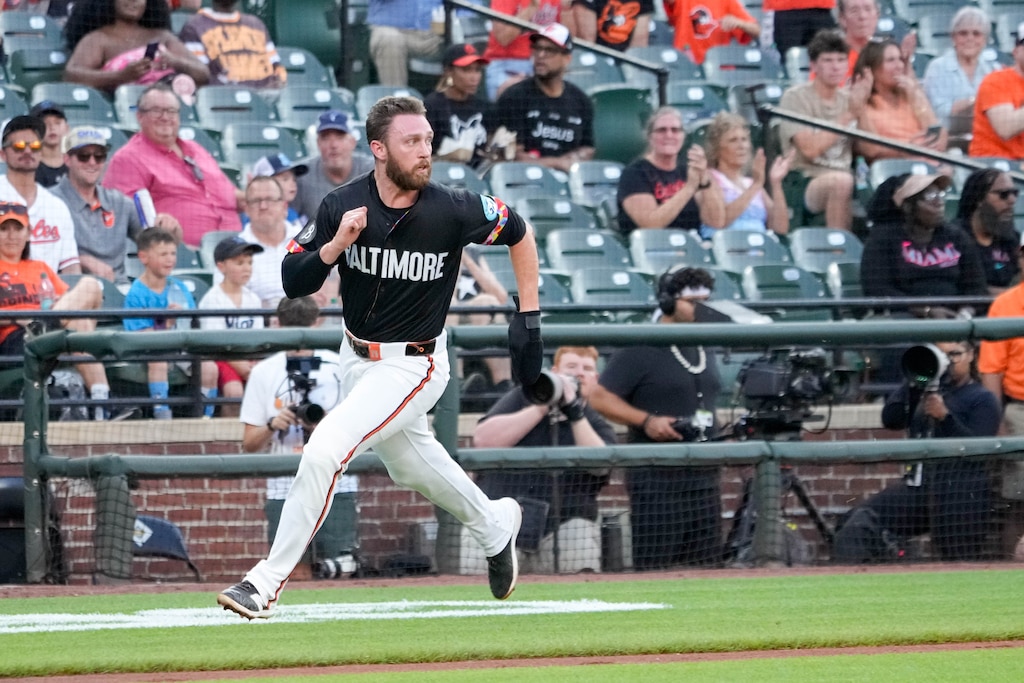
Third baseman Jordan Westburg is one of three products of the Orioles’ hitting program who has been to the All-Star Game early in his career. (Ulysses Muñoz/The Baltimore Banner)
The Orioles’ offense was a big part of their division title in 2023 and was among the game’s best in 2024 before a second-half swoon tanked their season — and brought about change.
Neither Borgschulte nor Fuller returned for 2025, both voluntary departures, and Asche was promoted to the top job. Johnson, a minor league coordinator who had a great rapport with the next wave of young hitters, came to the majors as assistant hitting coach alongside Asche’s former Phillies teammate, Tommy Joseph.
The hires made it clear the Orioles were still fully invested in their processes and philosophies. Asche said during spring training that little had changed from the previous year. The offense, however, never really got firing, thanks to injuries and regression from key players. We don’t need to recap all the reasons this season went badly, but the hitting coaches came under fire and now they’re turning over at least some of the group again.
Johnson took a job as a coordinator with the White Sox, where Fuller is director of hitting, but could have returned. The circumstances of Joseph’s departure aren’t clear. But whatever happens with Asche and how the staff is constructed for next year feels like a high-stakes proposition.
A complete new set of voices, and potentially new philosophies and priorities, would be the most significant admission of fault this organization has made yet. It would signal Elias’ soul-searching over what went wrong had a tangible outcome, and that they don’t think staying the course can get them where they want to go.
And yet, that wouldn’t be a consensus opinion internally if they strayed far from what they’ve been doing for years. Staying the course and mixing in some internal promotions with an outside voice who is aligned with the philosophies held dear here would make sense if they want to, but would be a little harder to justify, given how the last 18 months have gone. This wasn’t the best year for any of the Orioles’ homegrown hitters, but let’s not forget that Henderson, Rutschman and Westburg have been All-Stars.
Up and down the organization are hitters who can find the barrel consistently, elevate the ball at high exit speeds and control the strike zone. The Orioles draft players who can do one or two of those things in hopes of improving the others and making a complete hitter out of them. They’re pretty good at what they do, and many inside the organization haven’t lost sight of that.
They also haven’t had the offense they’ve wanted to for a full season and a half, and it takes a strong stomach and a high level of conviction to just ignore that and push on with what you’ve always done.
But it’s hard to imagine a true pivot from an organization led by this particular front office toward a traditional, put-the-ball-in-play approach, but that holds true for any club. Quality contact is a universal goal.
Every front office has data, and data shows hard elevated contact delivers the most runs over time, but there are different ways to get to it. The Blue Jays, for example, seem to have trained bat speed under new hitting coach David Popkins this year, and their offense has flourished because their players are hitting the ball harder. The Orioles’ means to hard contact has been swinging at pitches each individual can most consistently drive.
How the group of hitting coaches looks come spring training will tell us whether the whole operation has been scapegoated internally, or if it’s just fans who are scapegoating them out of anger at the club’s regression.
Whatever direction the Orioles go in, the reality is they have had really good hitting coaches over the last couple of years and the standard the outgoing coaches were held to was high because the organization did such a good job developing hitters over the years.
That’s not going to change in 2026 and beyond. But who they choose to meet that standard this year will speak volumes.