
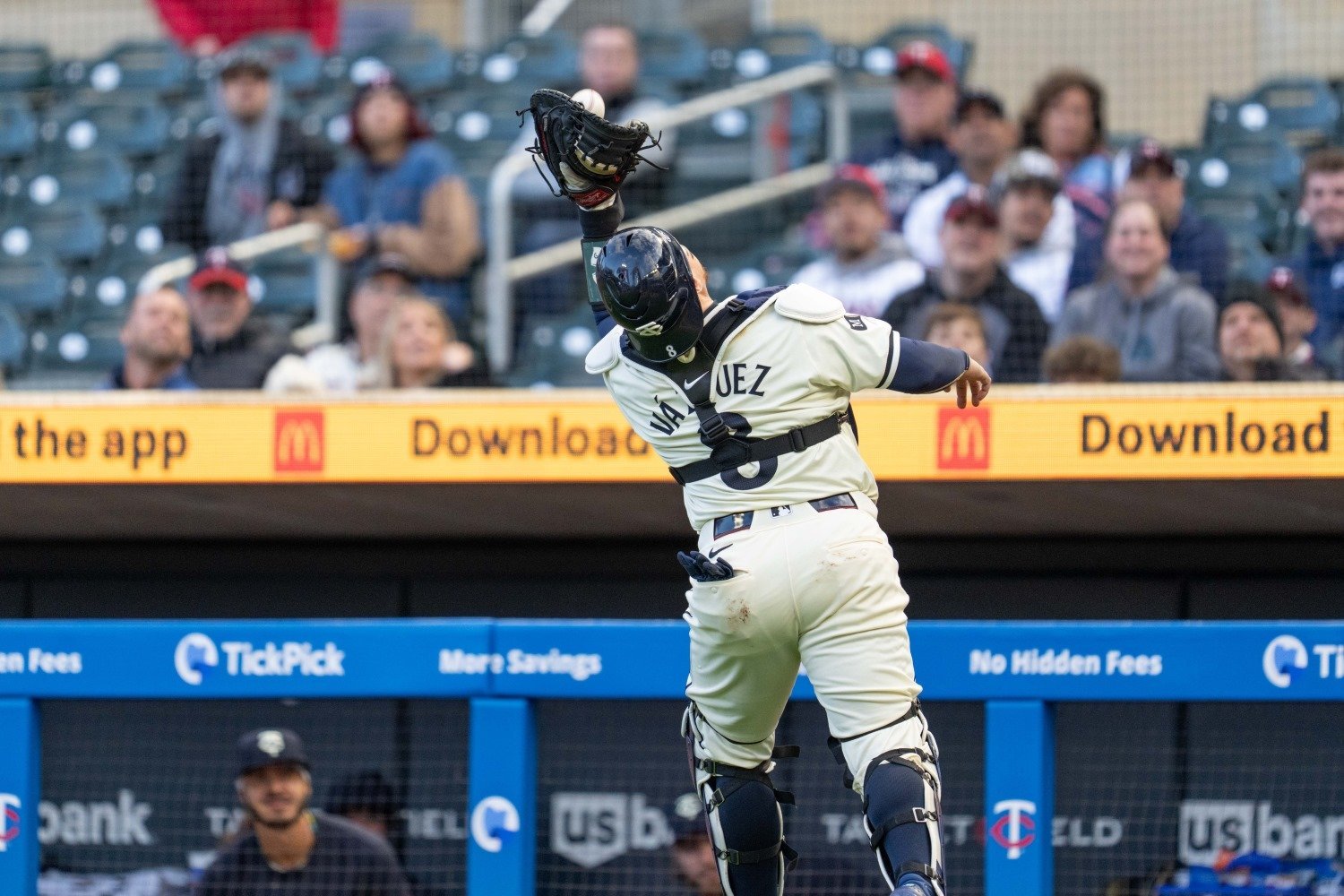
When the Minnesota Twins signed Christian Vazquez to a three-year, $30 million contract before the 2023 season, the move was meant to add experience and stability behind the plate. Ryan Jeffers was still viewed as a developing catcher with offensive potential, but he lacked the track record to be handed a full-time role. Vázquez, fresh off years of playoff experience with the Boston Red Sox and Houston Astros, seemed like the perfect complement.
However, the vision never materialized. Over the course of his Twins tenure, Vázquez’s offensive struggles outweighed his defensive reputation. He had an 85 OPS+ before signing with Minnesota, a reasonable total for a strong defensive catcher. During his Twins tenure, he posted a 58 OPS+, a total tough for a manager to continue to use.
Besides the non-existent bat, his defensive metrics declined more rapidly than expected. He ranked in the 75th percentile or higher in Blocks Above Avg, CS Above Avg, and Framing during the 2023 season. Last year, his CS Above Avg (68th percentile) and Framing (27th percentile) started showing his age.
Now, as Minnesota looks ahead to 2026, the question has come full circle. The Twins once again need to identify a reliable backup catcher. The irony is hard to ignore. After three years of trying to balance the position, the team could find itself revisiting the same name to fill that role once again.
Why the Twins Might Need Him
As things stand, Jeffers is the only established big-league catcher on the Twins roster. He continues to be one of the AL’s best-hitting catchers, but every team needs a dependable second option. Catchers wear down quickly, and even the best require regular rest to stay fresh over a long season. The Twins have used Jeffers and Vazquez in a timeshare behind the plate, and it seems likely that Vazquez will be used in a lesser role as he nears the end of his career.
The issue is that Minnesota’s internal options are thin. Mickey Gasper and Jhonny Pereda saw playing time over the season’s final weeks, but neither are a long-term solution. Other minor league options like Ricardo Olivar or Noah Cardenas profile more as Triple-A depth than reliable big-league backups.
That leaves the front office with two realistic paths: bring back Vázquez or find another veteran through free agency or trade. Both routes carry risk, but Vázquez’s familiarity with the Twins’ pitching staff could be a key factor. He has already worked with most of the projected rotation and bullpen. That experience could be especially valuable with young arms like David Festa and Zebby Matthews potentially taking on more significant roles.
What It Would Cost
At the time the Twins signed him, Vázquez was one of the best catchers on the market. Minnesota’s three-year, $30 million deal was one of the largest commitments ever made to a catcher in franchise history. The front office justified the contract by emphasizing Vázquez’s strong defensive resume, postseason experience, and leadership qualities. But those strengths have faded.
Now, the situation is very different. Vázquez is entering the next phase of his career, likely as a part-time or backup option. His offensive production has cratered, and most teams will view him as a low-cost signing rather than a potential starter. For the Twins, that could mean an opportunity to bring him back on a modest one-year contract (something in the range of $2–4 million) if both sides are open to a reunion.
This type of deal would align with the Twins’ payroll flexibility heading into the offseason. The team is expected to operate with a reduced budget so that every dollar will matter. A low-risk, short-term deal for a familiar veteran might be more appealing than spending resources on an untested free agent or parting with talent in a trade.
Freezer Burn and Familiarity
There is no denying that a reunion with Vázquez carries some baggage. Fans remember his underwhelming performance and may not be eager to see the team revisit a partnership that never quite clicked. The concept of “freezer burn” fits here, something that once seemed appetizing but didn’t age well over time.
Still, there is a case to be made for comfort and continuity. Vázquez’s knowledge of the pitching staff, game preparation habits, and familiarity with the Twins’ defensive system could all be helpful in a supporting role. His veteran presence might help guide younger pitchers as they transition into full-time major league contributors.
While there is little upside remaining in his game, there is also value in dependability. The Twins know what they are getting with Vázquez. He is a steady professional who can handle pitchers, call a game, and step in when needed. Sometimes, that predictability is worth more than taking a gamble on an unknown alternative.
The Decision Ahead
Ultimately, the Twins’ decision will come down to balancing comfort against opportunity. Bringing back Vázquez would offer stability, but it would also mean passing on the chance to try something new. The front office must decide whether experience outweighs the potential upside of a fresh face behind the plate.
If the price is right and the market remains limited, Vázquez could make sense as a short-term solution. His familiarity with the organization might help smooth the transition into another season of roster turnover. However, if Minnesota prefers to move in a new direction, there will be veteran catchers available through free agency who could fill the role just as effectively.
Either way, the Twins cannot afford to enter next season without a dependable plan behind Jeffers. Whether that means turning back to a familiar veteran or exploring a new path, the backup catcher question remains one of the quieter but more important decisions of the offseason.
Should the Twins consider bringing back Vázquez? Leave a comment and start the discussion.