

During Bruce Sherman’s ownership tenure, the Miami Marlins have never approached an offseason with the explicit purpose of constructing a playoff-caliber team. Given the quality of their performance at the end of 2025 and the opportunities that will be available to reinforce the roster without breaking the bank or mortgaging too much of the future, it’s time for that change.
In what has become an annual tradition, I’m imagining how the Marlins offseason would go if I were in charge of baseball operations.
There is no new reporting in here, to be clear. I have devised this blueprint based on my understanding of the organization’s roster construction philosophy, minor league depth and broad goals for next season and beyond. However, Fish On First cannot confirm whether any of the following hypothetical free agent signings, trade acquisitions or contract extensions are being considered by Peter Bendix’s front office.
Post-World Series roster crunch
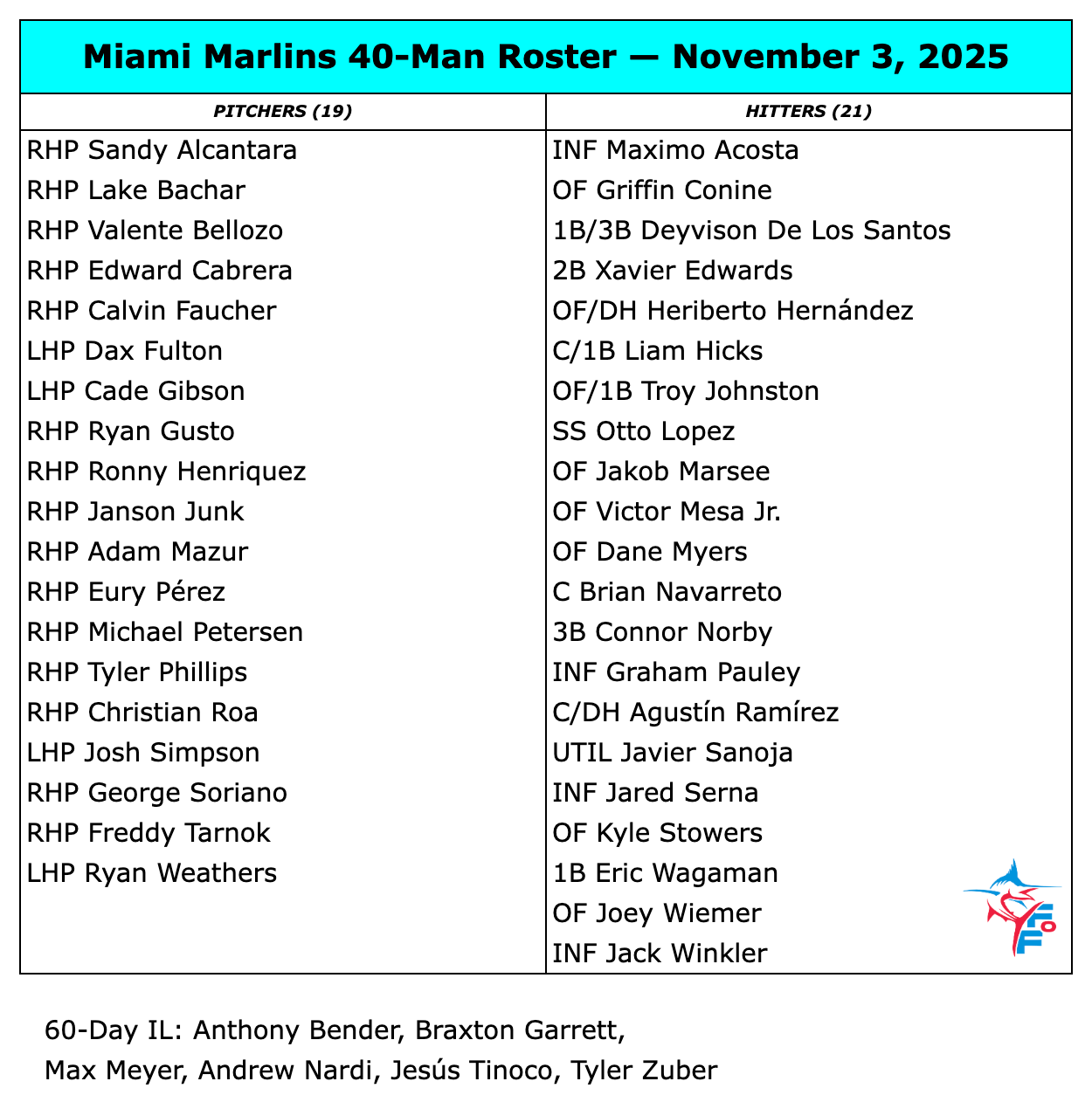
Within a couple days of this article’s publication, the Marlins will make real-life roster moves in order to reinstate players who finished the 2025 season on the 60-day injured list. Their 40-man roster is full before even accounting for these players. Within a couple weeks of that, they will select at least one (likely multiple) prospects to the 40-man to protect them from the upcoming Rule 5 draft.
What would Ely do?
Marlins waive LHP Andrew Nardi, RHP Christian Roa, LHP Josh Simpson, RHP George Soriano, RHP Jesús Tinoco, 1B Eric Wagaman, OF Joey Wiemer, INF Jack Winkler and RHP Tyler Zuber
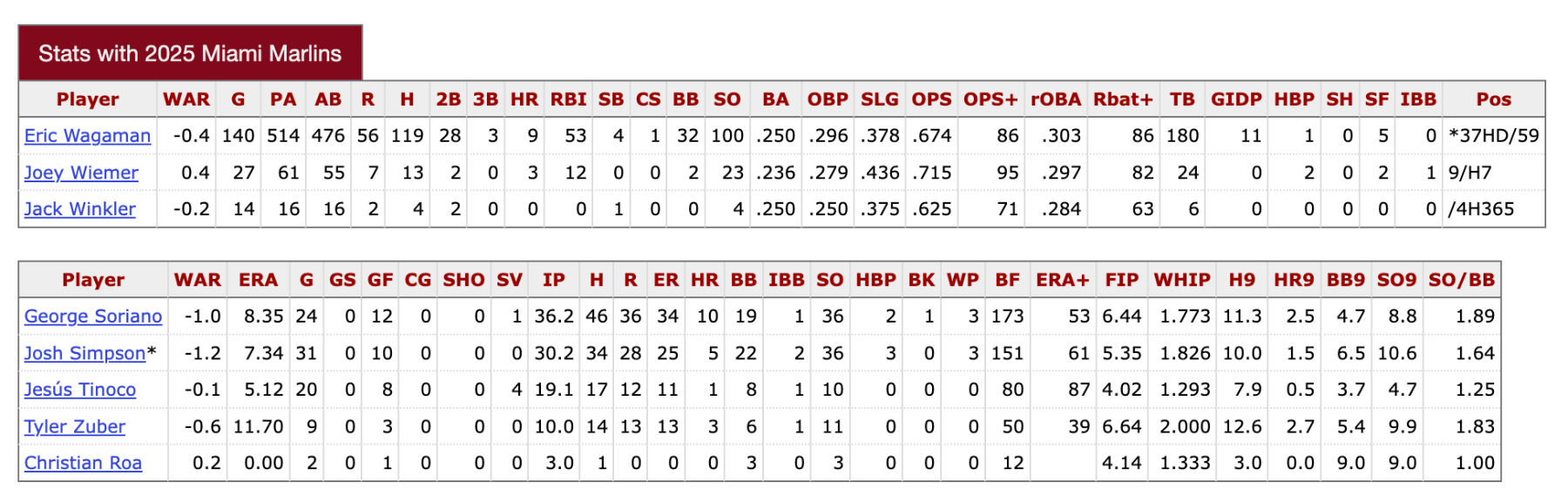
I previously wrote about these roster cut candidates here. Each of them spent less than half of the 2025 season on the Marlins active roster with the exception of Eric Wagaman, who stunningly stuck around from wire to wire.
The other MLB teams would have the opportunity to claim them off waivers. If unclaimed and outrighted to the minor leagues, they are all allowed to elect minor league free agency with the exception of Joey Wiemer, who would remain under the Marlins’ control. (To become MiLB FAs, players must have completed seven professional seasons or previously been outrighted.)
Marlins select RHP William Kempner, C Joe Mack and RHP Josh White to 40-man roster
Joe Mack is the no-brainer of this trio. He has had back-to-back excellent all-around seasons in the upper minors at a premium defensive position, and he’s still two months shy of his 23rd birthday. Mack is a critical piece of the Marlins’ future.
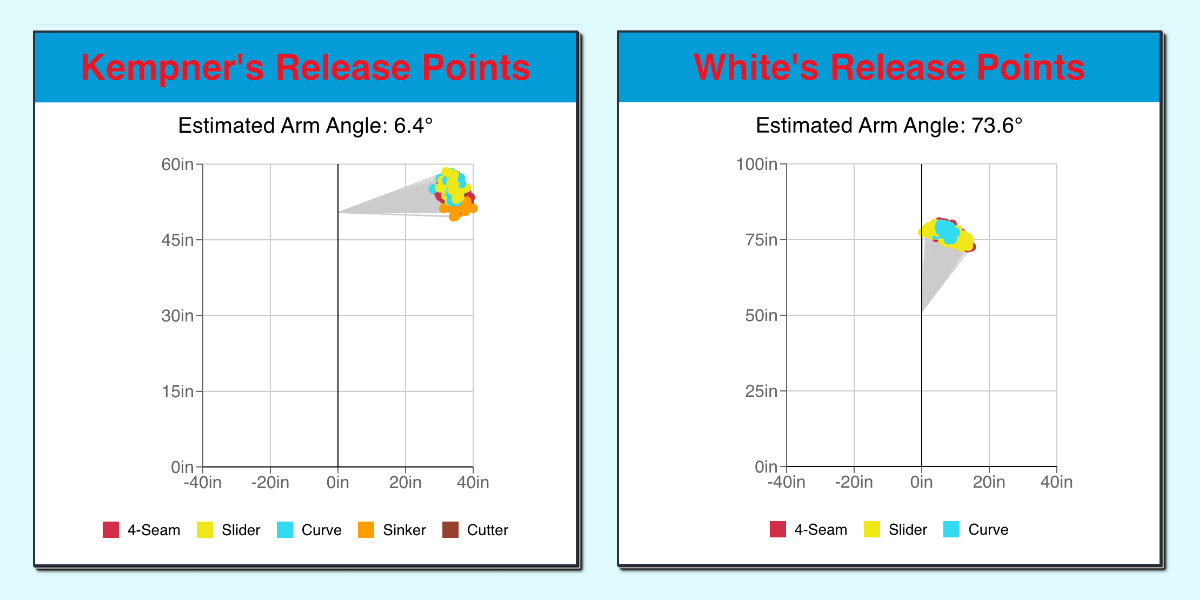
William Kempner and Josh White were damn near unhittable out of the bullpen in 2025. The difference between their arm angles is amusing, with Kempner practically throwing sidearm and White using an outlier over-the-top delivery. Both approaches result in lots of strikeouts and very few barrels. I prefer their upside over any of the aforementioned waived players and worry that they’ll be taken in the Rule 5 if left unprotected.
Free agency
Marlins sign RHP Ryan Helsley (3 YR/$24M)
$6M in 2026, $9M in 2027 and $9M in 2028
Annual $500k award bonus for Relief Pitcher of the Year
Helsley may opt out following 2026 season
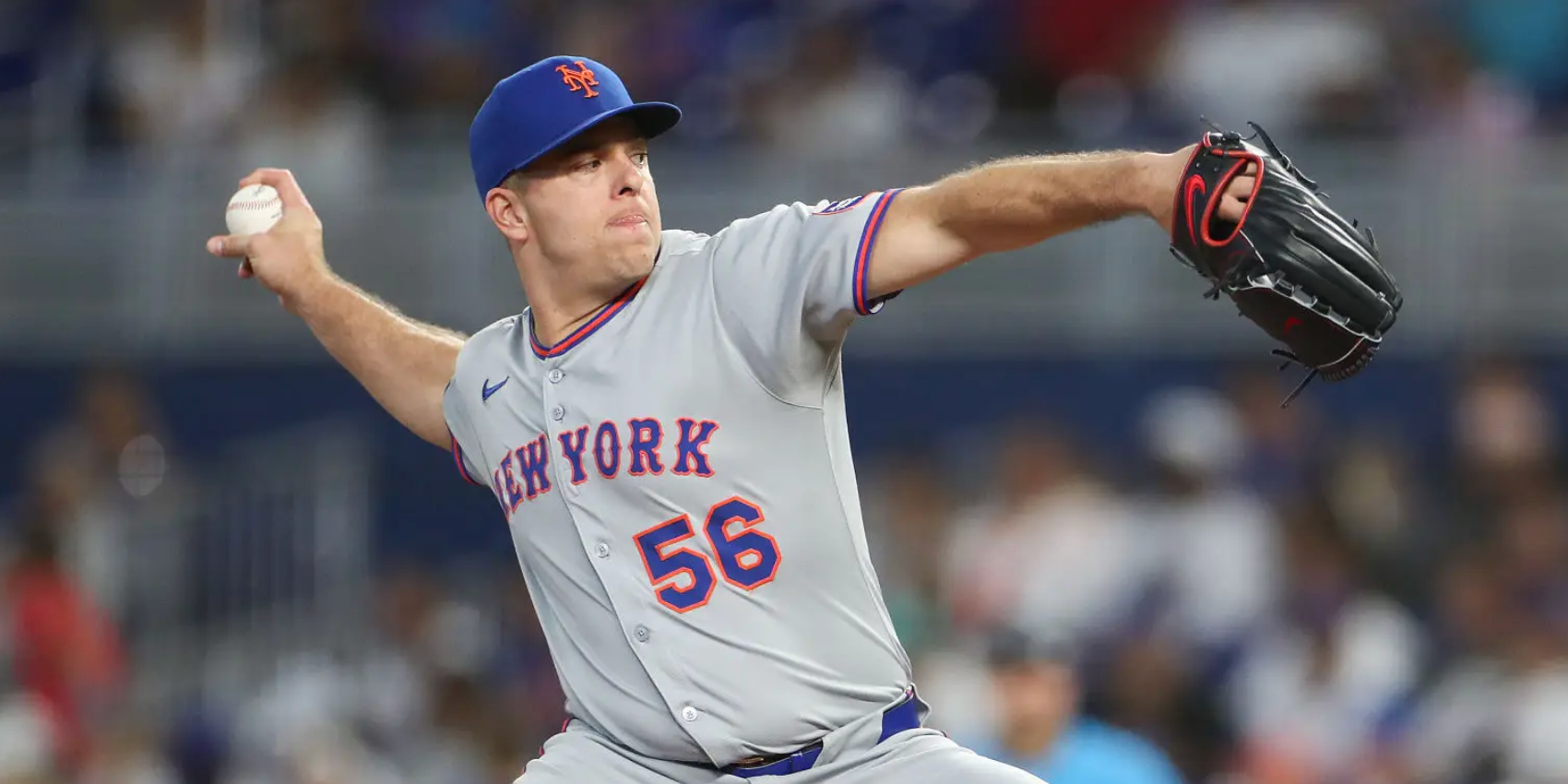
The Marlins bullpen was devoid of elite velocity this season, and as much as I believe in Kempner and White, their fastballs don’t have that “elite” characteristic.
Ryan Helsley’s four-seamer does with an average velo of 99.3 mph, which ranked ninth among all individual reliever pitch types in 2025, according to Baseball Savant (min. 100 pitches thrown). His velo held steady even during his brutal second-half slump as a member of the New York Mets.
Helsley was a top-five RP in Major League Baseball in 2024. Then, the opponent’s slugging percentage against his fastball skyrocketed three hundred points, from .367 to .667 in 2025. As far I can tell, most of that is attributable to falling behind in counts way more often and becoming predictable in those situations—he threw 64.7% fastballs when behind. My bounce-back plan for the 31-year-old would involve using fewer four-seamers to maximize their overall effectiveness. Whether facing lefties or righties, his slider is absolutely lethal.
It is a guaranteed three-year contract for Helsley, but both sides would be rooting for him to depart after one. Simply performing up to his career averages in 2026 would justify opting out to test the market again. Along the way, he’d be significantly improving Miami’s ‘pen.
Marlins sign RHP Triston McKenzie, LHP Jordan Montgomery, C Eric Haase, OF Harold Ramírez and 1B Eric Wagaman to minor league deals
This is a rare situation where I am so comfortable with the internal rotation options that I feel no need to sign any free agent starting pitchers to guaranteed contracts.
Browsing the vast pool of minor league deal candidates, I covet Triston McKenzie for his upside. His performance was only a smidge below All-Star-caliber in 2022, he’s squashing injury concerns by pitching right now in the Dominican Winter League and he’s entering his age-28 season. Coming off a lost year in which he threw only half of his MLB/Triple-A pitches for strikes, McKenzie’s lack of control is the foremost worry. The benefits of a potential career rejuvenation would be realized beyond 2026 because he has at least one more year of arbitration eligibility (waiting until late April to select him to the Marlins roster would make it two years).
Jordan Montgomery was a high-end No. 3 starter from 2021-23 before a disastrous stint with the Arizona Diamondbacks. The tall southpaw underwent Tommy John surgery in April, and with that being his second career TJ, I’d be targeting the All-Star break for his return. He’s mainly an insurance policy in case this Marlins season goes to s*** and I wind up selling one or more starting pitchers at the trade deadline, leaving behind innings for Montgomery to eat in August/September.
There is an extreme amount of swing-and-miss in Eric Haase’s game, but that hasn’t precluded him from having some great offensive stretches. The eight-year MLB veteran will compete for the backup catcher’s job. Haase is a good athlete who can even fake it in left field in emergencies.
Am I showing my bias with the Harold Ramírez idea, or respectfully carrying on the annual tradition of reuniting Peter Bendix with players he previously knew from his Tampa Bay Rays tenure? A bit of both. Ramírez is a lifetime .285/.322/.406 hitter in MLB, but he posted a yucky .261/.280/.324 slash line in 2024. He played this past season in the Mexican League.
Although Wagaman did not merit a 40-man spot throughout the offseason, there’s a path for him to get back up to Miami as a short-side platoon bat. It would require a few injuries and some actualization of his impressive raw power during spring training.
Trades
Marlins trade INF/OF Andrew Salas, RHP Eliazar Dishmey, OF Victor Mesa Jr. and RHP Adam Mazur to the St. Louis Cardinals for OF/1B Alec Burleson, 3B Nolan Arenado, LHP JoJo Romero and $7 million cash
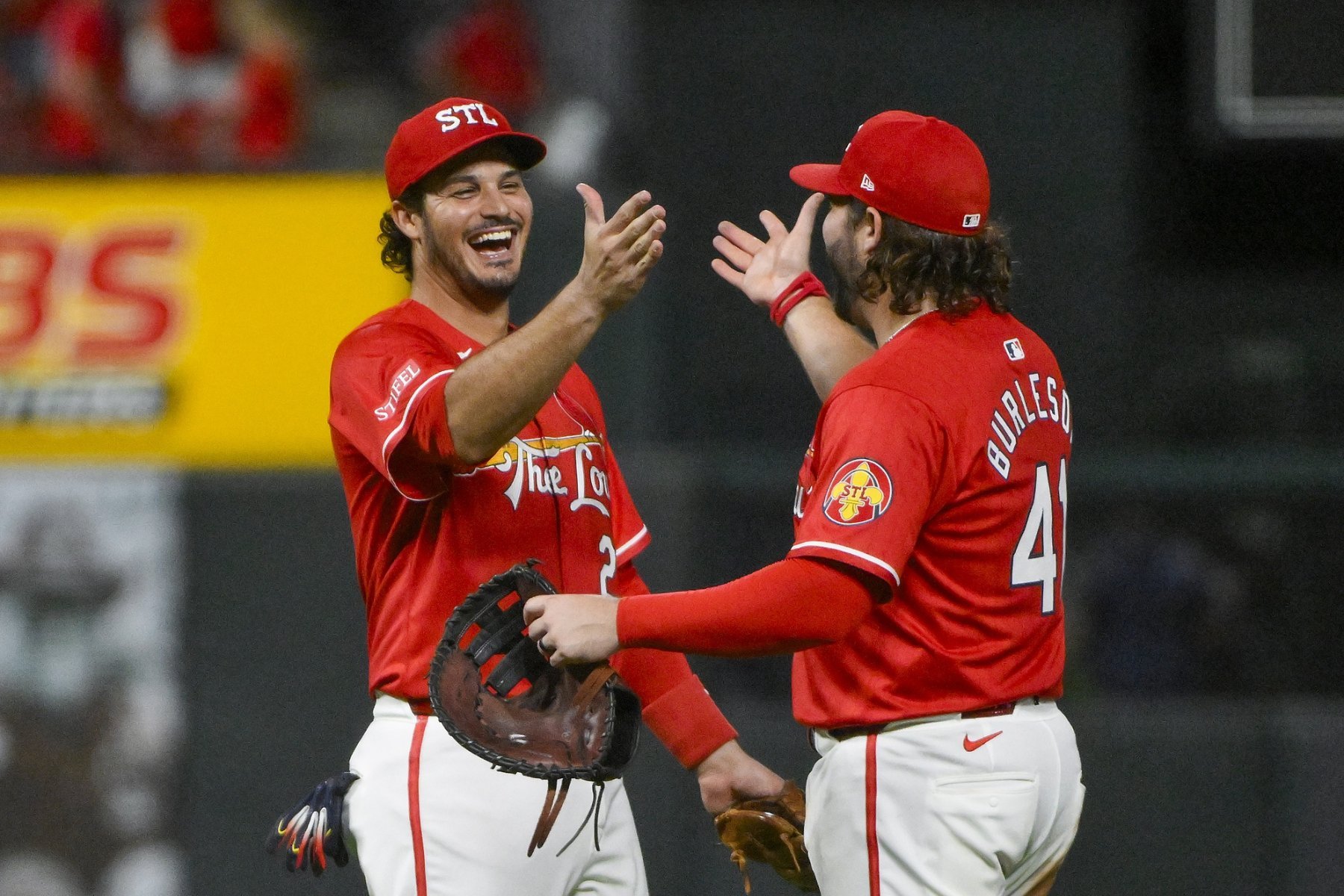
For a complete analysis of this seven-player swap, read here.
Alec Burleson would be the centerpiece. He has the potential to be the best first baseman that the Marlins have had in decades—a low bar to clear, but still—and he’s under club control through 2028 via arbitration.
JoJo Romero would slot in as the top left-handed option in the Marlins bullpen. He’s a ground ball machine who stranded 23 of 26 inherited runners in 2025. Romero is a pending free agent.
There are two years left on Nolan Arenado’s underwater contract. He also has full no-trade protection, but there’s reportedly mutual interest in finding him a change of scenery. He remains a plus contact hitter and defender at the hot corner. Although undoubtedly past his prime, Arenado could easily top this season’s .237/.289/.377 slash line with plate approach adjustments and a clean bill of health.
This trio would count for approximately $23 million toward the Marlins payroll in 2026 ($6M of Arenado’s salary is deferred until 2040).
The prospect package heading up to St. Louis consists of several “layers” of talent. Victor Mesa Jr. and Adam Mazur would be competing for big league reps right away, whereas in Miami, both were pretty far down the depth chart. Eliazar Dishmey could be a Cardinals rotation candidate by the end of 2027. Extreme patience is needed with Andrew Salas, the crown jewel of the latest Marlins international free agent class ($3.7M signing bonus). Salas turns 18 in March.
Marlins trade LHP Braxton Garrett and INF Connor Norby to the Seattle Mariners for OF Jonny Farmelo
A toolsy and well-rounded center fielder, Jonny Farmelo was sidelined for most of the 2024 and 2025 seasons due to injuries. That hasn’t hindered him at all during the Arizona Fall League as he’s seemingly in the midst of cementing himself as a consensus Top 100 MLB prospect. His ability to handle breaking balls still must be developed. Farmelo would likely be assigned to High-A Beloit to begin next season.
Braxton Garrett’s trade value is tough to gauge at the moment because of his own health setbacks, but I would expect the Mariners to find him attractive. Their ultra-talented but all-right-handed starting rotation took a step back in 2025, and that group continues to get more expensive via arbitration raises. Garrett owns a lifetime 111 ERA+ through parts of five MLB seasons on the strength of plus command. He is under club control through 2028.
There just isn’t a sensible fit for Connor Norby in my alternate universe, with Arenado and Graham Pauley sharing third base and Xavier Edwards locked in at second base. He slashed .293/.344/.500 with a 131 wRC+ after returning from midseason hamate surgery. However, he’s been merely an average hitter during his Marlins tenure overall. Valuable veterans Eugenio Suárez and Jorge Polanco are both pending free agents. Assuming that the Mariners are unable to retain both, there’d be ample room in their infield for Norby.
Marlins trade RHP Anthony Bender to the Athletics for 3B/1B Tommy White
The A’s would be dealing from an area of strength here as they have a handful of controllable, dynamic offensive players already in place at the major league level. A highly accomplished college slugger, “Tommy Tanks” has put up pedestrian numbers as a pro so far (98 wRC+ in 118 games). I’d be thrilled to buy low on him. His raw power is still unquestionably plus and so is his contact ability, and he may actually stick at third base moving forward, even if the best-case scenario there is average defense. If the Arenado pick-up flops and he continues to decline, White could be his successor by 2027.
Anthony Bender has had a good Marlins career, particularly given his origin as a minor league free agent signing. In 2025, he posted a career-best 2.16 ERA and he was also on pace for a career-best in win probability added (1.01 WPA) before going down with a leg injury. He’s super reliable against right-handed batters and still a bargain ($2.3M arbitration projection), but rebalancing the bullpen to neutralize lefties continues to be a priority for me.
Marlins trade OF Brandon Compton to the Atlanta Braves for LHP Hayden Harris
Hayden Harris eviscerated the upper minors in 2025, permitting three earned runs in 52 innings pitched while striking out more than 40% of opposing batters. The Braves rewarded him with a September call-up. He leans very heavily on a low-90s fastball. The pitch’s velocity plays up due to the seven feet of extension in his delivery and his arm angle. I’m not expecting dominance from Harris in MLB, but I’m intrigued by the contrast in styles between he and JoJo Romero—even a top-tier righty would have trouble adjusting to both of them within the same game.
QndvN2RfWGw0TUFRPT1fVlZKWkFnSldWd01BQ1ZRREFnQUhCZ0VGQUFCUUJRVUFVQU1DVWdZRVZWZFdCZ1ZX.mp4
Miami’s second-round selection in the 2025 draft, Brandon Compton got his MiLB career started with High-A Beloit (.217/.354/.359 in 27 games). There is prodigious power potential as he demonstrated during the MLB Draft Combine. Alas, being limited to left field defensively and susceptible to swing-and-misses, there are too many ways for his progress to stall. I’ll humbly tip my cap to the Braves if they can develop him into a consistent big leaguer.
Contract extensions
Marlins extend RHP Eury Pérez (5 YR/$60M with 2031 club option)
$5M in 2026, $7.5M in 2027, $10M in 2028, $12.5M in 2029, $20M in 2030 and $23M club option for 2031 ($5M buyout)
Extension covers ages 23-28 if option is exercised
Annual $500k award bonus for Cy Young
If I were advising Eury Pérez, I would do everything possible to steer him toward free agency. MLB teams adore pitchers with his combination of size, fastball quality and youth. Thanks to that unique profile, he has immense job security regardless of what he accomplishes during his four remaining club-controlled years. If he’s “broken” by a series of unfortunate events, suitors will be lining to fix him; if he gradually improves in terms of effectiveness and workload, he’s poised to receive one of the richest pitcher contracts ever.
Conveniently for the Fish, Pérez may be getting different advice. He has the same representation as Sandy Alcantara (Adriel Reyes of CAA), the only player to date who has signed a long-term contract extension during the Bruce Sherman era.
The terms of my hypothetical “Baby Goat” extension are partially inspired by Alcantara’s, but I see Cincinnati Reds right-hander Hunter Greene as a more relevant comp. This deal would set a new MLB record for most expensive club option included in a pre-arb pitcher’s extension.
I am not remotely bothered by Pérez’s 4.25 ERA this season, which was inflated by the way opponents clustered their hits against him. I saw a pitcher who leveled up from his rookie year despite overall production that obscures this trend line. In 2026, I think Pérez could establish himself as an ace-caliber starter. Let’s get out ahead of the full-blown breakout.
Marlins extend C Joe Mack (6 YR/$31M with 2032-34 club options)
$1M in 2026, $1.75M in 2027, $2.5M in 2028, $5M in 2029, $8M in 2030, $11M in 2031, $14M club option for 2032 ($1.75M buyout), $14M club option for 2033 ($1.75M buyout) and $14M club option for 2034 ($1.75M buyout)
Extension covers ages 23-31 if all options are exercised
Annual $250k award bonus for Gold Glove
Annual $250k award bonus for Silver Slugger
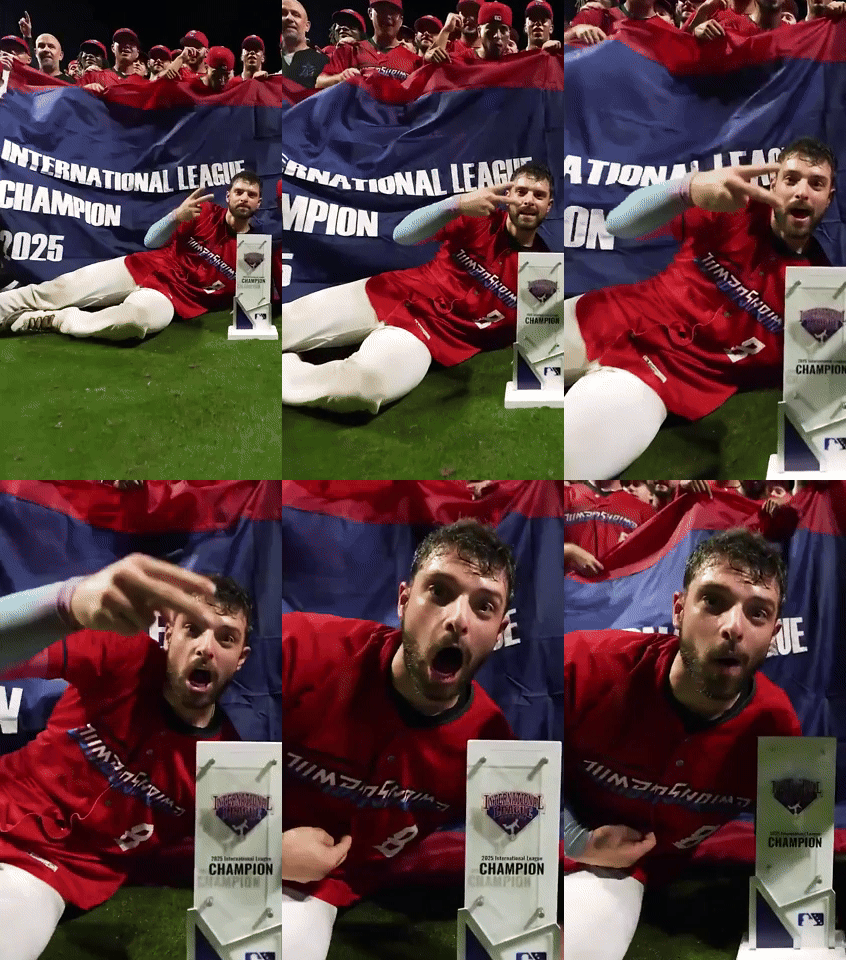
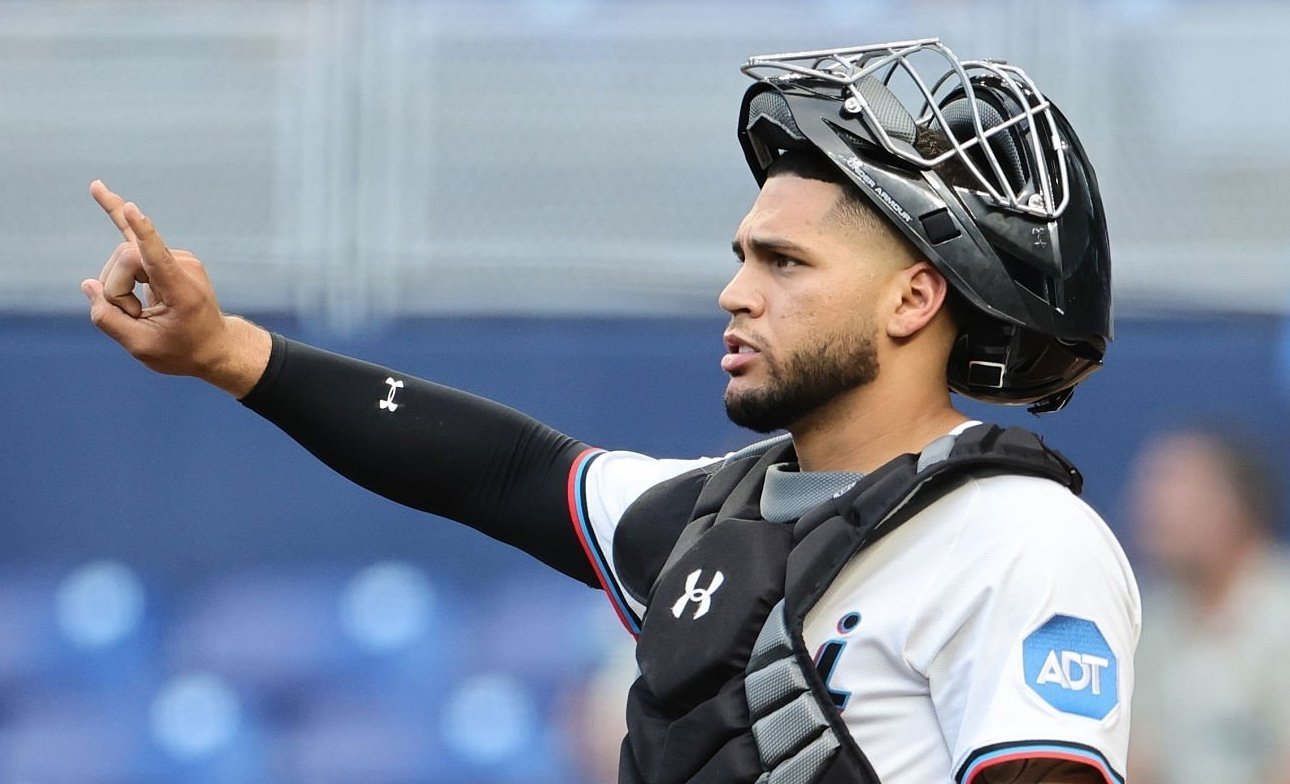
There has never been a pre-debut extension for a catcher before, and this technically wouldn’t be one either, as I’ll explain at the end.
Joe Mack had a sensational 2024 season spent mostly at Double-A. His 2025 campaign was practically a carbon copy of it, except it came against Triple-A competition. Both years, he OPS’d over .800 while throwing out one-third of would-be base-stealers. Marlins fans will naturally use J.T. Realmuto as the reference point for an ideal homegrown catcher. Although Mack isn’t quite on his level as a pure hitter or baserunner, he’s the most promising candidate that this franchise has had to fill the quality backstop void since Realmuto’s departure.
The growth of catcher salaries has lagged behind league-wide inflation and that should continue to be the case, which works to my advantage in negotiations.
Future earning potential at the position has been dinged by the rarity of stars reaching free agency. World Series hero Will Smith would’ve broken the bank this offseason had he not already signed a lifetime deal with the Los Angeles Dodgers. American League MVP finalist Cal Raleigh finalized his own extension too soon to capitalize on a historic season.
We are on the verge of getting the ABS challenge system in MLB games. With the technology to overturn the most egregious missed calls from umpires, that will limit the impact of pitch framing (and the value that good framers will have on the open market). Also, the Marlins organization is experimenting with having coaches lead the pitch-calling process, and the early returns are encouraging. Taking another job responsibility off of a catcher’s plate further shifts leverage to the team.
I’m especially eager to see Mack form a battery with Eury Pérez because their skill sets are complementary. It will always be a challenge for the 6’8″ right-hander to control baserunners, but Mack’s lightning-quick release and accuracy can mitigate the damage.
Colt Keith received a surprising pre-debut extension from the Detroit Tigers entering 2024 under the premise that his standout hit tool made him a safe, high-floor contributor. I think Mack’s defense behind the plate serves the same purpose—that’s why I used Keith’s extension as a template for Mack’s.
Although Mack would be on my Opening Day roster, we would wait a few days after his debut to announce the deal. That preserves his Prospect Promotion Incentive (PPI) draft pick eligibility.
How the pieces fit together
Here is a before-and-after look at the Marlins 40-man roster once the dust has settled on my offseason moves.
Players no longer with the organization have been crossed off
Outside additions to the 40-man roster are highlighted, underlined and italicized
Down arrows denote players who are still with the organization, but no longer hold 40-man spots
Up arrows denote players who were already with the organization, but now hold 40-man spots
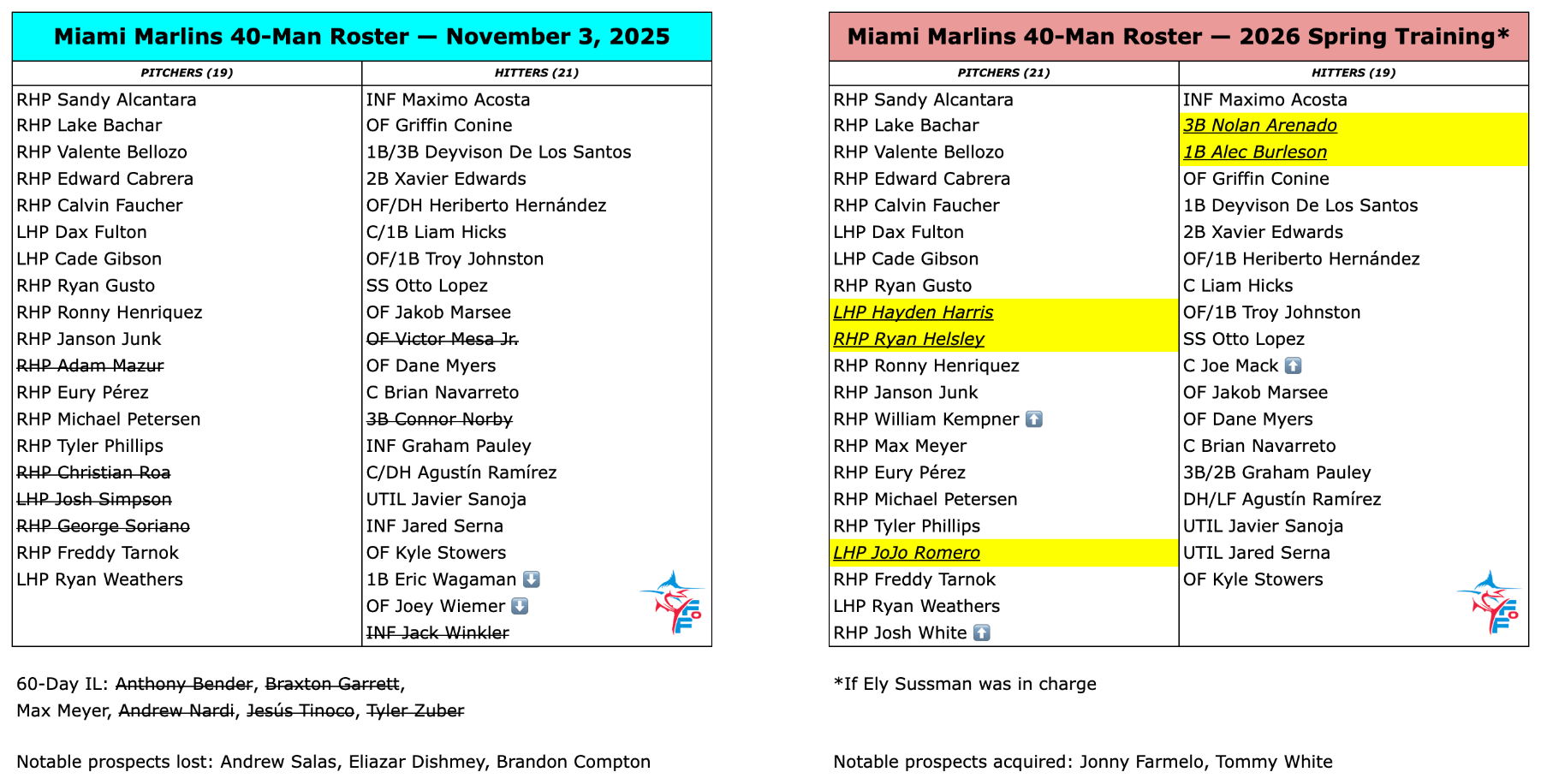
Look closely and you’ll see I have made a few position changes. The most important one is moving Agustín Ramírez off of the catcher’s position. He shouldn’t throw his equipment in the trash—in the event of a significant Mack injury, Ramírez may be needed. But I would head into 2026 with zero expectations of using him back there. The common transition of failed catchers becoming first basemen isn’t applicable to the Gus Bus, who struggles most of all with receiving balls and picking them out of the dirt. Instead, I would prepare him to play left field against occasional left-handed starters. The vast majority of the time, he’d be my designated hitter, and I’m bullish about his production at the plate going way up.
Heriberto Hernández, who had some first base experience in the lower minors, took practice reps with the Marlins this season. I’m comfortable deploying him there in real games when Alec Burleson needs a breather (and until Deyvison De Los Santos potentially crashes the party later in the year).
My probable Opening Day starting rotation (health permitting) would be Sandy Alcantara, Eury Pérez, Edward Cabrera, Ryan Weathers and Janson Junk. Potential trades of Alcantara and Cabrera ought to be explored in July, but not yet. Anticipating midseason contributions from Robby Snelling and Thomas White, I believe this will be the team’s greatest strength.
The out-of-options relievers are Ryan Helsley, JoJo Romero, Ronny Henriquez, Tyler Phillips and Freddy Tarnok. There’d be countless ways to fill in the bullpen around them.
Accounting for dead money owed to Giancarlo Stanton and Avisaíl García, the Marlins would enter 2026 with a payroll in the $90-100 million range. That is where they stood in early 2023 before spending even more to augment the roster in pursuit of a postseason berth. Bruce Sherman will pay to support a winner again if the opportunity arises…right?