
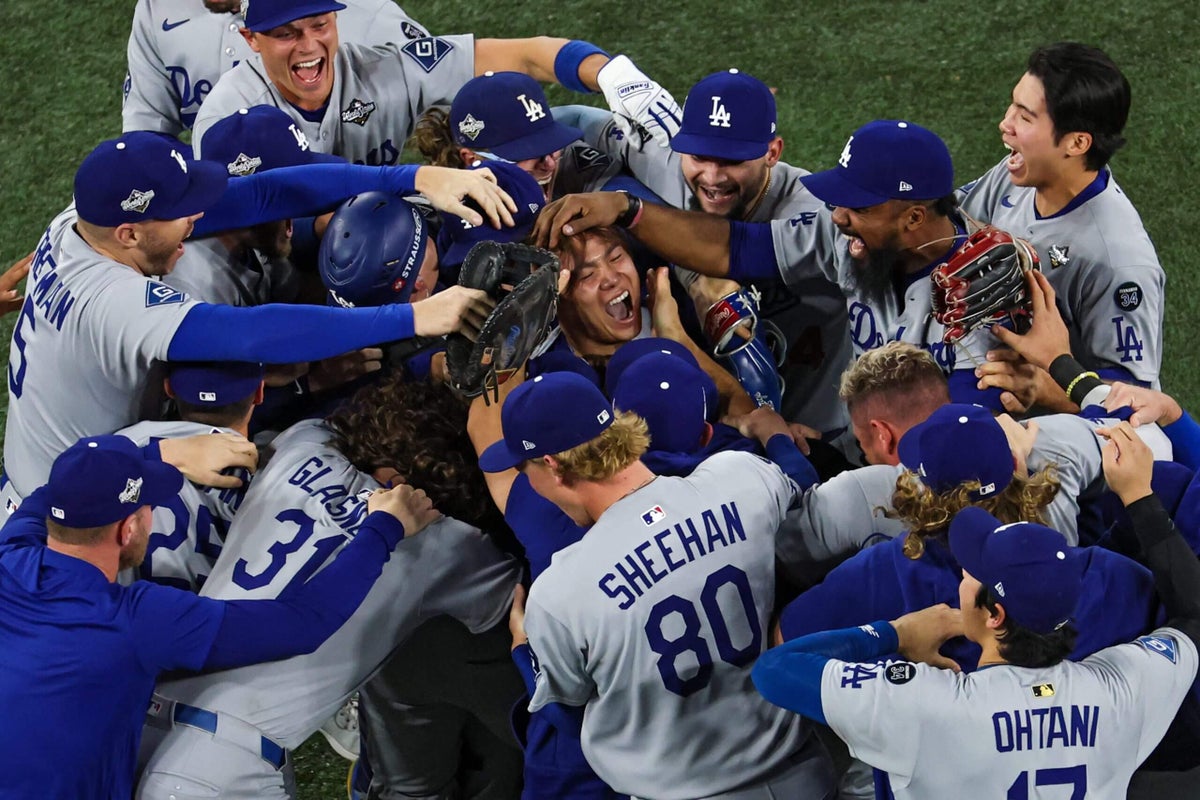
TORONTO — How can you tell when you’ve just been part of the greatest World Series game of your lifetime? Or maybe we should make that anybody’s lifetime?
Do you have to wait for a panel of historians to rule on it? Or do you just look into the eyes of your teammates and recognize that you all know it when you see it, when you live it, when you play in it?
So that brings us to your 2025 World Series champions, the Los Angeles Dodgers, because they knew. They’d just spent an epic night on the baseball field that had turned Saturday into Sunday morning. They’d won this Game 7. They’d won this World Series. But this was more.
This was a game that would be lifted forever above all those other games. They didn’t need to hear from any historians or any of us wizened baseball scribes. They just knew. They felt it. They got it. This was that game they’d waited a lifetime to play in — the greatest Game 7 of them all, the perfect finale to one of the most spectacular World Series ever played.
It was Dodgers 5, Blue Jays 4, in a game in which the winning team never led until the 11th inning. It took historic home runs sailing through the Toronto sky in the ninth and 11th innings. Both teams threw out the go-ahead run at the plate — in back-to-back half-innings. The benches and dugouts emptied after a fourth-inning hit-by-pitch. And that’s not even the half of it.
There were twists. There were turns. There was confetti floating above a stage full of Dodgers, the first champions to repeat in 25 years. There were empty hearts aching in the clubhouse of a Blue Jays team that got within two outs of glory before their world turned upside-down.
“Just a great game,” said Dodgers first baseman Freddie Freeman, as the clock on the clubhouse wall ticked toward 2 a.m. ET. “There was so much. Everything you could think of happened in that game. You know, benches clearing, everything. Everything. I mean, we had everything in that Series. And I’m just glad we won it.”
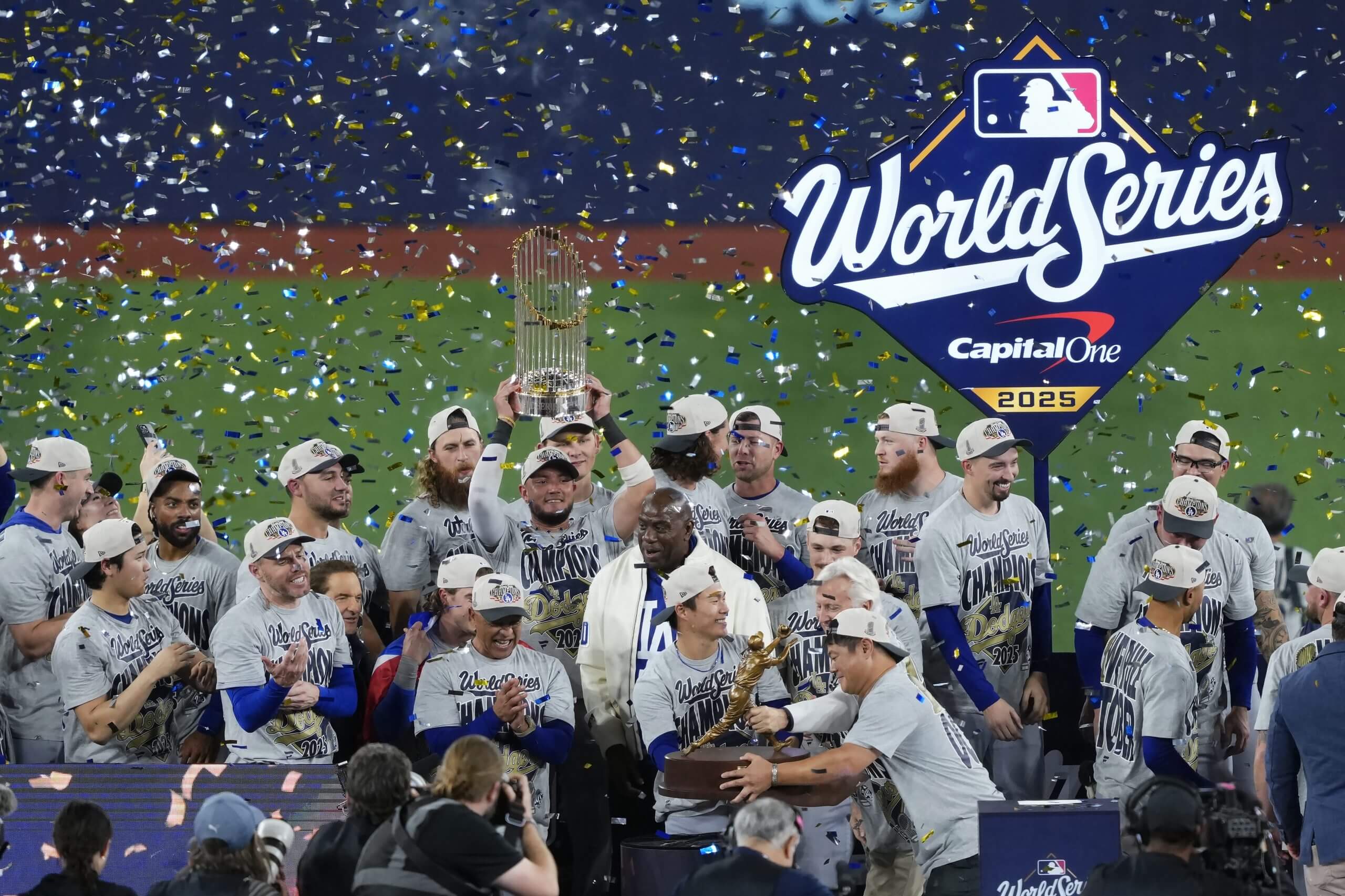
Confetti falls on the Dodgers during the trophy presentations after they prevailed in an epic Game 7. (Mark Blinch / Getty Images)
This game was something, all right. It was 11 innings’, and 248 minutes’, worth of greatness and madness. Seven starting pitchers pitched in this game — including the entire Dodgers rotation. The winning pitcher in relief – Yoshinobu Yamamoto – was the same man who started and won Game 6 the night before.
You couldn’t make this stuff up. And fortunately, because baseball is awesome, you didn’t have to.
Afterward, one of the Dodgers’ owners — a gentleman named Magic Johnson — roamed around the field where all this had unfurled, soaking it in with that signature Magic smile. So I asked him this question:
THE ATHLETIC: “Magic, this was such an epic baseball game. How does it compare to a great Game 7 in your sport (i.e., basketball)?
THE MAGIC MAN: “It’s the same — because we were both throwing haymakers, left and right. It reminds me of the great (Muhammad) Ali-(Joe) Frazier fights, when they were going back and forth for 15 rounds — because Toronto kept coming. … So let me just say this: Don’t forget to give Toronto some love. That team probably would have beat any other team, right? And they gave the world a Series that nobody’s going to forget forever.”
He’s right, you know. Nobody is going to forget this one. So this is where the World Series Weird and Wild column steps in one last time to help you digest the moments, memories and history lessons this game delivered from start to finish. Ready? Here we go.
Getting Miggy with it
Every baseball classic needs a hero like Miguel Rojas — because he was very possibly the least likely man on the field to step to the plate with one out in the ninth, with the Dodgers two outs away from winter, and do this.
MIGUEL ROJAS WITH THE BIGGEST SWING OF HIS LIFE 💥
GAME 7 IS TIED IN TORONTO pic.twitter.com/tDwUGzBrVq
— MLB (@MLB) November 2, 2025
That’s a home run that will be floating on the winds of history for the rest of time. But you’ll never mistake the man who hit it for, say, Aaron Judge. Rojas has played 12 seasons in the big leagues. He has reached double figures in home runs in one of them — and it was seven years ago.
Before Friday, when Dodgers manager Dave Roberts played a hunch and put him at second base, Rojas hadn’t started a game in more than three weeks. His postseason extra-base-hit total was zero. He’d hit one home run since July 19. So of course he walked up there with one out in the ninth and smoked a hanging Jeff Hoffman slider for a life-changing, Series-changing, game-tying home run.
Ready for the complete list of men who have hit a game-tying World Series home run in the ninth inning of a Game 7? Here it comes:
Miguel Rojas — Game 7, 2025
End of list
“Really? He’s the first?” Freeman said, incredulously, when I broke that news to him. “That’s amazing.”
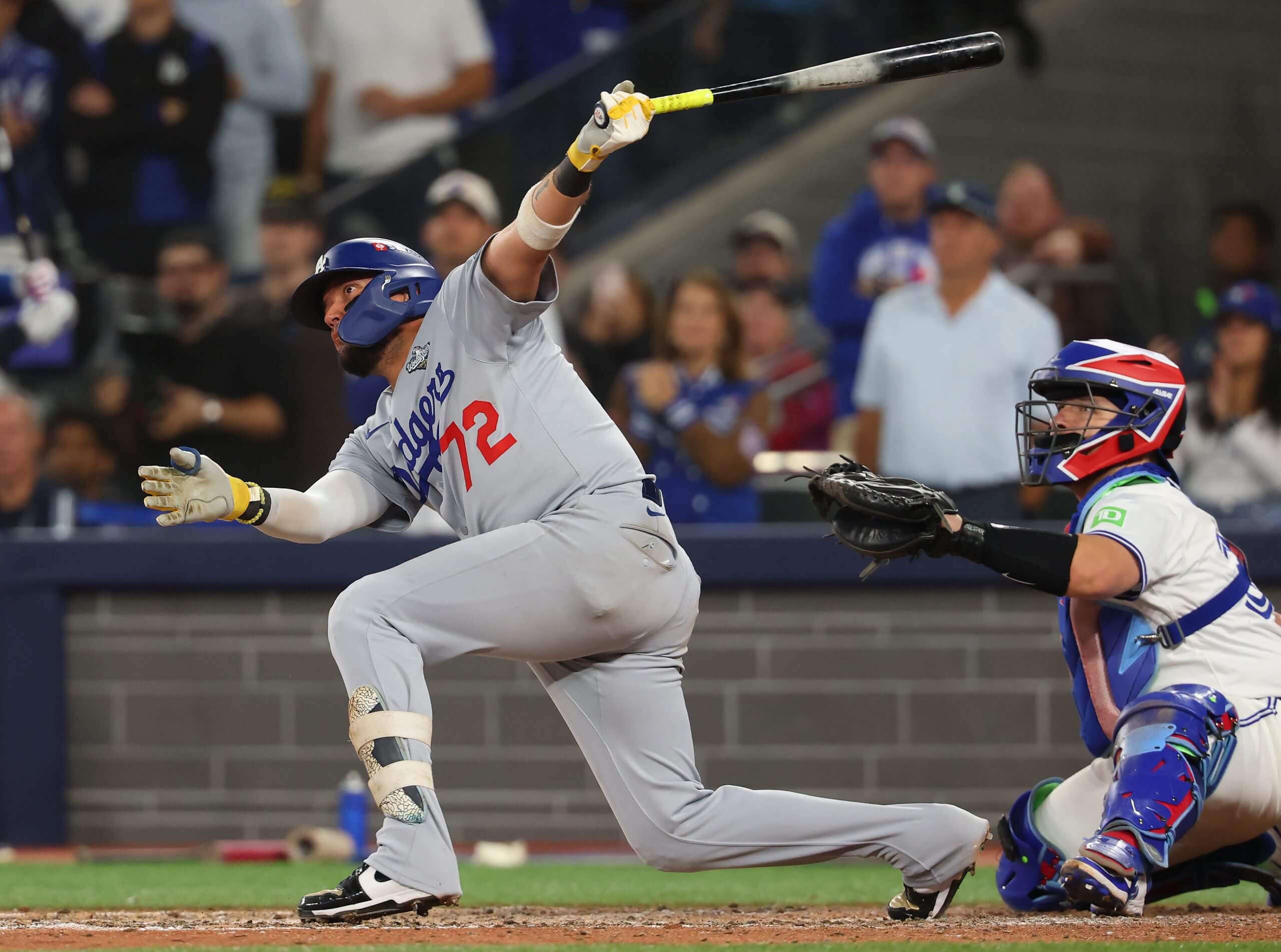
Miguel Rojas watches his ninth-inning, game-tying homer, which kept the Dodgers’ title hopes alive. (Gregory Shamus / Getty Images)
Except it’s probably even more amazing than Freeman could possibly think.
How long had it been since Rojas hit a home run in the ninth inning of any game? How about six years, since he lofted one against the Pirates on Sept. 3, 2019.
And how many homers did he hit against right-handed pitchers this year? Well, the good news is that, contrary to what he told the Fox broadcast afterward, he did hit one this season. But there’s an excellent reason he might not remember it:
Because he hit it off a position player — Giants catcher Logan Porter, who was mopping up a June 14 game his team was losing 10-0.
And then this same guy — Miguel Rojas, a 36-year-old, glove-first, backup infielder — hit this home run? Whoa. How incredible is …
Baseball!
Where there’s a Will (Smith)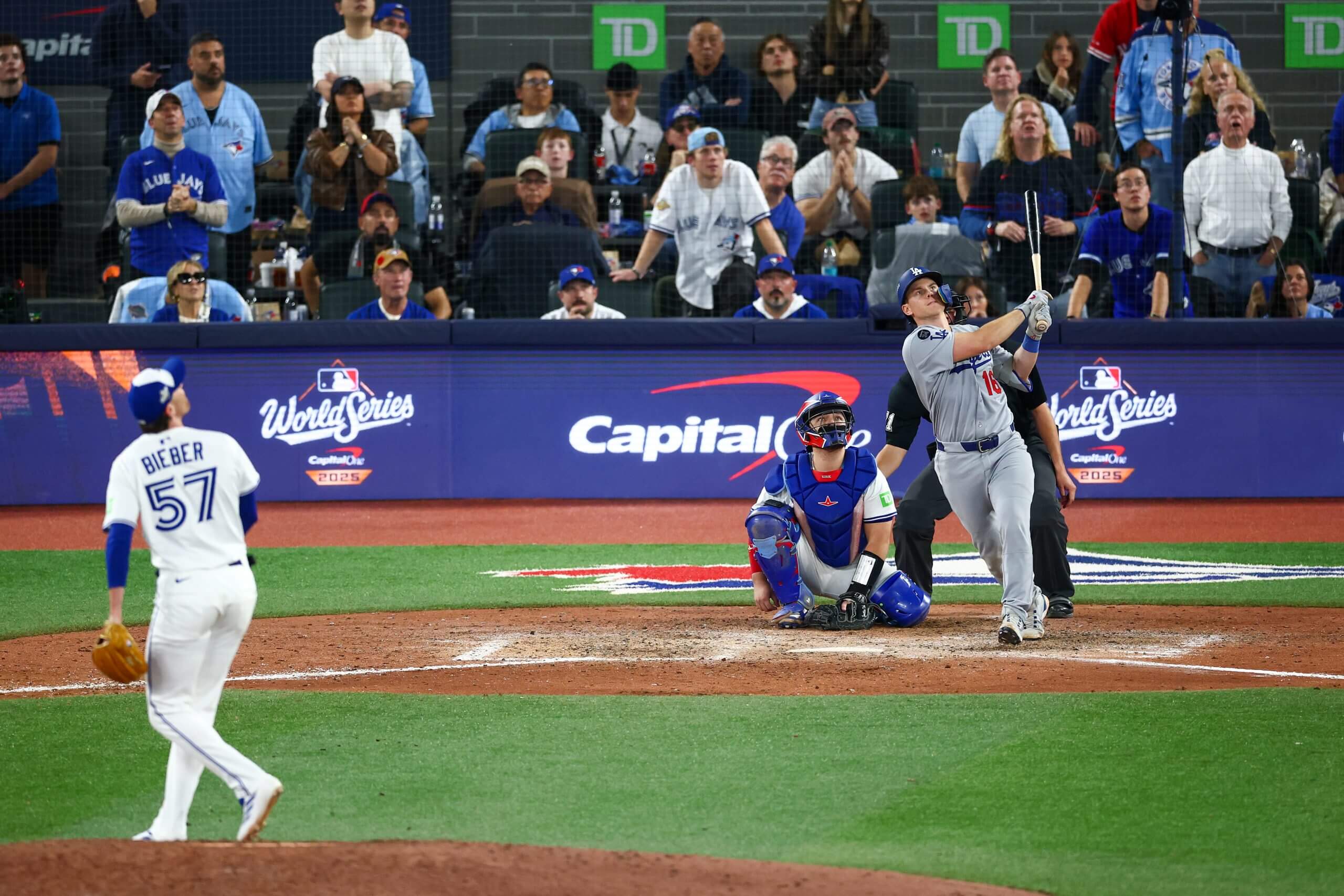
Him again? The Dodgers’ Will Smith made an everlasting mark on this World Series. (Vaughn Ridley / Getty Images)
It isn’t true that every year in baseball history, the team that won the World Series employed a player named Will Smith. But it is true that it has now happened every year for the past six seasons:
2025 — Dodgers catcher Will Smith
2024 — Dodgers catcher Will Smith
2023 — Rangers left-hander Will Smith
2022 — Astros left-hander Will Smith
2021 — Braves left-hander Will Smith
2020 — Dodgers catcher Will Smith
So by that standard, there was nothing surprising about the fact that the Dodgers catcher was the one who pounded the dramatic homer off Shane Bieber in the 11th inning to give his team the lead for the first time all night. But there was also this part:
Here’s another eye-popping list — of all the batters in history who have hit a home run in extra innings in a World Series Game 7:
Will Smith — 2025 Game 7
That’s all, folks
Yes, you read that right. No one had ever gone deep in extra innings in any Game 7 ever played … until this wave of Smith’s bat Saturday night. And I bet you could have stumped pretty much everyone seated around your bar stool with that wild little trivia question. But it’s true.
Other than that Smith was still recovering from a broken bone in his right hand, which cost him almost all of September, he doesn’t fit anyone’s definition of unlikely hero. He’s a three-time All-Star who has been one of the backbones of this Dodgers team for the past seven seasons. However …
How many home runs had he ever hit in the 11th inning or later before his game-winning rocket Saturday? As always, zero would be an excellent guess.
But then he connected on this one. And it will resonate through history as one of the most clutch World Series home runs ever.
Over at Baseball Reference, they calculate a metric known as Championship Win Probability Added. And where does this long ball rank? How about No. 1 among all World Series homers ever hit in the ninth inning or later. (By the way, look who’s at No. 3!)
PLAYER YEARcWPA
Will Smith
2025
+41.03%
Bill Mazeroski
1960
+36.74%
Miguel Rojas
2025
+34.91%
Joe Carter
1993
+30.38%
Kirk Gibson
1988
+27.31%
Will Smith, man. The World Series is his kind of scene.
Burying the lead
It isn’t often a team wins a World Series Game 7 even though it spends four hours playing mostly from behind. But have we mentioned that the Dodgers somehow pulled that off in this game?
Only four teams have ever won a World Series the way the Dodgers won this one — in a Game 7 in which they didn’t take the lead until extra innings:
• 1924 Senators, in the 12th, in the Walter Johnson in Relief Game.
• 1991 Twins, in the 10th, in the Jack Morris Game*.
• 1997 Marlins, in the 11th, in the Edgar Renteria Game.
• 2025 Dodgers, in the 11th, Saturday.
(*Guess who threw out the first pitch before Saturday’s game? It could only have been … former Blue Jays hero Jack Morris!)
Paging Mr. Yamamoto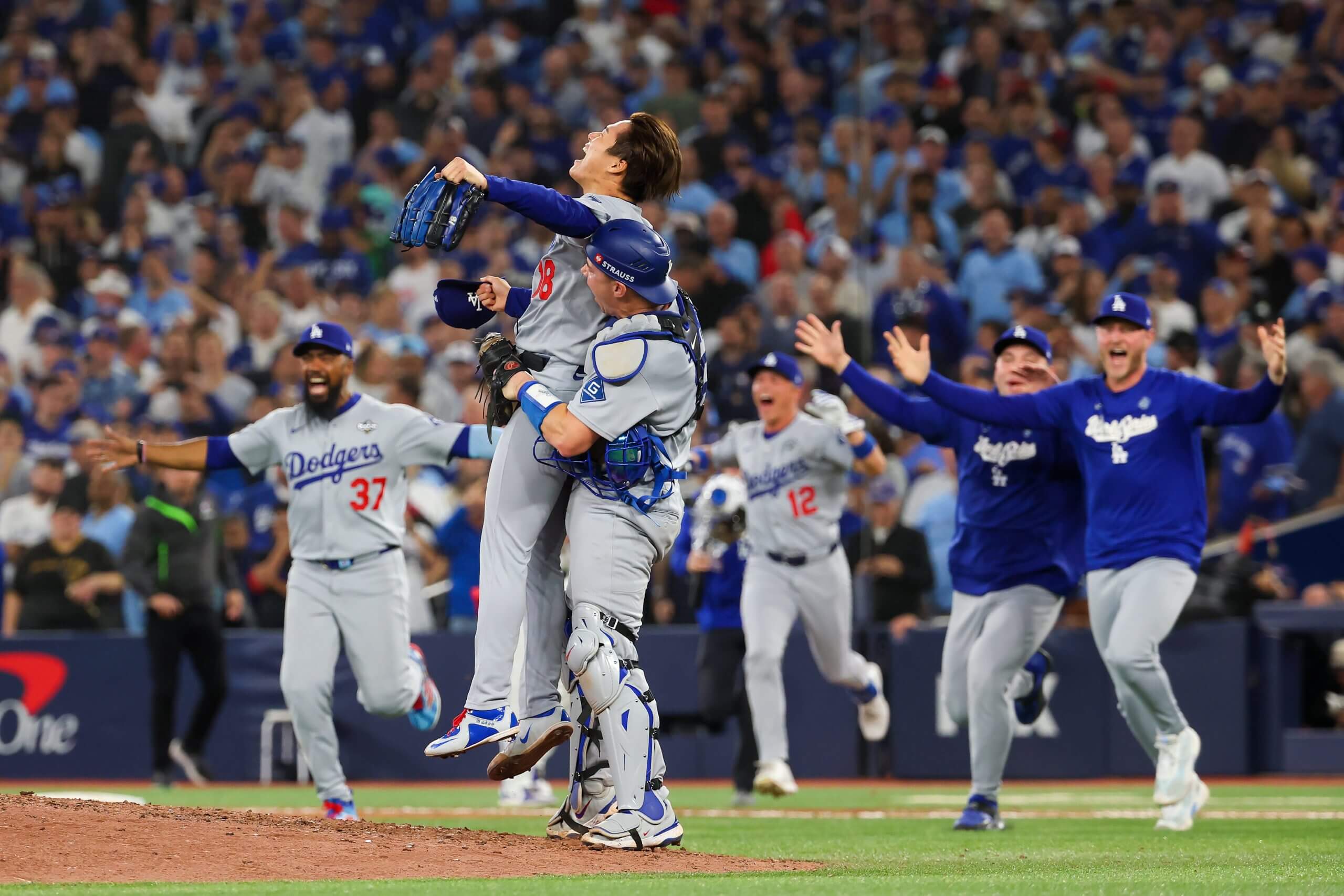
Catcher Will Smith hoists Yoshinobu Yamamoto as the Dodgers run to the mound to celebrate after prevailing in a marathon Game 7. (Gregory Shamus / Getty Images)
I still get goosebumps when I think back on the ninth inning of Game 7 of the 2001 World Series — and not just when remembering Luis Gonzalez’s iconic walk-off single against the great Mariano Rivera. But before that chill-bump attack, there was this one:
It’s the legendary image of Randy Johnson trotting out of the Arizona bullpen to pitch the ninth inning in relief a day after throwing seven innings as the starter in Game 6. I can still picture him stomping toward the mound that day. I never thought I’d see anything like it again.
Then Yoshinobu Yamamoto showed up.
Let’s recap Yamamoto’s World Series. In Game 2 last Saturday, he became the first pitcher since Curt Schilling (2001) to throw back-to-back postseason complete games. That was cool… In Game 3 on Monday, he volunteered to go to the bullpen and was actually warming up in the 18th inning before that marathon ended. That was heroic… Then, in Game 6 on Friday, he started the game that saved the Dodgers’ season, throwing 96 pitches over six innings. That was huge.
So after that game Friday night, Yamamoto was the one pitcher whom his manager, Dave Roberts, said would not be available in Game 7. Made sense — to everyone on the planet not named Yamamoto. So who came trotting out of the Dodgers’ bullpen in the ninth inning to pitch the last 2 2/3 innings of Game 7 in relief?
Ha. Let’s just say it wasn’t Eric Gagne.
If you didn’t realize Yamamoto was the best pitcher in the world before this weekend, I hope you realize it now. What a warrior.
From 96 pitches Friday to 34 more Saturday — on zero days’ rest? Who does that in this day and age?
“I mean, it’s unbelievable,” said Dodgers pitching coach Mark Prior. “It really is. That’s going to go down in history as one of the best championship performances in any sport.”
So how rarified was this? About as rarified as you’d think!
It happened a few times early in the 20th century. But over the last 90 World Series, just two other starters have pitched at least six innings in Game 6 of a World Series, then came back the next day to work again in Game 7.
There was the Big Unit, and the aforementioned outings in 2001. He was the winning pitcher in both of those games. And there was Vic Raschi, of the 1952 Yankees. He won Game 6, then pitched in relief in the seventh inning the next day.
But those were very different times — and yes, I’m including 2001 in that. So for Yamamoto to do it in this ultra-protective pitching era is incredible. But it’s also not even the Weird and Wild part. The Weird and Wild Part is this: He got more outs in Game 7 (eight) than any other Dodgers pitcher! (Hat tip: Freddie Freeman.)
So how many other pitchers in World Series history have ever done that — won Game 6 as a starter, then got the most outs of anyone on their team in Game 7? Yessir, that would be … none!
Start me up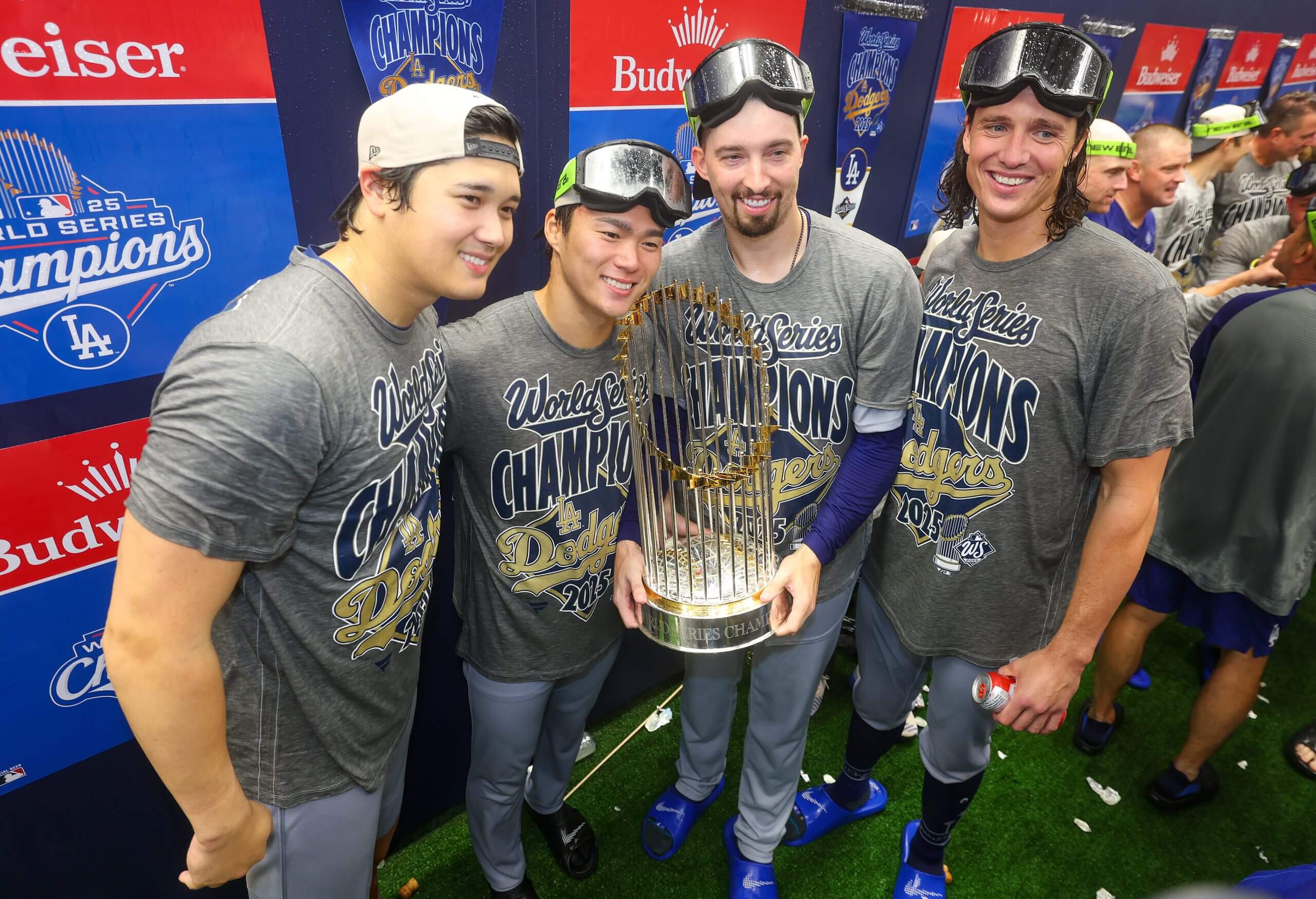
From left, Dodgers starters Shohei Ohtani, Yoshinobu Yamamoto, Blake Snell and Tyler Glasnow pose with the Commissioner’s Trophy. They all pitched in Game 7. (Gregory Shamus / Getty Images)
The Dodgers have this group of pitchers they like to think of as “their starting rotation.” And just as we all expected, the four most prominent members of that rotation started the first six games of this World Series: Yamamoto, Blake Snell, Shohei Ohtani and Tyler Glasnow.
Then, just as we didn’t all expect, on Saturday, all four of them pitched in the same game — three of them in relief — in a topsy-turvy Game 7. And if you’re thinking you don’t see that much, it’s because you definitely don’t see that much! Not in the 2000s, anyway.
I asked my friends from STATS Perform to look into this. The question: How many times had any team used four pitchers in one World Series game who had also started a game on the mound in the same World Series?
Not surprisingly, before Saturday, it last happened 80 years ago.
The 1945 Cubs did it in Game 6 to stay alive to play (and lose) a Game 7 the next day to the Tigers. And before that, the 1934 Tigers and 1924 Giants both did it in Game 7 of their Series. Here’s a fun fact: All those teams lost in that World Series. But the Dodgers did it — and will brag about it all the way to the parade floats.
THE ATHLETIC TO PRIOR: “Do you believe you used your entire starting rotation in one game?”
PRIOR: “I do, actually. Game 7’s bring out wacky things, and nothing’s off the table.”
Aw, just start without me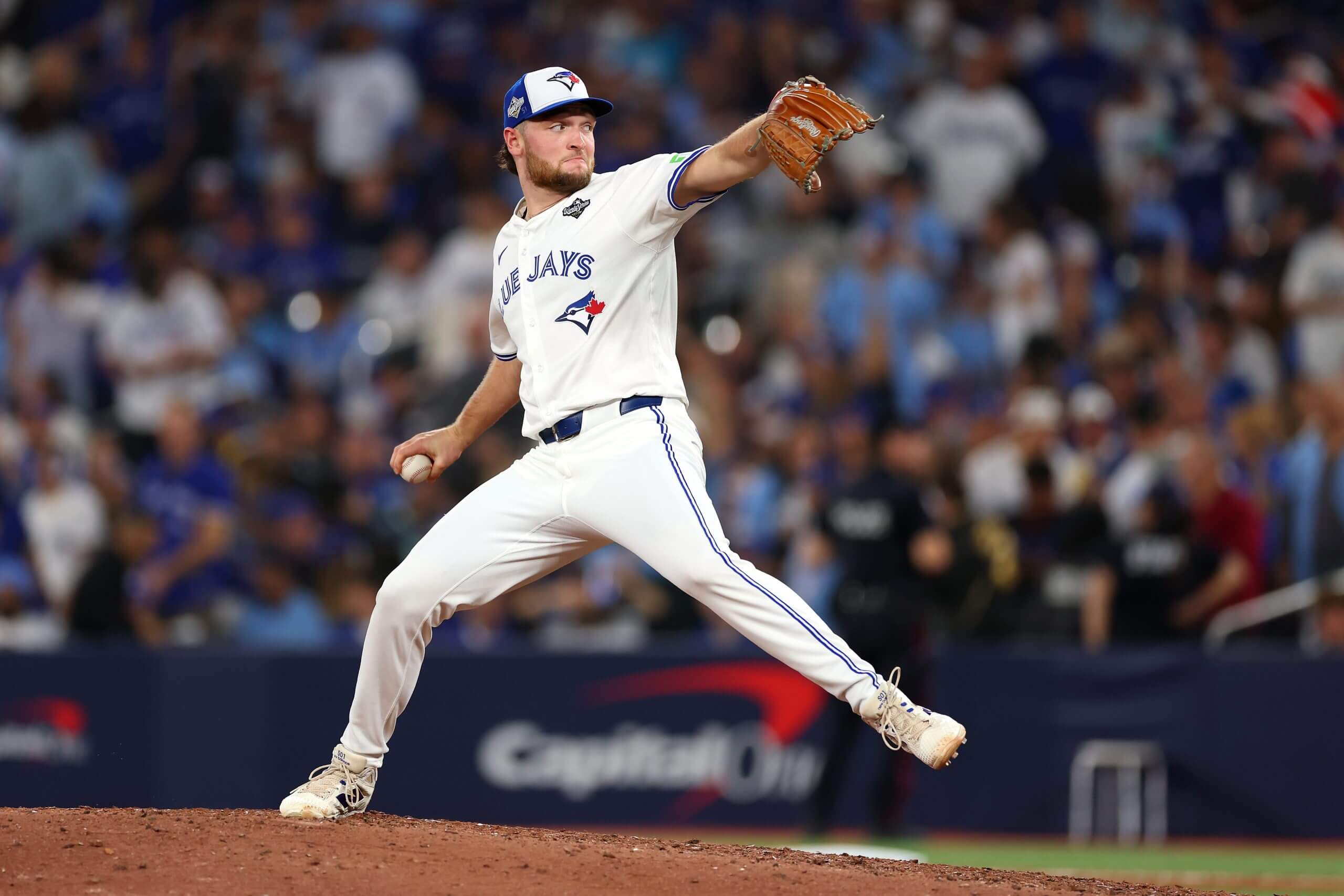
Trey Yesavage was one of three Blue Jays starters who appeared in Game 7. (Gregory Shamus / Getty Images)
But hold on. This gets even Weirder and Wilder, because the Blue Jays used three of their starting pitchers in this game, too: Max Scherzer (who started), Trey Yesavage and Bieber.
So if you’re paying attention out there, yes, that means these two teams combined to use seven pitchers in this astonishing Game 7 who had also started games in this World Series. Naturally, I asked STATS to dig into that development.
Turns out there has been only one other game in World Series history in which two teams used seven members of their World Series rotations in the same game. And that one happened as recently as 101 years ago, when the 1924 Giants and Senators did it. The Giants used Art Nehf, Hugh McQuillan, Virgil Barnes and Jack Bentley. The Senators trotted out Firpo Marberry, George Mogridge and emergency reliever Walter Johnson.
I’d have bet my copy of the Life and Times of Firpo Marberry that this would never happen again. But then … Game 7 of this World Series happened!
He’s Trey-Dimensional
All right, one more item on starters who did their Andrés Muñoz impression in this game. Before the Dodgers arose from the dead to win Saturday night, the most unforgettable entrance by a starter trotting out of the bullpen did not involve Yamamoto.
Instead, it was the oh-wow moment in the seventh inning, when Blue Jays phenom Trey Yesavage arrived on the mound, three days after starting and winning Game 5, to face none other than … Ohtani.
OK, so Yesavage’s six-batter outing didn’t quite channel the modern-day Madison Bumgarner vibe that Jays manager John Schneider was hoping for. Yesavage walked Ohtani to lead off the top of the seventh, then allowed a home run to Max Muncy in the eighth that cut the Toronto lead to a run.
Nevertheless, his relief appearance was still A Moment. So I asked STATS to check on this one, too. And would you believe …
This was the first time a pitcher who had won Game 5 as a starter then entered Game 7 in relief — to face that season’s MVP — in 65 years!
It’s happened only one other time in the MVP era. That was in Game 7, 1960 — when Harvey Haddix, the Pirates’ Game 5 starter, was called in from the ’pen to face a fellow named Roger Maris, who was about to win his first MVP trophy.
So how’d that go? Haddix got Maris to popup — but then blew the Pirates’ two-run lead, with Mickey Mantle and Yogi Berra driving in the runs. No problem! A few minutes later, nobody much cared, thanks to a historic home run by a man named Mazeroski.
Jeff, meet Mariano
Speaking of blown saves, it’s time to talk about poor Jeff Hoffman.
The Blue Jays’ closer had put together a tremendous postseason before Saturday, allowing just five hits (and no home runs) to the 43 hitters he’d faced, while giving up one earned run for a picturesque 0.82 ERA. But, thanks to Rojas, few will remember all his fine work before that untimely hung slider.
Hoffman becomes only the third reliever since the dawn of the modern save rule (in 1969) to blow a save in the ninth inning, with his team no more than three outs from winning the World Series. At least one of the other two proves there can be life after Game 7 blown saves:
Mariano Rivera, 2001 — The Yankees were one out away from a four-peat. But Luis Gonzalez had other plans.
Jose Mesa, 1997 — This one was even more painful. Cleveland was two outs away from ending 49 years of championship-free torture, except that’s not how this turned out. Mesa allowed singles to the Marlins’ Moises Alou and Charles Johnson. Then Craig Counsell (yes, that Craig Counsell) tied the game with a sacrifice fly. And 28 years later, championship-free torture in Cleveland is still a thing.
So maybe there will be more chances for Hoffman, just as there were for Rivera. But sometimes, the chance to wipe away those ugly postseason moments never comes back around. Mesa — and the entire population of Cleveland — could tell him all about it.
Bo knows bombs
It wouldn’t be a stretch to say that Saturday very well might have been Bo Bichette’s final game as a Blue Jay. And he’d carved out quite a storyline for himself … until the Dodgers brought in their Rewrite Department.
This was the third-inning swing we thought — until late in the evening — Bo would be forever remembered for.
BO BICHETTE BELTS ONE TO DEEP CENTER 🤯@BLUEJAYS LEAD 3-0 IN GAME 7 pic.twitter.com/64ai0Udfyl
— MLB (@MLB) November 2, 2025
When this ball landed, the Blue Jays led Game 7, 3-0. And if there was a louder place in North America than Rogers Centre, I hope somebody working nearby had an earplug concession stand.
Along with this homer, off a scuffling Ohtani, came some big-time Weird and Wildness:
• It was Bichette’s first extra-base hit since Sept. 6 (the day he hurt his left knee).
• Ohtani, meanwhile, hadn’t given up a home run with a runner on base all season. And Bichette hadn’t hit a go-ahead home run with a runner on base in this ballpark all season.
• It was only the third go-ahead three-run homer in Game 7 history, believe it or not. And the other two both happened in the same game! That was the legendary Game 7, 1960 classic that keeps coming up in this column. Yogi Berra and Hal Smith both hit go-ahead three-run bombs in that one. Like Bo, neither of them came away with a home run that won that game. (Yeah, it was all that Mazeroski guy’s fault that day.)
• And does anyone else find this shocking? Bichette’s blast was only the sixth three-run homer ever hit in any Game 7. The last one happened as recently as 58 years ago — a Julian Javier shot off Jim Lonborg in the 1967 Series.
If Miguel Rojas hadn’t found his power stroke, you would have found yourself reading so much more about Bichette’s day in this column. But that’s how the baseball writing biz goes sometimes.
In other news …
There was so much more in this sensational baseball game.
The benches cleared? Yeah, they did. After Justin Wrobleski plunked Andrés Giménez in the fourth inning, Giménez made just enough gestures and uttered just enough words not heard on Nickelodeon that both benches and bullpens got in a little productive running and milling around.
You can’t believe how many occupants of the press box wanted me to research the last time there was a bench-clearing something or other in a Game 7. Sorry! Even I couldn’t figure out how to research that one.
The Andy Pages catch! You knew the manager of the Dodgers was doing some savvy button-pushing on this day, when in the ninth, he cagily inserted Andy Pages into the game in center field, in place of Tommy Edman, in mid-inning — and then, with two outs and the bases loaded, this happened:
OH MY GOODNESS WE ARE GOING TO EXTRAS pic.twitter.com/r3I9Swj4gg
— MLB (@MLB) November 2, 2025
That was Pages, steamrolling his left fielder, Kiké Hernández, to make a World Series-saving catch even though, by almost any rational measure of outfield geography, this was the left fielder’s ball.
“I was going to pull a Willie Mays,” Hernández quipped afterward. “And then he tackled me.”
Starring on 30 Rock … was the breakout star of this postseason, Toronto’s Ernie Clement. Oh by the way, he was the guy who hit the ball that Pages ran down. But even though that turned into an out, Clement still got 30 hits (and batted .411) in the playoffs — the most hits ever in a single postseason. Among the players who didn’t get 30 hits in the entire regular season: Gary Sánchez, Jhonkensy Noel and Austin Hedges.
Louis the 15th! We actually had this debate in the press box at one point. Which was more likely to happen this week — the sun rising or “Every Day” Louis Varland pitching that day? And we decided Varland was the correct answer. Craig Kimbrel pitched in 14 games all season. Varland pitched in 15 games just in this postseason, the most ever. Who knew!
Max versus Shohei! It seems like a long time ago. But this game had the kind of pitching matchup that belongs on a marquee. It was the first Game 7 featuring a three-time Cy Young Award winner (Scherzer) starting against a man about to become a four-time MVP (Ohtani).
As YES Network’s James Smyth observed on BlueSky, some day this matchup will join the ranks of winner-take-all World Series games featuring two Hall of Fame starters. Here are the three currently on that list:
1991 — Morris versus John Smoltz
1965 — Sandy Koufax versus Jim Kaat
1926 — Jesse Haines versus Waite Hoyt
The Dodgers’ road to repeating was longer than Marco Polo’s! Hey, did you hear that the Dodgers became the first World Series champs to repeat in a quarter-century? Or that they became only the second National League team to repeat in the last 100 years (joining the fabled 1975-76 Big Red Machine)?
I wrote all about that after Game 2. So in this space, I thought I’d let you know just how long their road to repeating really was. They opened their season in Tokyo, on March 18. Which means …
Their “season” lasted an outrageous 228 days, and spanned three countries on two continents. They also traveled (by my count) 63,488 miles in the air this season. That’s the equivalent of more than two and a half trips around the world! When I passed that air miles update along to Muncy, he shook his head and said: “That’s crazy.”
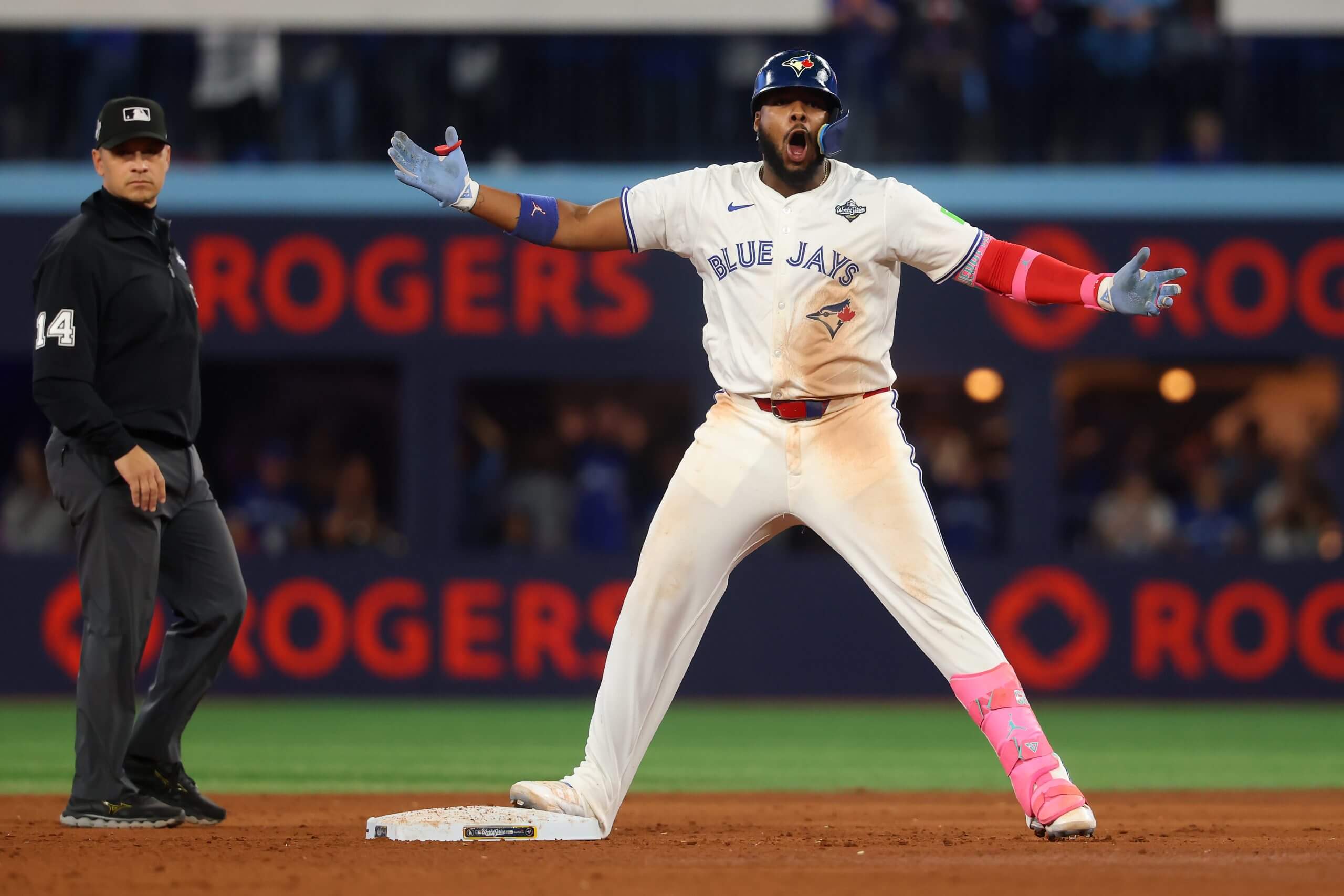
This World Series just kept delivering moments, from Vlad Jr. to Ohtani, Yesavage to Yamamoto, and many more. (Gregory Shamus / Getty Images)
Wow, what a great World Series! Finally, I hope you realize you’ve spent the last week and a half watching one of the very best World Series ever played. I wrote about it in Friday night’s column. But let’s update it now.
This Series had some similarities to 1975 (Reds-Red Sox) and 1964 (Cardinals-Yankees). But it’s honestly in a class by itself — because it’s the first World Series in history to feature all of this …
• A pinch-hit grand slam (by Addison Barger)
• Two extra-inning games (18 innings in Game 3, 11 innings in Game 7)
• Two extra-inning homers (by Freeman and Smith)
• A walk-off homer (by Freeman)
• A 7-4 double play to end a game (Game 6)
• Back-to-back homers to lead off a game (Game 5)
• A complete game (by Yamamoto)
• The first 12-strikeout, zero-walk game pitched in World Series history (by Yesavage)
• A player who reached base nine times in one game (Ohtani)
• A game-tying ninth-inning homer that flipped the World Series (by Rojas)
• And a Game 7 so good, the men who played in it have no doubt it was the best ever
We can debate someday where that game and this World Series rank among the all-time classics. But let’s leave that for another time. What matters, in the here and now, is that it was a World Series that reminded us all why there’s no better sport ever invented than …
Baseball!