
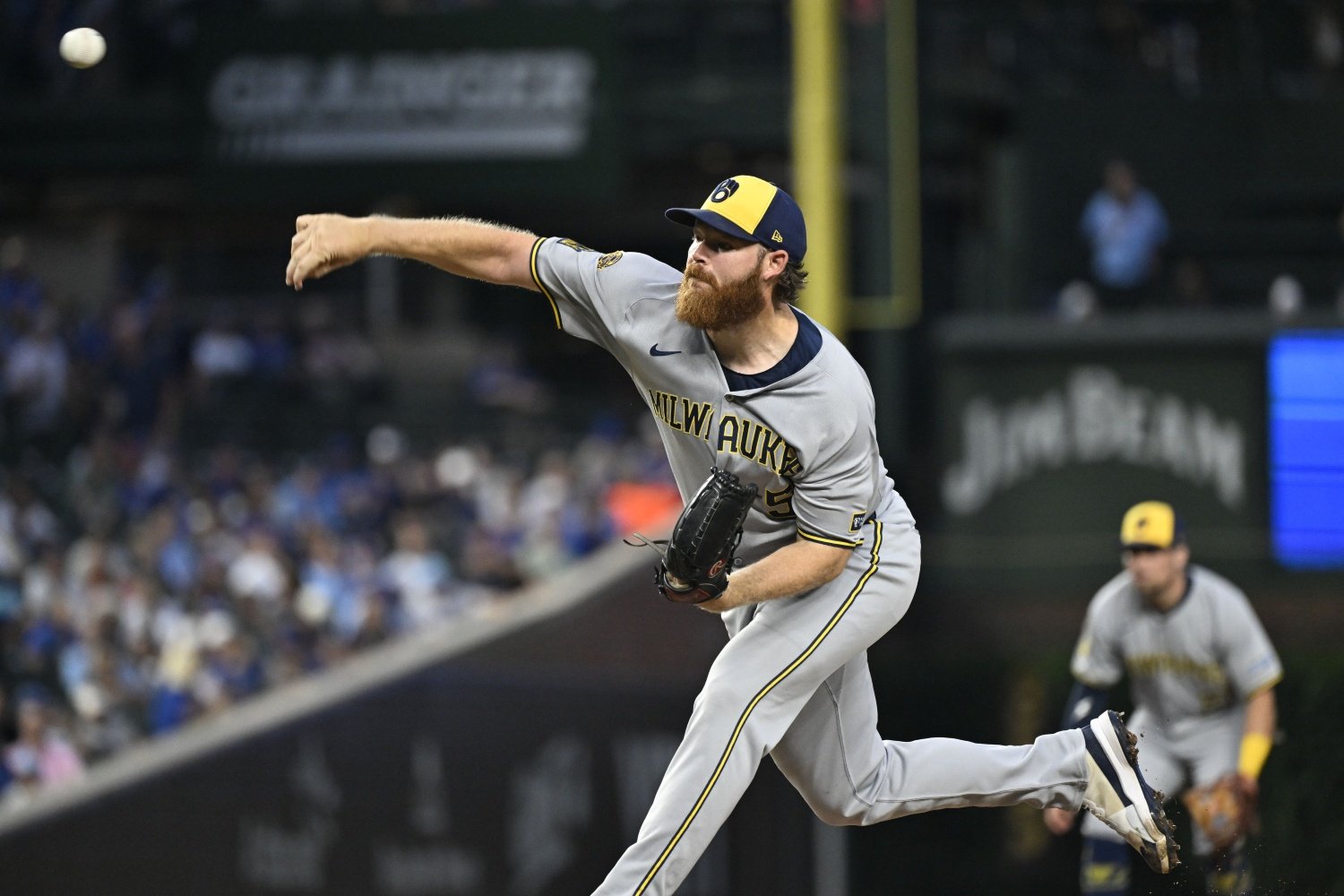
As expected, the Brewers declined their half of the mutual option on Danny Jansen on Monday. Equally unsurprisingly, Brandon Woodruff declined his side of a mutual option for 2026. Milwaukee will owe buyouts to Jansen and Woodruff, but the $10 million they’ll pay to the latter will be divided evenly between January and July installments, and it’s a small price to pay to have had Woodruff under contract for just $5 million in 2025. They’re letting each player hit the market, but there’s a good chance they’ll re-engage with Woodruff in the coming days and weeks. He’s more likely to find his highest bidder elsewhere, but the Brewers won’t simply wave goodbye and the door and turn away from their erstwhile co-ace.
For now, though, Jansen and Woodruff join the pool of free agents and come off the Milwaukee roster, which made room for Coleman Crow. After a strong season was cut short by injuries, it was an open question whether Crow would merit such a spot. He’s only pitched twice at Triple-A Nashville, and between the injuries that have held him to a total of 74 innings since the start of 2023 and the lack of experience at the highest level of the minors, it’s hard to imagine that he’ll make much of a contribution in 2026. He’s a dubious use of a roster spot, at the front end of the winter, but the team clearly didn’t want to lose him for nothing. They’ll try to navigate at least the early stages of next season with a slightly shorter 40-man, in the hope that Crow can come up and contribute as needed by the time the early spring gives way to summer.
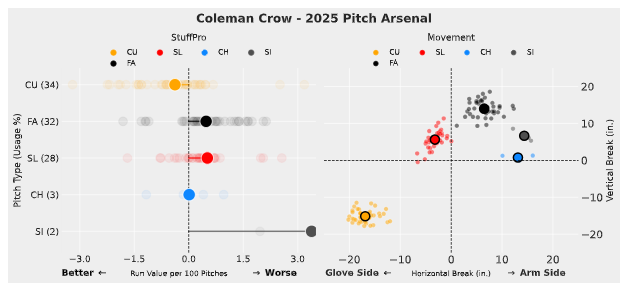
Crow has five pitches, in theory, but his sinker and changeup don’t yet look playable by major-league standards. He does generate excellent spin rates and a flat vertical approach on his four-seam fastball, but that pitch only sits 92-93, and it’s pretty ordinary, overall. His best offerings are a slow curveball in the mid-70s and a cutterish slider in the 87-88 range.
If the Brewers view Crow as a potential starter for 2026, it makes sense to retain him now. They probably wouldn’t have done so if they saw him only as a reliever, although the lines between multi-inning relief roles and that of a starter are blurrier than they used to be. As a starter, Crow has prospective utility, but he needs several more starts in the upper minors before he’s likely to be ready for that kind of assignment—and, to reiterate, his durability is a major question.
There are still, technically, decisions to come on a few more players with contract options for 2026. Milwaukee did officially exercise their option on Freddy Peralta, whom they can retain for $8 million in 2026, but that was never in doubt. Nor is it much of a mystery that the team will decline their sides of options with Jose Quintana and Rhys Hoskins. These procedural moves are important, but they’re also perfunctory. The departures of Jansen, Quintana, Hoskins and even (for now) Woodruff aren’t especially newsworthy, but the fact that Crow got one of the spots created by those moves is interesting. The Brewers are always working to build a homegrown, low-cost, deep pitching staff, and Crow fits into that paradigm. His upside is extremely limited, though, and the team is likely to need his roster spot for a better arm at some point next year.