
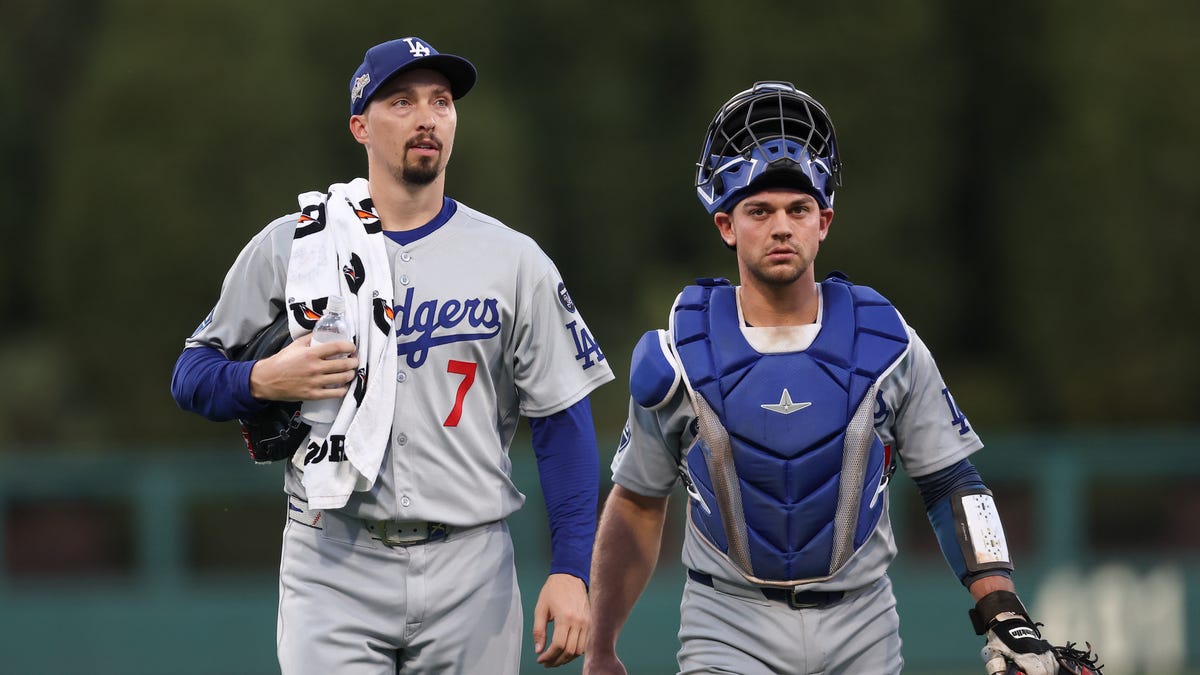
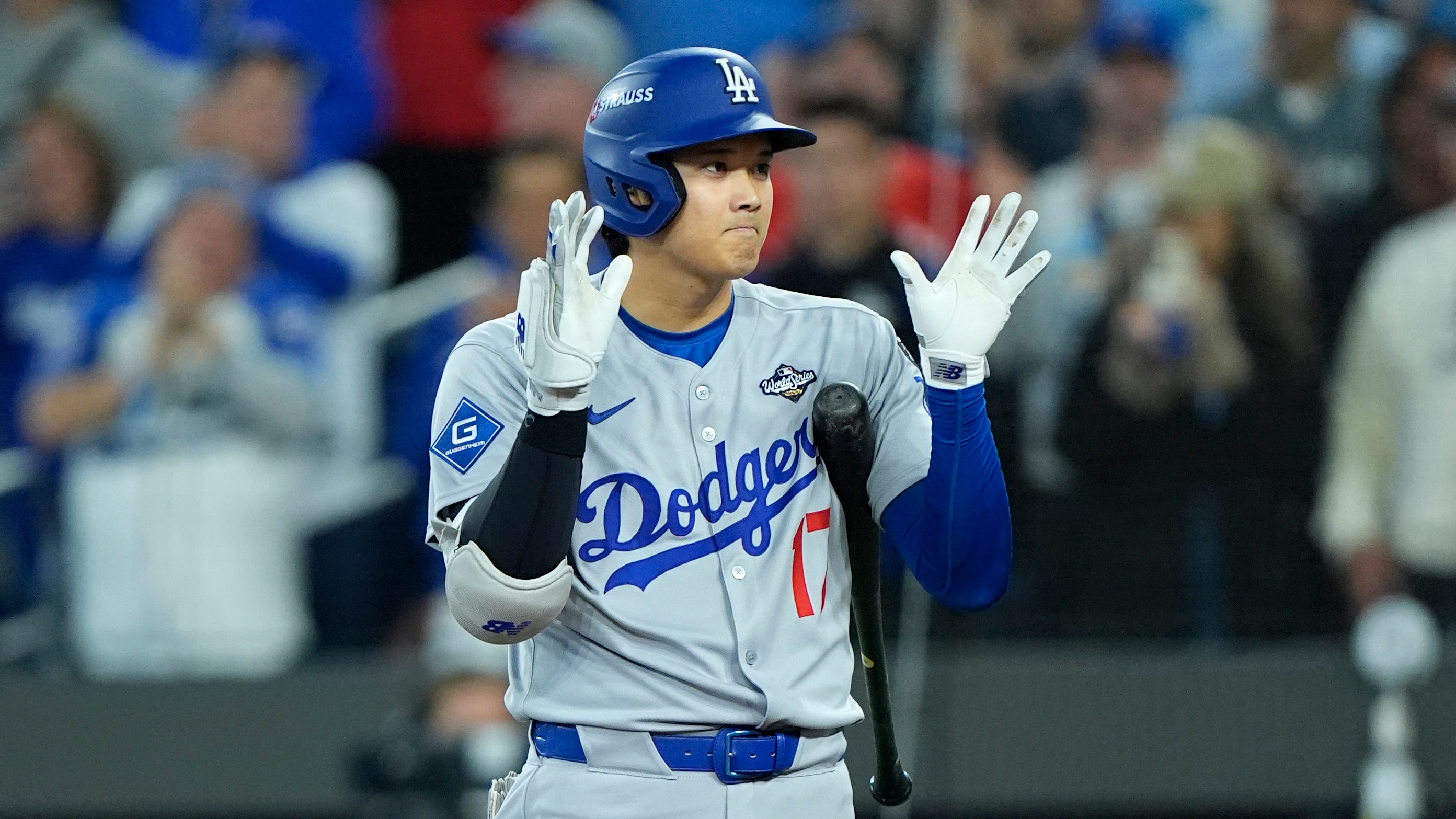

Dodgers beat Blue Jays, become first back-to-back champs since 2000
For the first time since 2000, MLB has a repeat champ. The Dodgers go back-to-back and cement their place among baseball’s modern dynasties.
Sports Pulse
Two Wisconsin high-school alumni celebrated with the Commissioner’s Trophy on Nov. 1, when the Los Angeles Dodgers repeated as World Series champs.
Outfielder Alex Call from River Falls finished with one hit and one walk in seven at-bats over the course of three games in the seven-game series.
Ben Rortvedt from Verona spent the entire series on the roster but not on the field, serving as a backup catcher to Will Smith. Smith, as it turned out, hit the go-ahead home run in extra innings of the seventh game and set a record for most innings caught in a World Series.
Rortvedt, acquired at the trade deadline from the Tampa Bay Rays, played 18 games for the Dodgers in the regular season, often filling in for an injured Smith. He had three hits, including a double, in the postseason.
Call, also acquired at the deadline from the Washington Nationals, played in 38 games for the Dodgers and had four hits and three walks in 15 postseason plate appearances.
It’s the second straight year the Dodgers have managed to get a Wisconsinite a ring, although not the same players. Gavin Lux of Kenosha won his second ring with the Dodgers last year.
They join a very small fraternity of Wisconsin-born players to win multiple World Series titles, including Tony Kubek, Al Simmons and Eric Hinske. Craig Counsell, who wasn’t born in Wisconsin but was raised in the state, also won a pair as a player.
Here’s a look at Wisconsin natives who won a World Series:
Gavin Lux (Kenosha Indian Trail), 2020 and 2024 with Los Angeles Dodgers
Lux hit a game-tying sacrifice fly in Game 5 of the 2024 series, knotting the Dodgers and New York Yankees at 6-6, before Mookie Betts followed with a go-ahead sacrifice fly in the 7-6 series-clinching win.
Lux was part of the 2020 Dodgers team that won the World Series but he only appeared in the division series during that postseason — and had just one plate appearance. This time around, the 26-year-old second baseman appeared in 12 games and had six hits, including a homer and a double.
The former minor-league player of the year missed all of 2023 after tearing his ACL. After the 2024 triumph, he was traded to the Cincinnati Reds, meaning he wasn’t there for the 2025 repeat.
Eric Hinske (Menasha), 2007 with Boston and 2009 with New York Yankees
The third baseman may mostly be associated with Toronto, but in 2007, he won a title with Boston, despite only making two plate appearances in the postseason — striking out both times.
Hinske actually played in three straight World Series with three different teams. He was with Tampa Bay in 2008 and homered in the 2008 World Series, though the Rays lost to Philadelphia. Hinske made the final out, striking out against Brad Lidge in Game 5.
But he won in 2009 when he played with the Yankees, walking and scoring a run in his one plate appearance in the World Series. Hinske didn’t play in the previous two rounds with New York.
Jarrod Washburn (Webster), 2002 with Anaheim
The University of Wisconsin-Oshkosh alumnus made two starts in the 2002 World Series and they went badly, with 10 runs allowed on 12 hits in just less than 10 innings, with a 9.31 ERA and 1.966 WHIP. Much of that damage was done in Game 5; he had a more standard line in Game 1, when he allowed four runs in just less than six innings. But, Washburn’s team still beat the San Francisco Giants in seven games.
Washburn also allowed one run in seven innings during an American League Championship Series win that year and appeared in the 2004 and 2005 postseasons with the Los Angeles Angels.
Damian Miller (West Salem), 2001 with Arizona
The former Viterbo University alumnus (in La Crosse) and future Milwaukee Brewer won a ring in the thrilling seven-game series win over the Yankees. He had two doubles and two RBIs in the World Series and ultimately appeared in 16 of 17 postseason games as the Diamondbacks’ starting catcher.
Gene Brabender (Black Earth), 1966 with Baltimore
Brewers fans might know the name; Brabender was with the Seattle Pilots during the franchise’s inaugural season in 1969 and came to Milwaukee and made 21 starts for the Brewers in 1970. As a rookie, he was part of the Orioles team that won the World Series over the Dodgers, although Brabender didn’t appear in the Series after posting a 3.55 ERA in 31 games (mostly out of the bullpen) that season.
Bob Uecker (Milwaukee), 1964 with St. Louis
You’ve heard of him? In his legendary career as Brewers radio broadcaster, Uecker has often returned to the well of disparaging his playing career, but you can’t take away the fact that he won a ring with the 1964 Cardinals over the Yankees, although Uecker didn’t appear in the World Series. He was traded by the Braves in April of that season to St. Louis. He was an alumnus of Milwaukee Tech.
Tony Kubek (Milwaukee), 1958, 1961 and 1962 with New York Yankees
Six years after Uecker won the Ford C. Frick Award given to a broadcaster each year during the Baseball Hall of Famer ceremony, Kubek also won.
One of the greatest MLB players to hail from Milwaukee, then-rookie 21-year-old Kubek saw his first World Series in 1957 and hit two home runs (both in Game 3, a four-RBI game) among his eight hits in seven games, but his hometown Milwaukee Braves defeated the Yankees that year. A throwing error at third base in the third inning of Game 7 opened the door for the Braves to score four runs. In the 1958 rematch, Kubek struggled mightily, with just one hit in 23 plate appearances, but this time, the Yankees won the seven-game series. Kubek played outfield and third base in 1957 but was at shortstop for much of what remained in his postseason career.
The Bay View High School alumnus drove in three runs with 10 hits in the 1960 World Series, but his team fell to the Pirates in seven games, and Kubek left Game 7 with a serious injury after being hit in the throat with a line drive.
Still, the Yankees came back to win each of the next two years, a five-game series win over the Cincinnati Reds and a seven-game series win over the Giants. Kubek had been pressed into military duty in 1962 but returned in time to join the Yankees in August of that season and then contributed to the title run.
Kubek, who just turned 90 in October, went on to a long career in broadcasting with the Yankees, Blue Jays and NBC broadcasting.
Ryne Duren (Cazenovia), 1958 with New York Yankees
Duren was an all-star this season and worked three World Series games in a seven-game series win over his home-state Milwaukee Braves. He finished with one save and two games finished, posting a 1.93 ERA over 9⅓ innings of work in that series, with 14 strikeouts. Duren made three all-star teams in his career, working largely as a reliever, and he served as a bit of inspiration for an iconic character in the movie “Major League.” The high school he attended in Cazenovia is now known as Weston High School.
John DeMerit (Port Washington) and Andy Pafko (Boyceville), 1957 with Milwaukee Braves
When Milwaukee won its one and only World Series, it had two Wisconsinites on board. DeMerit, who played college baseball at UW-Madison, was an outfielder who made just one appearance in the World Series at age 21, without getting an at-bat. Pafko, a four-time all-star earlier in his career with the Cubs, was much more involved at age 36, making 15 plate appearances over 15 games, although he only finished with three singles. Pafko also had 10 plate appearances in the 1958 World Series, finishing with three hits (one double) and an RBI.
Hal Peck (Big Bend) and Ken Keltner (Milwaukee Tech), 1948 with Cleveland
Keltner served as Cleveland’s starting third baseman and a man who received MVP votes that season, after he drove in 119 runs with 31 homers and a .917 OPS, far and away the best numbers of his career. In the World Series, however, he was limited to just two hits in 23 plate appearances against the Boston Braves, with two walks and three runs scored. One was a big one, though, when he singled against Warren Spahn in the eighth and scored the run that ultimately proved the winning tally in a 4-3 win Game 6 to clinch the series victory.
Peck, an outfielder, appeared in just one game and didn’t bat for Cleveland in the World Series. He appeared in 45 games for Cleveland that season.
Morrie Arnovich (Superior), 1940 with Cincinnati
The left fielder had been an all-star with Philadelphia the year before but was traded midway through the season to Cincinnati; he went on to make two plate appearances with a sacrifice in the 1940 World Series; the Reds beat the Detroit Tigers in seven games.
Burleigh Grimes (Emerald), 1931 with St. Louis
The Hall of Fame pitcher already had five World Series starts under his belt and was 37 by the time his Cardinals defeated the Philadelphia Athletics in 1931. He had lost both games in a six-game series loss to Philadelphia in 1930, and he’d gone 1-2 with Brooklyn in a series loss to Cleveland in 1920. In 1931, he was at his best, recording a 2.04 ERA in his two starts (17⅔ innings), allowing just four earned runs. That included a win in Game 7, when he gutted through appendix pain to pitch eight scoreless innings. He was finally pulled after two outs in the ninth, and even though the A’s scored twice, the 4-2 win clinched the title for the Cardinals. All told, including two appearances in 1932, Grimes pitched 56⅔ innings of World Series baseball.
Al Simmons (Milwaukee), 1929 and 1930 with Philadelphia Athletics
Bucketfoot Al is probably the greatest player Milwaukee ever produced, and today, you’ll find the Milwaukee South Division alumnus in the Baseball Hall of Fame. He was 27 and 28 when he helped lead the Athletics to back-to-back World Series triumphs, first over Chicago in five games and then against St. Louis in six. Simmons hit two homers and drove in four runs in the latter series and belted two homers with five RBIs in the former. In Game 2 of the 1929 World Series, Simmons homered twice in a 9-3 win over the Cubs. In Game 4, he opened the seventh inning with a homer and later singled and scored the go-ahead run as Philadelphia scored a remarkable 10 runs in the inning to overcome an 8-0 deficit and prevail.
Simmons hit two more homers and drove in eight runs despite a seven-game loss to St. Louis in the 1931 World Series. Overall, he finished with six World Series homers and 17 RBIs, part of a 1.037 OPS.
Fred Thomas (Rice Lake), 1918 with Boston Red Sox
The third baseman collected two hits in 19 plate appearances during the World Series with Boston when the Red Sox defeated the Cubs in six games.
Happy Felsch (Milwaukee), 1917 with Chicago White Sox
The outfielder had six hits, including a double and homer, as the White Sox defeated the New York Giants in six games. His homer in Game 1 gave his team a 2-0 lead, in a game the White Sox eventually won, 2-1. Felsch is better known for the 1919 World Series, when he was part of a group paid to intentionally lose the World Series and was subsequently banned from baseball. Charlie Sheen portrayed Felsch in the movie “Eight Men Out.” The real Felsch is buried in Brookfield.
Billy Sullivan (Fort Atkinson) and Roy Patterson (St. Croix Falls), 1906 with Chicago White Sox
Sullivan didn’t get a hit in 22 plate appearances with the White Sox during the World Series, but the starting catcher wasn’t exactly a masher; the White Sox had a reputation for being a weak hitting team that nonetheless won games, with the nickname “Hitless Wonders.” His squad defeated the crosstown Cubs, four games to two.
Patterson didn’t play in the World Series but had an excellent regular season, posting a 2.09 ERA in 142 innings.
Claude Elliott (Pardeeville), 1905 with New York Giants
Elliott didn’t pitch in the 4-1 World Series win over the Philadelphia A’s. He had a 4.74 ERA that season in 10 games; it was his third and final year in Major League Baseball.
Bonus: Craig Counsell (Whitefish Bay), 1997 with Florida and 2001 with Arizona
He was born in Indiana but nonetheless became Milwaukee’s favorite son (for … a while, anyway), attending Whitefish Bay High School and enjoying some remarkable career highlights during his 16-year Major League Baseball career as a utility infielder. He famously scored the winning run in Game 7 of the 1997 World Series, scoring on a line-drive single in the 11th by Édgar Rentería to defeat Cleveland.
He won another ring with Arizona in 2001 on another walk-off winner in the seventh, though he did his best work in the NLCS when he was named the series MVP, with a .905 OPS and four RBIs. Counsell, of course, later made playoff appearances with the Brewers in 2008 and 2011 and became the team’s manager in 2015, on his way to becoming the franchise’s all-time leader in managerial wins. He jumped to the Chicago Cubs to become their manager in 2024.
Bonus: Jarvis Brown (Kenosha), 1991 with Minnesota
Technically born across the border in Waukegan, Illinois, Brown nonetheless played at Kenosha St. Joseph and played in three World Series games for the Twins in a victorious and unforgettable seven-game series. Brown went 0-for-2 at the plate in that series against the Braves, but as a pinch runner in Game 7, he was standing on third base in the bottom of the ninth with two outs and could have been the winning run had Paul Sorrento not struck out. Instead, the Twins won in the 10th, 1-0, when Gene Larkin (hitting in Brown’s spot) scored the winning run with what went down as an RBI single.
(This story was updated to add new information.)
Special thanks to Baseball-Reference.com.