
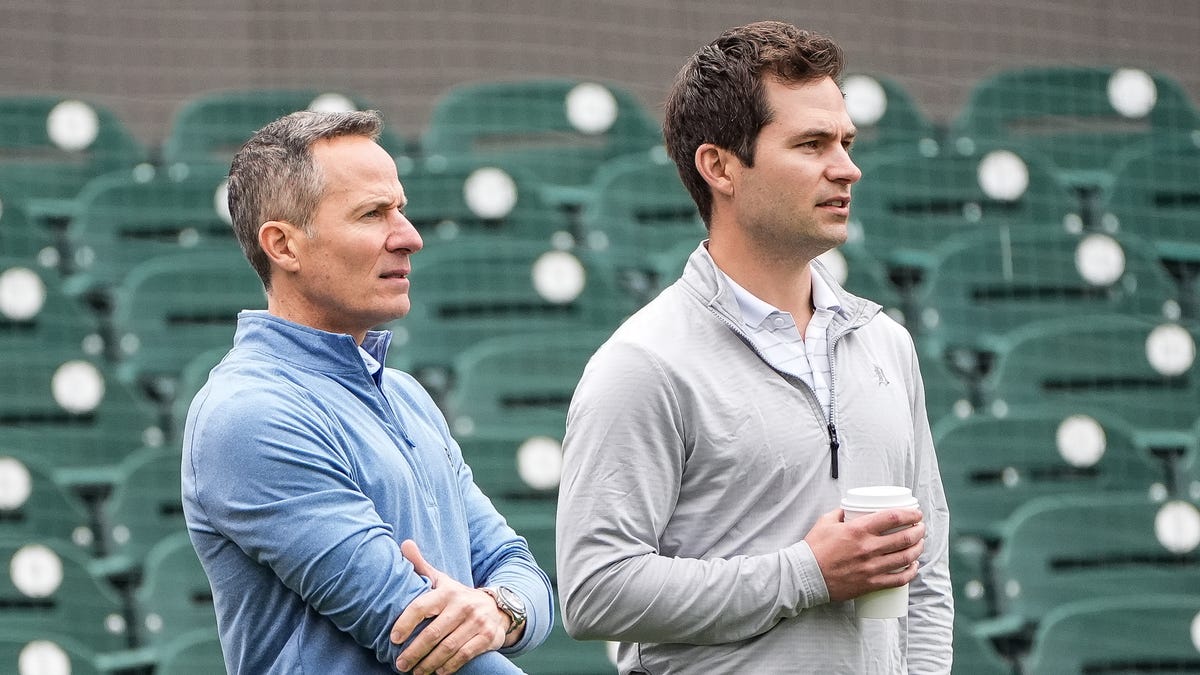
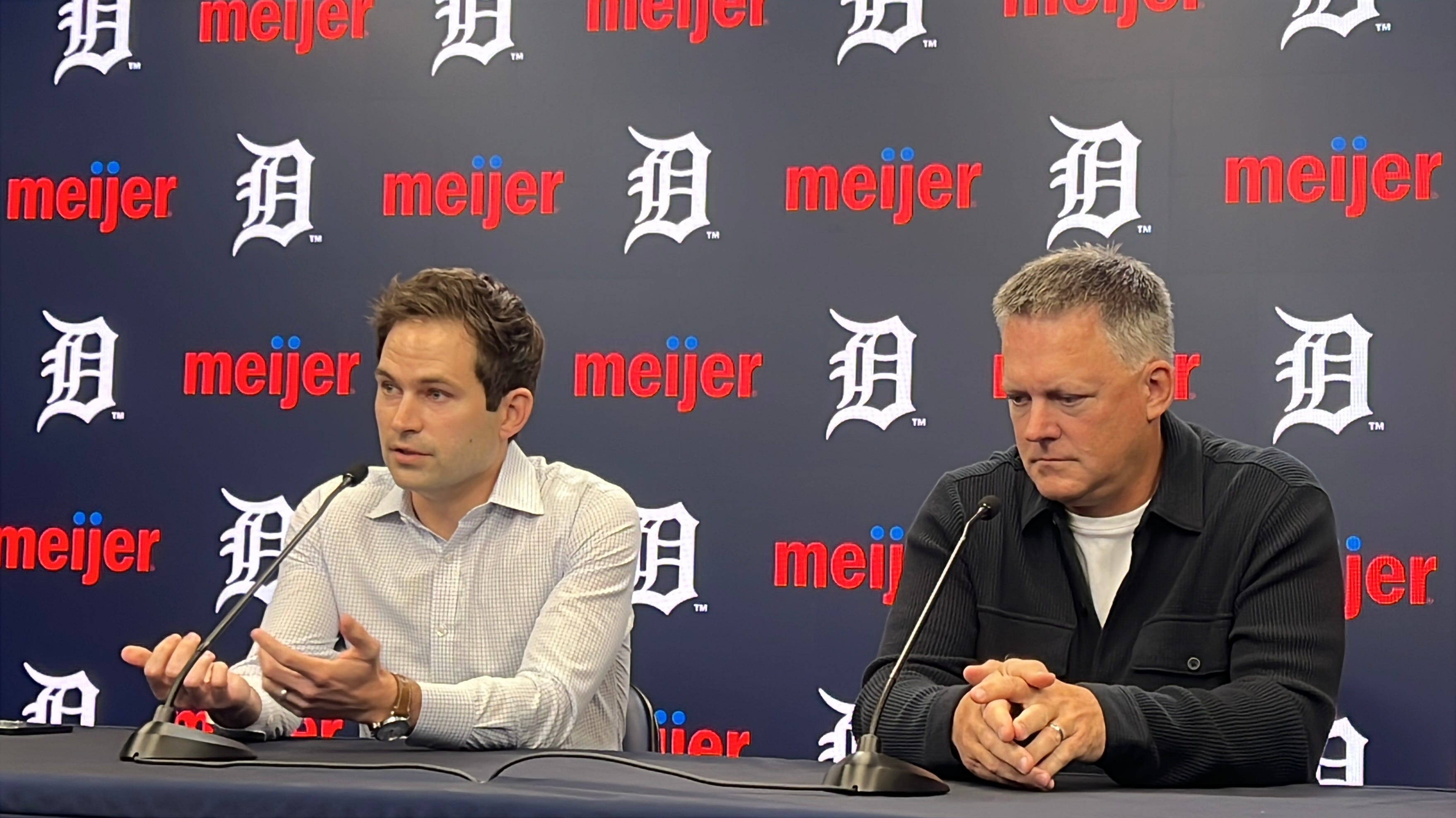

Detroit Tigers president of baseball Scott Harris recaps 2025 season
Detroit Tigers president of baseball operations Scott Harris opened his news conference with a long statement Oct. 13, 2025, at Comerica Park.
Entering the 2025-26 offseason, the Detroit Tigers project to have a payroll of roughly $115 million in the 2026 season. If that number holds, the 2026 Opening Day payroll would rank in the bottom half of the 30 MLB teams.
The Tigers have financial flexibility to upgrade their roster this offseason through trades and free agency.
The uncertainty of a 2026 payroll projection – likely between $100 million and $125 million, but no more than $140 million – stems from the $40 million tied to four players with contract options and the projected $60 million for 15 arbitration-eligible players.
The four contract options must be accepted or declined by Thursday, Nov. 6: right-hander Jack Flaherty with a $20 million player option, right-hander Paul Sewald with a $10 million mutual option ($1 million buyout), right-hander Randy Dobnak with a $6 million club option ($1 million buyout) and right-hander José Urquidy with a $4 million club option.
The Tigers ranked 17th with a $143 million payroll on 2025 Opening Day, well below the three highest spenders – the New York Mets ($323 million), Los Angeles Dodgers ($321 million) and New York Yankees ($293 million) – and well above the three lowest spenders, the Tampa Bay Rays ($79 million), Athletics ($73 million) and Miami Marlins ($67 million).
Here’s a look at the Tigers’ payroll, with Scott Harris set to embark on his fourth offseason as the president of baseball operations:
Guaranteed contracts: $28.3 million
SS Javier Báez: $24 million.
INF Colt Keith: $4.3 million.
Báez enters the fifth season of his six-year, $140 million contract, which accounts for more than 20% of the Tigers’ projected $115 million payroll. After 2026, he is owed another $24 million in 2027 before his deal is up. He provided positive value in 2025 and remains the No. 1 shortstop on the depth chart entering 2026, so the Tigers are expected to keep him, even if he only serves in a platoon role. Keith enters the third season of his six-year, $28.64 million contract signed before his MLB debut. His team-friendly deal, age (still just 24 after two seasons), defensive versatility, offensive upside and former top-prospect pedigree could make him an appealing trade candidate.
Player options: $20 million
RHP Jack Flaherty: $20 million.
What the Tigers do this offseason – and how much money they spend to acquire players – could hinge on Flaherty’s impending decision on whether to stay in Detroit or decline his player option and test free agency for the third straight offseason. He signed a two-year, $35 million contract that guaranteed $25 million for 2025 and included a $10 million player option for 2026, but the value of the player option increased to $20 million once he reached 15 starts in 2025. Flaherty posted a 4.64 ERA with 59 walks and 188 strikeouts across 161 innings in 31 starts. The question: Can he find a better deal than one year and $20 million on the open market? That’s for Flaherty to decide.
Club options: $10 million
RHP Randy Dobnak: $6 million.
RHP José Urquidy: $4 million.
The Tigers have shown a commitment to Urquidy after guiding him through rehab from his second Tommy John surgery and facilitating his MLB return after a two-year absence. Expect them to accept his $4 million club option, keeping him for 2026 – and perhaps throwing him into the competition for the final spot in the starting rotation. It would be surprising if the Tigers picked up Dobnak’s $6 million club option, which includes a $1 million buyout. The Tigers acquired the former USPBL success story from the Minnesota Twins in the Chris Paddack trade before the July 31 trade deadline, with the Twins using the trade as a way to dump his salary. Although Dobnak posted a 3.79 ERA over 38 innings in nine games (eight starts) with Triple-A Toledo after the trade, he probably isn’t worth $6 million. If the Tigers were to keep him, his contract also includes a $7 million club option for 2027 and an $8.5 million club option for 2028, both with $100,000 buyouts.
Mutual options: $10 million
RHP Paul Sewald: $10 million.
For mutual options, both the player and the club must accept – if both sides agree, the player returns; if either side declines, the player becomes a free agent. In Sewald’s case, the Tigers are expected to decline the $10 million mutual option, which includes a $1 million buyout. The Tigers acquired an injured Sewald from the Cleveland Guardians at the July 31 trade deadline with hopes that he would help as a high-leverage reliever in the postseason. But he wasn’t trusted enough to pitch in the best-of-three AL wild-card series and wasn’t included on the roster for the best-of-five ALDS. He earned $7 million in 2025 and posted a 4.58 ERA across 19⅔ innings in 22 games, limited by two shoulder injuries. Based on that, he doesn’t deserve a raise via the mutual option, though the Tigers could decline and try to re-sign him at a cheaper rate.
Salary arbitration: $61.65 million
Players on the 40-man roster with fewer than six years of MLB service time must be tendered contracts, but players between three and six years – including Super Two qualifiers – can negotiate their salaries through the arbitration process.
There are two key dates: The non-tender deadline on Nov. 21 and the salary exchange deadline on Jan. 8.
For the first deadline, if a player is tendered, they’re guaranteed a contract, but if a player is non-tendered, they immediately become a free agent. For the second deadline, the tendered player and the team must agree to a salary to avoid an arbitration hearing.
This offseason, the Tigers have 15 players eligible for salary arbitration. Here is what each player – listed in order by service time – is expected to earn in 2026, as estimated by MLB Trade Rumors:
Tanner Rainey: $1.6 million.
Tarik Skubal: $17.8 million.
Casey Mize: $5.4 million.
Jake Rogers: $2.9 million.
Will Vest: $3.3 million.
Zach McKinstry: $3.5 million.
Matt Vierling: $3.1 million.
Jason Foley: $3.15 million.
Alex Lange: $900,000.
Andy Ibáñez: $1.8 million.
Riley Greene: $6.6 million.
Spencer Torkelson: $5.1 million.
Kerry Carpenter: $3.5 million.
Beau Brieske: $1.3 million.
Tyler Holton: $1.7 million.
Retaining all 15 arbitration-eligible players will cost the Tigers more than $60 million, with nearly 30% of that total going to Skubal. Most of the players are locks for new contracts, but Rainey is virtually guaranteed to be non-tendered while Brieske, Foley, Ibáñez, Lange and Vierling are possible non-tender candidates due to injury and underperformance.
Pre-arbitration: $15 million
The Tigers have several players on the 40-man roster due for pre-arbitration contracts, including Reese Olson (who missed Super Two status by less than 20 days of service time), Wenceel Pérez, Parker Meadows and Dillon Dingler. The MLB minimum salary is $780,000 for the 2026 season, an increase of $20,000 from 2025.
Contact Evan Petzold at epetzold@freepress.com or follow him @EvanPetzold.
Listen to our weekly Tigers show “Days of Roar” every Monday afternoon on demand at freep.com, Apple, Spotify or wherever you listen to podcasts.