
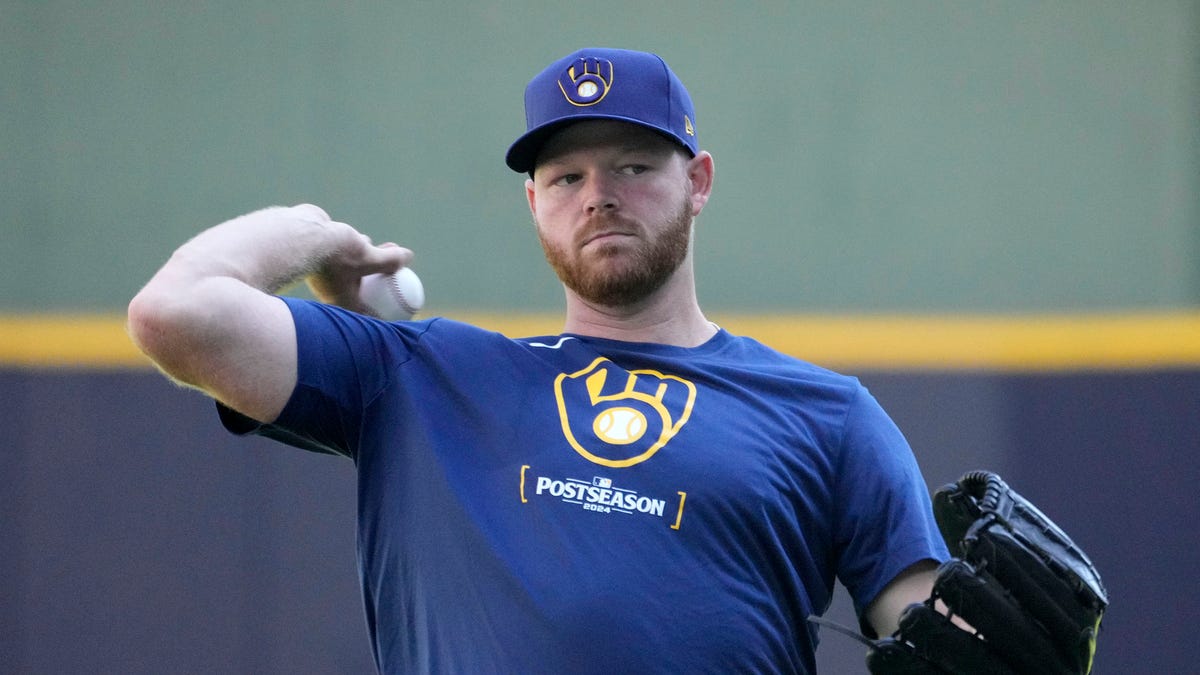


Watch Murphy’s son Austin answer a question about the Brewers 2-0 NLCS deficit
Watch Pat Murphy’s son Austin answer a question about the Brewers 2-0 NLCS deficit during an off-day news conference.
The 2025 Major League Baseball season is over, and the team that ousted the Milwaukee Brewers is now World Series champion for a second straight year and third time in six seasons.
The Los Angeles Dodgers won a thrilling seven-game series over the Toronto Blue Jays, with an 11-inning win in the finale, bringing us to the offseason.
So, when do things get going for the Brewers, a 97-win team in 2025 that stands to return most, if not all, of its key pieces in 2026?
Here are the offseason dates to know:
Nov. 6: Free agents can sign with any team; you should know about ‘qualifying offers’
The offseason begins in earnest Thursday, Nov. 6, when players are free to sign with new teams. Any player or team with a contract option will need to have those decisions made by 4 p.m. Central, and teams will also need to decide whether they want to issue “qualifying offers” to free agents.
First, a look at the roster decisions to note:
Brandon Woodruff, $20 million mutual option (or $10 million buyout). Woodruff has already declined.Rhys Hoskins, $18 million mutual option (or $4 million buyout)José Quintana, $15 million mutual option (or $2 million buyout)William Contreras, $12 million club option (or $100,000 buyout)Danny Jansen, $12 million mutual option (or $500,000 buyout). The Brewers have already declined.Freddy Peralta, $8 million club option. The Brewers have already exercised it.The other free agents are Shelby Miller and Jordan Montgomery
Don’t expect both sides to accept the Hoskins or Quintana options. Contreras is a little more complicated, and we’ll discuss that in a second.
What is a qualifying offer? It’s a one-year deal teams can offer their free agents, worth the mean salary of the league’s 125 highest-paid players, so that’s worth $22.025 million for 2026. If a player accepts the deal, that’s his salary for 2026. If a player declines (most do), he can explore the free-agent market.
A couple wrinkles: The player can’t have previously received a qualifying offer in his career, and the player must have been in the organization the entire season (so a mid-season acquisition like Jansen is ineligible).
Why is a qualifying offer important? If a team loses a free-agent who’s been offered a qualifying offer, the club that lost the player is eligible for draft-pick compensation in the following MLB draft. Last year, that pick was a pretty high one when Willy Adames received a qualifying offer and he signed for big bucks with the Giants; it was a “Competitive Balance A” pick that came right after the end of the normal first round.
Last year, that was the 32nd overall pick, and the Brewers used that to draft high-school infielder Brady Ebel, regarded as the No. 11 prospect in the organization by MLB Pipeline.
There are also penalties for the team signing the qualified free agent, with the loss of one or more draft picks based on where the team stands on the economic hierarchy of MLB. A “competitive balance tax payor” (the teams with the biggest payrolls) will lose something more valuable than what a “revenue-sharing recipient (like the Brewers, a team near the bottom of payrolls) would lose.
Will the Brewers issue any qualifying offers this year? The lone natural candidate is Woodruff. Even though Woodruff declined his option to essentially become a free agent, Milwaukee can then offer the qualifying offer and see if he chooses to take it; if he declines, it would mean draft compensation.
Why would the Brewers decline William Contreras’ option?
Last year, Contreras signed a one-year deal worth $6.1 million with a club option for $12 million in 2026. If that sounds low, it’s because Contreras is still subjected to the arbitration process, and that’s true again in 2026 if the Brewers decline the option. Perhaps the Brewers believe he’d make less in the arbitration process this offseason; MLB Trade Rumors ran projections that estimated Contreras was likely to earn $11.1 million.
The Brewers could theoretically decline the option and look for the savings; then again, that projection could be wrong and it winds up costing the Brewers money. Either way, Contreras would still be a Brewer next year, no matter what happens to that option.
Nov. 6: Awards season begins
There’s also some postseason hardware to hand out.
Nov. 6: National League Silver Slugger winners announced.Nov. 7: American League Silver Slugger winners announced.Nov. 10: Rookie of the Year winners announced. We could see a handful of Brewers finish in the voting.Nov. 11: Manager of the Year winners announced. Will Pat Murphy win for a second straight year?Nov. 12: Cy Young winners announced.Nov. 13: MVP winners announced.Nov. 13: Reliever of the Year, Comeback Player of the Year and Hank Aaron Award winners announced, and the All-MLB team gets revealed.Nov. 18: Deadline for players to accept a qualifying offer and a Rule 5 deadline
As mentioned above, this is where the Brewers, perhaps, get some news on Woodruff.
This is also the deadline teams have to add players to the 40-man roster or risk losing them to the Rule 5 Draft in December.
Last year, the Brewers elected to move Chad Patrick and Logan Henderson to the 40-man, and that paid off when both played roles on the 2025 team. They famously left Shane Smith unprotected, and he became the first overall Rule 5 pick by the White Sox, then represented Chicago in the all-star game.
The Brewers have already elected to add one name to the 40-man roster: Coleman Crow, a 24-year-old righty who has battled injuries in his career but has been highly intriguing. There aren’t any obvious additional candidates to add.
Nov. 21: Brewers must decide on non-tenders
By 7 p.m. CST, the Brewers must decide whether to offer contracts to arbitration and pre-arbitration players on their 40-man roster. Players who are non-tendered immediately become free agents.
Here’s the list of Brewers players who are arbitration eligible: Jake Bauers, Trevor Megill, Garrett Mitchell, Nick Mears, Blake Perkins, Brice Turang and Andrew Vaughn. Would the Brewers cut ties with any of these players and avoid paying them what they’ll make through the arbitration process?
It’s unlikely, but the Vaughn situation is interesting.
He’s projected to make $7.8 million by MLB Trade Rumors, which is a pretty significant sum. That dollar amount would have made him the fifth-highest paid player on last year’s team, and one of the guys ahead of him (Danny Jansen) was only here for a short time on a prorated cost.
Vaughn would certainly be worth that amount if the Brewers believe his post-trade breakout was real in 2025, but if not, it’s a tougher call. Safe to say, he’d immediately get snatched up by another team after his strong showing with the Brewers.
Dec. 7: Winter meetings begin
The annual extravaganza in Orlando runs through Dec. 10 and offers teams a chance to talk trades (among many other topics). We’ll also hear the names of players selected for the Pro Baseball Hall of Fame by the Hall by the Veterans Committee (newly named the Contemporary Baseball Era Players Committee). We should hear the names of the eight candidates under consideration sometime in early November. They’ll be players from the 1980s or later.
Dec. 9: Draft lottery
This won’t involve the Brewers, but the amateur draft lottery will decide the order of the top-six picks in the 2026 MLB Draft. The non-playoff teams all have a chance (except for three teams, including the Rockies, because they’ve had recent lottery successes) to get a top-six pick, with the White Sox holding the best chance.
Dec. 10: Rule 5 Draft
This is an annual opportunity for teams to pluck unprotected players (as in, not on a team’s 40-man roster and already in pro baseball for 4-5 years) off other teams’ organizational depth charts. Players must stay on their new team’s active roster for the entire 2026 season or get offered back to their original organization.
The Brewers selected reliever Connor Thomas via Rule 5 last year; he was eventually lost to a season-ending injury. They picked Gus Varland in 2022, but he was offered back to the Dodgers in May.
Jan. 8: Deadline to exchange salary figures in arbitration
This is the point where teams and players submit the salary they think they deserve for 2026.
Most arbitration-eligible players (usually players entering years 4-6 in the big leagues) and teams will come to terms on contracts for the 2026 season before it gets to a hearing, and many before this deadline.
If the team and player advance to a hearing, those take place at undetermined times in early February. At a hearing, arbitrators either select the player’s number or the team’s; there’s no middle ground, whereas teams and players can find a compromise point if they agree to terms outside a hearing.
Jan. 15: International signings announced
With the opening of the 2026 international-amateur signing period, teams will usually announce a new crop of international free agents. Brewers fans should pay attention; this is the process that brought Jackson Chourio into the organization, not to mention three of the team’s top four prospects: Jesús Made, Luis Peña and Jeferson Quero.
Jan. 21: Hall of Fame announcement
Unlike last year with CC Sabathia, there aren’t any Brewers who will figure prominently in the mix this year, although Ryan Braun is eligible for the first time.
Feb. 20: Spring training begins
Winter is thawing! Kind of. Many players will have already reported voluntarily before this date.
March 5-17: World Baseball Classic
We’ll get an early dose of baseball in 2026 because of the World Baseball Classic, which has been played sometimes with three-year gaps and sometimes four years. Will Sal Frelick lead Team Italy to glory? He played on the team in 2023 before making his big-league debut.
March 25: Opening Day, sort of
The San Francisco Giants host the New York Yankees in a standalone season opener.
March 26: Opening Day for the Brewers
It’s a Thursday game at American Family Field, with a 1:10 p.m. start against the Chicago White Sox. Let’s do it all again.