
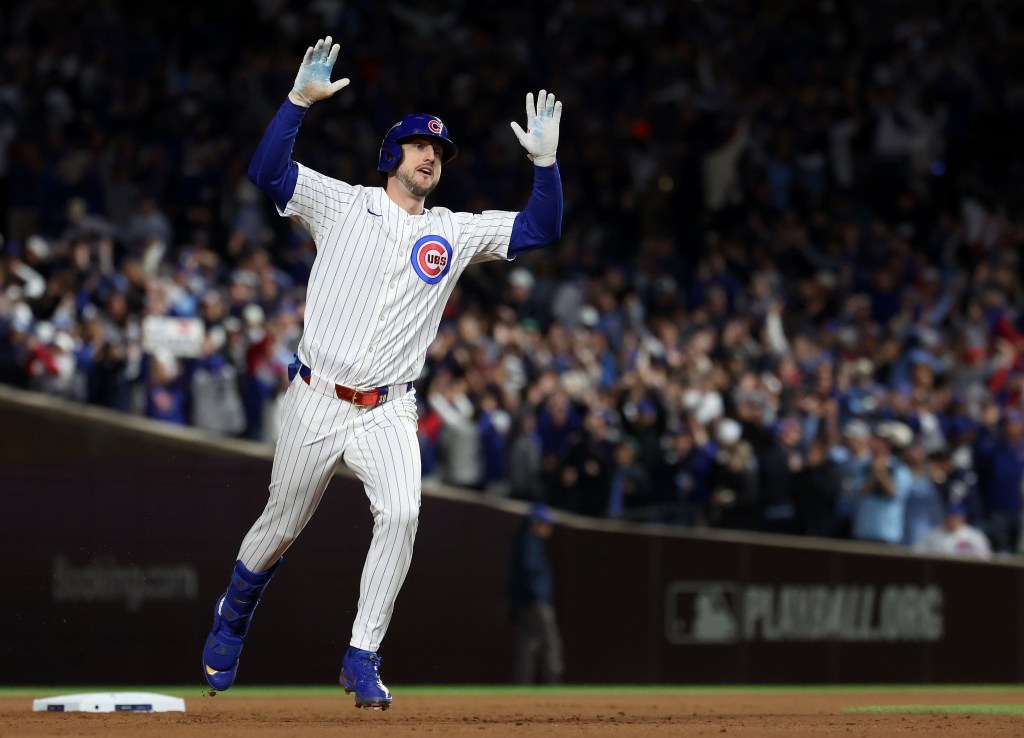
The Chicago Cubs’ offseason approach will soon start to take shape. Now that the World Series has ended, the Cubs face important decisions.
Their roster will largely stay intact, with Kyle Tucker holding the honor of being their most notable free agent. A season that ended one win shy of the National League Championship Series shows how well-constructed the 2025 version was in, at the very least, accomplishing their goal of returning to the postseason for the first time since 2020.
The Cubs fell short, though, of the deep October run they envisioned. So how do they replicate a 90-plus-win season and get farther in the playoffs next year?
Here are three key questions the Cubs face this offseason.
1. What approach will they take to upgrade the roster?
The core of the roster, namely the offensive side, will be back in 2026, and it could represent the last hurrah for that group.
Ian Happ, Nico Hoerner, Seiya Suzuki, Jameson Taillon and Matthew Boyd are entering the final year of their contracts. The Cubs have financial flexibility after 2026, but the expiring collective bargaining agreement at the conclusion of next season creates murkiness on how much long-term money teams will want to commit to their payrolls if the 2027 season is affected by a lockout.
Whether those economic conditions influence the Cubs’ willingness to add multiyear free-agent contracts will play a role in how aggressively they operate this offseason.
The Cubs needed players to outperform projections, something the front office noted would be important to the team’s 2025 success. They got those performances, namely from center fielder Pete Crow-Armstrong, first baseman Michael Busch, Hoerner, offensive output from the catchers and the bullpen, especially Brad Keller, Drew Pomeranz and Caleb Thielbar.
Part of the answer to improving the roster will come from within. Matt Shaw showed encouraging signs, especially defensively at third base, where he became a Gold Glove Award finalist. Crow-Armstrong didn’t sustain his MVP-level first half the rest of the way, leaving room for the 23-year-old to continue to grow. Cade Horton impressed in his rookie season, while the Cubs saw a good approach from catcher/designated hitter Moises Ballesteros.
The Cubs surely will look to address pitching depth again. But one of the biggest holes they likely need to fill doesn’t have an easy answer for replicating that type of production and impact.
2. How will the Cubs handle Kyle Tucker’s free agency and possibly replace his bat?
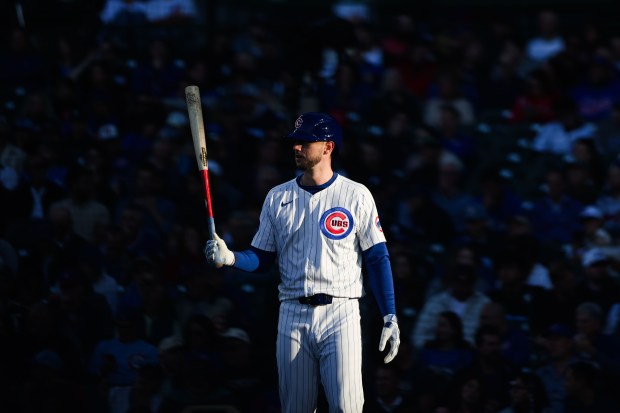 Cubs right fielder Kyle Tucker waits to hit during the first inning against the Marlins on May 13, 2025, at Wrigley Field. (Armando L. Sanchez/Chicago Tribune)
The Cubs fortunately do not have many key free-agent question marks, but Tucker’s potential departure puts pressure on the organization to either resign the 28-year-old or find an adequate replacement.
Tucker is expected to command top dollar in free agency after one season in Chicago following his seven years in Houston. The Cubs haven’t shown an appetite to delve into the megacontracts that span an uncomfortably long duration and dollar figure. They never were involved in Juan Soto’s free-agent process last offseason, which landed him a 15-year, $765 million deal with the New York Mets, or even with starting pitcher Corbin Burnes, who went to the Arizona Diamondbacks for six years and $210 million.
Shortstop Dansby Swanson’s seven-year, $177 million contract is one of the highest average-annual-value deals in franchise history. Bringing back Tucker would take them to another stratosphere. So if the Cubs decide not to attempt to re-sign Tucker or go to a financial mark they aren’t comfortable with, how they replace his presence in the lineup becomes one of if not the most important question of the offseason.
Even with his injuries, Tucker’s plate approach and power threat had an impact top-down on the lineup. Finding a hitter with that elite combination won’t be easy, and the Cubs might have to compromise on the type of hitter they feel best complements their returning group.
3. Will Shota Imanaga be a Cub in 2026?
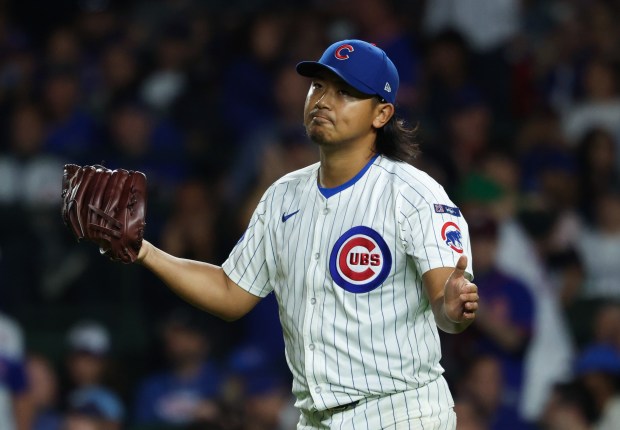 Cubs starting pitcher Shota Imanaga stands on the mound after giving up a three-run home run to Mets third baseman Brett Baty in the fourth inning Sept. 25, 2025, at Wrigley Field. (John J. Kim/Chicago Tribune)
Imanaga’s unique contract creates some murkiness on whether the lefty is part of the Cubs rotation next year, with both sides having a say in that outcome.
There are three possible scenarios that could play out this offseason:
The Cubs pick up Imanaga’s three-year, $57 million club option, tying him to the organization through the 2028 season and triggering a full no-trade clause.
The Cubs decline Imanaga’s three-year option, giving him a player option that would pay him $15 million in 2026 if he chose it.
Rather than selecting his player option — doing so also would give the Cubs a two-year, $42 million option after next season and set up the same player option for Imanaga — the 32-year-old declines it to become a free agent this offseason. The Cubs could put a qualifying offer on Imanaga that would be worth $22.025 million for 2026.
After a stellar debut season in 2024 in which he finished fourth in NL Rookie of the Year voting and fifth for the NL Cy Young Award, Imanaga came into this year expected to build off his first taste of major-league baseball. But he wasn’t able to come close to replicating his 2024 performance that featured a 2.91 ERA, 173 1/3 innings, a league-best 6.21 strikeout-to-walk ratio and a 137 ERA+ in 29 starts.
In 25 starts in 2025, Imanaga — who missed six weeks with a hamstring strain — posted a 3.73 ERA in 144 2/3 innings with a 4.50 K/BB ratio and a 103 ERA+.
Imanaga struggled during the second half with a 4.70 ERA in 13 starts, and his Game 2 start in the NLDS in Milwaukee was disastrous in a loss. Whether any of that causes the Cubs to reconsider a multiyear commitment to Imanaga is not yet clear. President of baseball operations Jed Hoyer didn’t provide much insight on the contract situation during his end-of-season news conference in October.
“When we signed Shota, if you had shown us his production over the last two years, we would’ve taken that in a heartbeat,” Hoyer said. “So not only has he produced for us, but he’s a great teammate and terrific asset to the organization. Obviously we have decisions to make and discussions to make — and over the next two or three weeks we’ll do that — but I’ve got nothing but positive things to say about Shota.”
Coming into the season, picking up Imanaga’s three-year option felt like an obvious decision given the premium on proven starting pitching. That very well could be the route the Cubs ultimately take with a rotation that returns Boyd, Taillon and Horton and expects to get Justin Steele back from his arm surgery early in the season.