

David Rubenstein didn’t wait long Tuesday to repeat a familiar phrase.
Seated a few feet from Orioles president of baseball operations Mike Elias as the team introduced new manager Craig Albernaz, the club’s owner again said Baltimore has “no particular financial constraints,” as MLB free agency begins this week.
Rubenstein boastfully added that Baltimore’s ownership is compiled of “an investor group that’s pretty deep-pocketed.”
“We are relying on what Mike and his team can do to find good players that want to be here and that can complement what we already have,” he said.
Take note how he said good players, not the best players.
Reading between the lines, his word choice of complement also tells us where this winter is headed.
Rubenstein continues to say that the Orioles are capable of operating like a big-market club, but his framing suggests another offseason aimed at targeted additions rather than top-tier spending and the type of acquisitions that alter a competitive window.
Sorry to break it to you, Birdland. But perhaps it’s best you lower your expectations as free agency opens Thursday.
Rubenstein, unsolicited, pointed to the Toronto Blue Jays as direct evidence that turnarounds can happen quickly. Toronto went from last place in the AL East in 2024 to clinching an AL pennant, and stretching their intense World Series appearance against Los Angeles to seven games.
“You can come back from the bottom and we expect to do that,” Rubenstein said.
Notably, the Blue Jays also ranked among the top five payrolls in MLB this season.
Is Rubenstein, who according to Forbes is worth $4.4 billion, and his peers willing to fork up that type of money?
For the first time in his tenure, Elias had real spending power last winter, when the Orioles signed seven free agents for a combined $105.25 million: outfielders Tyler O’Neill and Ramon Laureano, pitchers Charlie Morton, Tomoyuki Sugano and Kyle Gibson, reliever Andrew Kittredge and catcher Gary Sanchez.
Elias finally had the ability to run to the grocery store and shop in a different aisle, but the collective return from his free agency cart was awful.
There won’t be any returns for his regrettable purchases, either.
It was a no-brainer for O’Neill, who signed the largest and longest deal of any Orioles free agent since Elias took over in 2018, to recently opt into the final two years ($33 million) of his contract after he hit .199 over just 54 games in 2025. O’Neill was one of many Orioles affected by injuries, and Rubenstein is banking on the injury bug staying far away from the Orioles next season.
When Rubenstein referenced the Blue Jays, he also mentioned the Dodgers and how competitive the World Series matchup was and noted that Game 7 drew record-breaking viewership.
Well, Toronto jumped to the top-tier of payroll spending this season, while Los Angeles has boasted a top-three payroll in baseball two years in a row — and has back-to-back World Series trophies to show for it. Both clubs also have multiple superstars.
Let’s make it clear: Baltimore does not need to replicate those types of payrolls.
But ownership cannot point to those clubs as models and also tout yourself as a big spender without matching the action. Rubenstein, ultimately, has shown he wants to live somewhere in between; Baltimore ranked 15th in MLB in payroll this season.
Just look at the club’s new managerial choice.
Albernaz is rooted from two organizations, Tampa Bay and Cleveland, who’ve routinely done more with less, operating within a budget that looks more like Baltimore’s and less like Los Angeles’ and Toronto’s.
The Orioles, of course, boast a talented core, headlined by Adley Rutschman, Gunnar Henderson, Jackson Holliday, Jordan Westburg, Samuel Basallo and others. And to his credit, Albernaz appears to already understand the assignment.
“Whatever Mike wants to cook up,” Albernaz replied when asked what he’d like to see Elias add in the offseason. “That’s what Mike does best around the offseason is cook. … I trust Mike. I trust in the group.
“I’m not going to talk about who [Elias] should get. That’s not my job. That’s Mike’s job. … My job is the players in the clubhouse, so whoever’s in there, we’re going to pour into them, get the most out of them.”
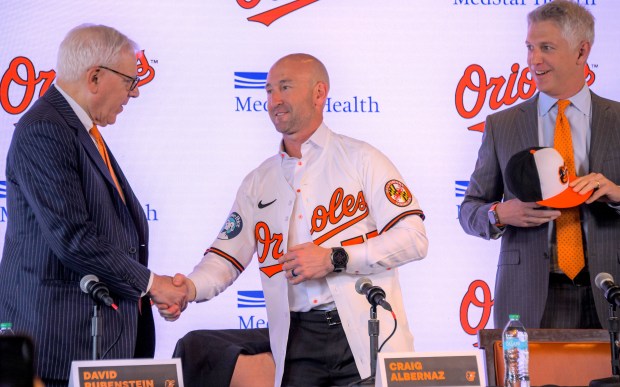 New Orioles manager Craig Albernaz, center, greets owner David Rubenstein, left, alongside president of baseball operations Mike Elias. Albernaz said that “what Mike does best around the offseason is cook.” (Karl Merton Ferron/Staff)
Albernaz’s No. 1 goal is to maximize what already exists in Baltimore and revive a team that entered this past season with late-October aspirations. The roster, though, still needs help, and the Rubenstein-Elias duo needs to decide how lucrative and bold that assistance will be.
It’s shaping up to be one of the most important offseasons in franchise history and certainly in the Elias era.
The Orioles, though, do not — and likely will not — need to chase the biggest, most expensive names on the board. Stop dreaming about the likes of Pete Alonso, Alex Bregman and Kyle Tucker slipping on a shiny new Orioles jersey.
Said Rubenstein: “We don’t feel we need to break records by setting payroll records.”
Rubenstein acknowledged that Elias already has been hard at work scouring through “good players.” That group should include a handful of smart additions who raise the team’s ceiling and, as Albernaz alluded to, help add meaningful ingredients to the team’s current recipe, widely consisting of homegrown talent.
Rubenstein and the Orioles say they boast deep pockets and can operate like a contender. Thus far, they haven’t properly spent nor flexed like one.
Elias’ decisions in the coming weeks and months will tell us exactly how they intend to compete.
Have a news tip? Contact Josh Tolentino at jtolentino@baltsun.com, 410-332-6200, x.com/JCTSports and instagram.com/JCTSports.