
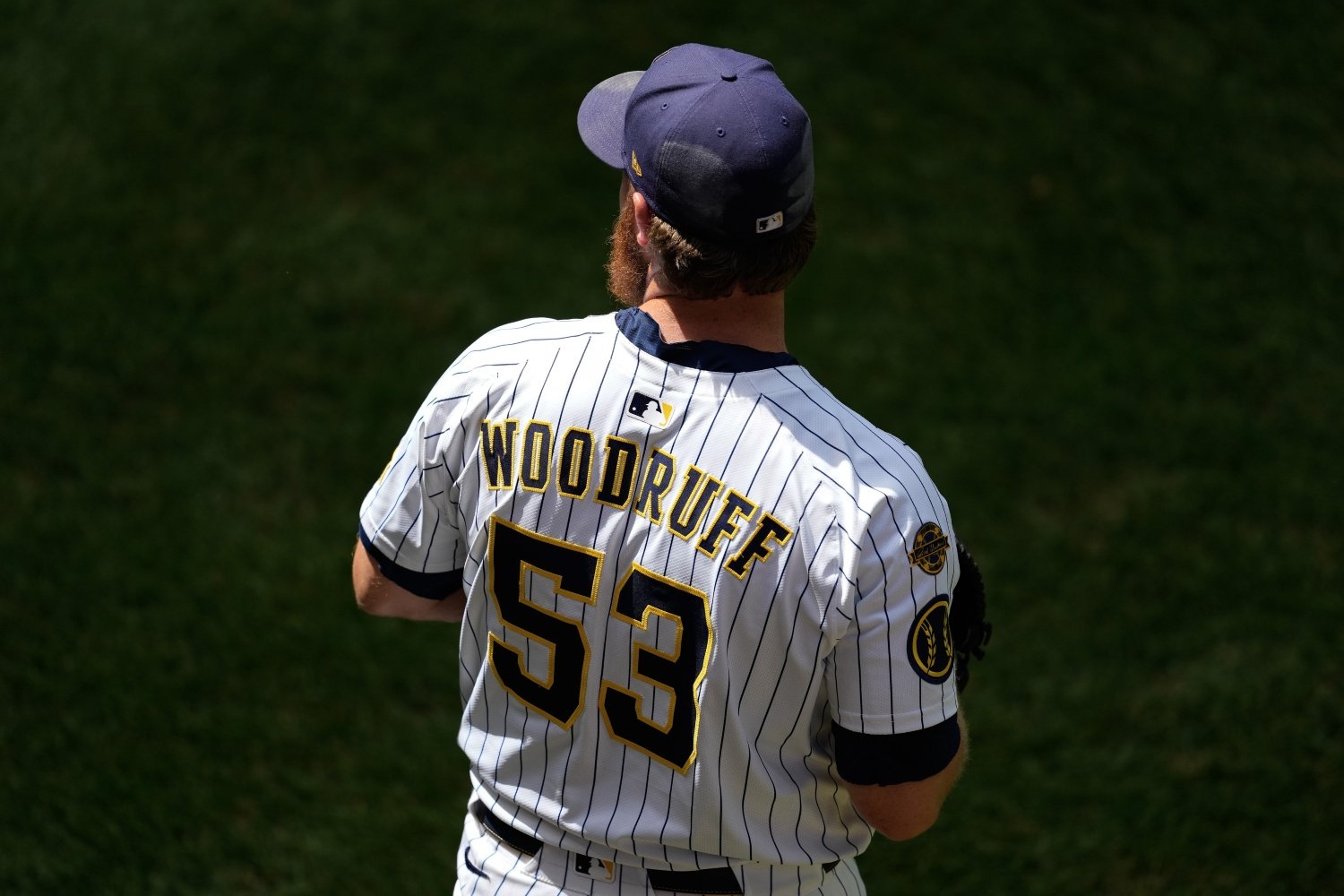
It has already been a busy offseason for the Brewers. After they recently declined options on William Contreras, Rhys Hoskins, and Jose Quintana, Brandon Woodruff declined his half of a $20 million mutual option, opting for a $10 million buyout and free agency. Not yet ready to let go (or at least not for free), though, Milwaukee decided to make a $22.025-million qualifying offer.
Their desire to retain him is understandable. He has been on the team since 2017, longer than anyone else currently on the roster, and has been incredible over that span, pitching to a 3.10 ERA over his eight seasons. Recurring injuries threatened to derail his career, but despite a long layoff and seeing a meaningful decrease in fastball velocity upon his return this year, he still managed to make 12 starts and post a 3.20 ERA.
His tangible pitching abilities aside, without him, Milwaukee has a severe shortage of veteran arms. Assuming no other additions to the rotation are made, Freddy Peralta is the only starter with more than 50 career games under his belt. The Brewers’ young pitching core undoubtedly has a bright future, with budding stars like Jacob Misiorowski and Quinn Priester, but Woodruff’s experience and savvy are ingredients otherwise missing from the stew.
This particular qualifying offer case is more nuanced than most. There’s a reason that, since this system was created in 2012, only 14 players have accepted qualifying offers. Because they represent opposite ends of the bargaining table, it’s rare that both players and organizations can agree upon a fixed value so easily. It’s the same reason mutual options are often declined, and why arbitration requires a neutral third party to be effective. Most of the time, a team won’t extend a qualifying offer unless a player is worth markedly more than its value. Most of the time, a player won’t accept such a deal once it’s offered, because it’s only for one year and their earning power is likely higher than that.
In Woodruff’s case, if he had remained fully healthy for the past few years, he’d absolutely be in the running for a robust free-agent contract that would comfortably exceed the value of the one-year qualifying offer. But because his ability to stay on the field is so uncertain, taking the qualifying offer adds a guaranteed outcome to his future.
For the Brewers, the risk behind the move is similar. They already accounted for injury risk when they signed him to a back-loaded two-year deal in 2024, acknowledging he would be recovering until some time in 2025 but betting on a strong return in the second half of the contract. In hindsight, 12 regular-season and zero postseason starts is hardly worth $17.5 million, but nonetheless, Milwaukee is ready to roll the dice again. After all, while his right lat strain sidelined him for the first two rounds of the playoffs, he’s projected to be fully healthy by Opening Day in 2026.
If Woodruff declines the qualifying offer, the Brewers would receive a compensatory draft pick if he finds a way to maximize his earnings elsewhere. Should Woodruff get more than $50 million in guarantees from a new team, Milwaukee would collect a pick after the first round. If he signs with another team but for less than $50 million, they’ll get a pick just before the start of the third round. Either way, for a team always looking to accumulate as much draft capital as possible, that would be a boost.
If he accepts, Woodruff will be paid handsomely for at least the next year and has a chance to positively impact his stock heading into 2027. The Brewers, remember, are already due to pay him $10 million in 2026 (half in January and half in July), as the buyout on the mutual option Woodruff turned down. Another $22 million would hit their budget pretty hard, so even if he accepts the offer, he might become a trade candidate. Woodruff would have to approve any deal, in that circumstance, but he might be able to make more money by accepting the deal and signing an extension with a new team of his choosing than by heading into the market with the QO around his neck. Certainly, if he does accept the offer, the Brewers will look to move whichever of he and Peralta yields more value in return—be that in the form of young talent or added financial flexibility.
Either way, this circumstance should give the front office some value to work with. Like many free agents who inevitably leave for bigger contracts and new horizons, Woodruff is by no means a must-have piece for next year’s roster—but he sure would make a dandy asset.