
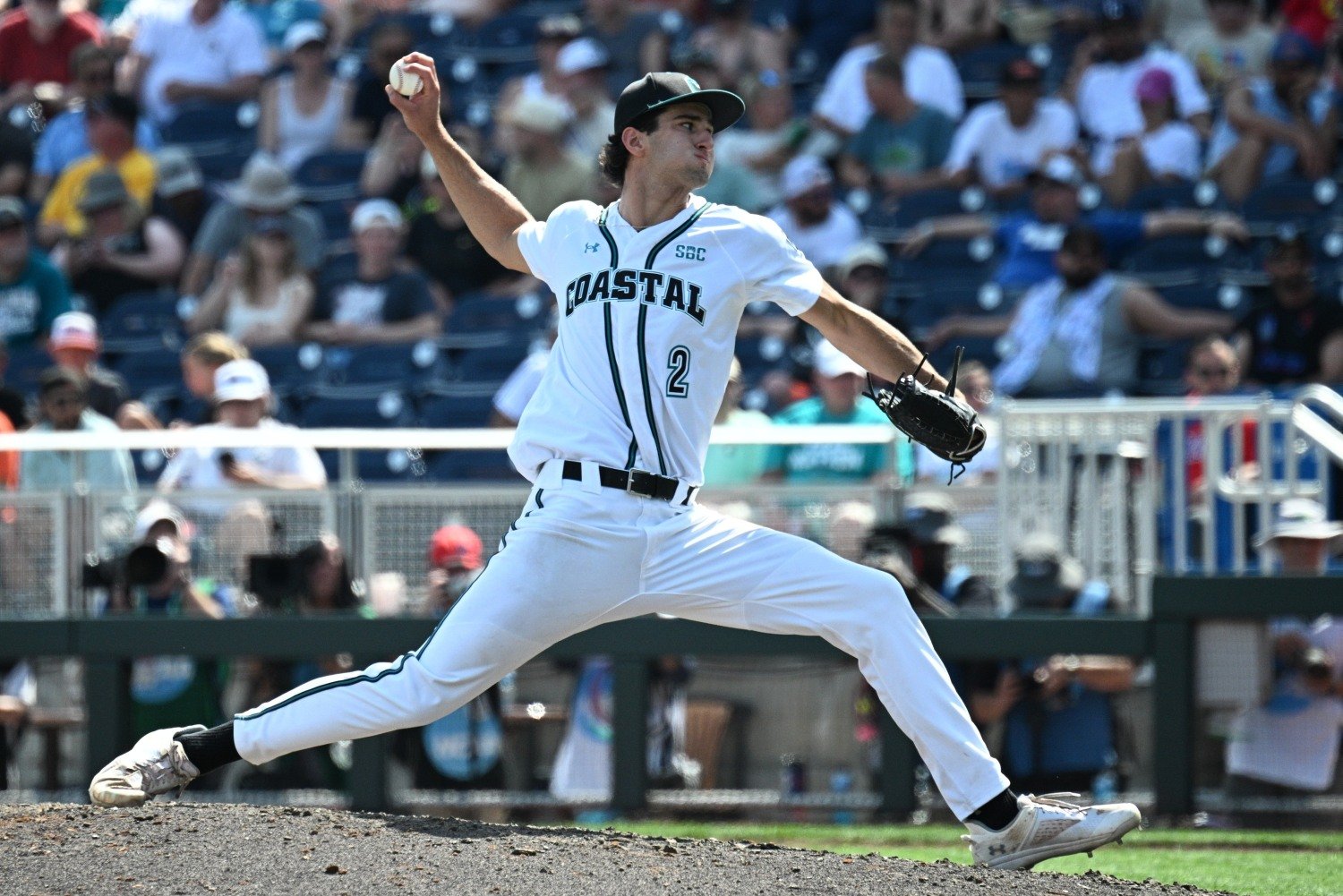
There are some extremely talented collegiate pitchers at the top of the 2026 draft class. We’re used to seeing teams lean into drafting college arms in the middle and late rounds, where the pitching talent outlasts the hitting talent. In recent seasons, though, we’ve seen a trend of elite college starters moving quickly to become major-league contributors, with Trey Yesavage being the best recent example.
The Twins have roughly 60% odds to land a top-3 pick. At this stage, if they maintain that position, I’d guess drafting a college arm is unlikely. If they fall somewhere between 4 and 7, however, all bets are off. Below, you’ll find a profile for the three top college arms in the draft (each of whom I’d consider top-15 type prospects in this draft today).
For each prospect, you’ll find their name, primary position, college, hitting and throwing hands, and their age on draft day 2026. You’ll find a summary of their 2025 performance. Pitchers are listed alphabetically by last name.
Jackson Flora, RHP, UC Santa Barbara, 6’4″, 185 lbs., R/R, 21
75 IP, 3.60 ERA, 3.16 FIP, 27.8 K%, 5.5 BB%
Flora is a right-handed pitcher out of UCSB, whose combination of size, athleticism, and stuff could make him the first arm off the board next July. He’s an elite mover, with great flexibility, explosiveness, and an incredibly quick, whippy arm action. There is some inconsistency in his delivery, with a few too many moving parts. This hasn’t impeded his ability to throw strikes, however. Flora has demonstrated good command of the fastball/slider combination that headlines his arsenal.
Stuff-wise, there’s plenty to like, too. Flora’s fastball sits in the 95-98-mph range, with outstanding carry and a flat approach angle. If he locates it up in the zone, it’s a nightmare pitch to try and square up. Flora has two distinct slider shapes—one acting more as a cutter, and one a sweeper, on which he generates up to 20 inches of horizontal break.
The warts here are landing on another effective pitch (he throws a changeup and curveball very sparingly, and neither is yet a reliable offering) and keeping the ball on the plate. If Flora shoves in 2026, he can cement his contention to be the first arm off the board.
Cam Flukey, RHP, Coastal Carolina, 6’6″, 205 lbs., R/R, 21
101.2 IP, 3.19 ERA, 2.68 FIP, 28.5 K%, 5.8 BB%
Flukey has a strong case to make for the most improved arm in college baseball in 2025, spearheading Coastal Carolina’s run to the College World Series. It’s a great pitcher’s frame, with a ton of projection remaining. Flukey operates from a high three-quarters slot, with a long, deep arm action that seems to provide some deception in his delivery.
The fastball has a chance to be outstanding, but has yet to produce the type of swing-and-miss you’d want to see from it. It sits at 95 mph, but has been up to 98 mph with 19 inches of induced vertical break, albeit from a steeper angle. Flukey also throws a 12-6 curveball in the high 70s, which generated a whiff percentage close to 50% in 2025. That pitch will need to add some firmness when he transitions to pro baseball. There’s a slider in the mix, too (which he threw for strikes over 70% of the time), and a split-change that generated plenty of misses. It feels like Flukey is just scratching the surface of how to leverage his arsenal. If he can thrive with a more balanced pitch mix in 2026, he has the polish and projectability to be a top-10 pick.
Liam Peterson, RHP, Florida, 6’5″, 200 lbs., R/R, 21
69.1 IP, 4.28 ERA, 3.63 FIP, 31.5 K%, 10.5 BB%
Peterson was a top-three-rounds caliber prospect ahead of a loaded 2023 draft, but got to campus at Florida and now has a great chance to be a top-10 overall pick. It’s a big-league frame already,, with premium athleticism and good extension in a delivery that he has worked to make more compact since arriving in Gainesville.
Peterson’s fastball is a weapon. It’s been up to 99 mph, flashing 20 inches of carry at the top of the zone. He made strides with his control of the pitch in 2025, and triple-digits velocity readings seem likely in 2026. It’s paired with a slider (with a ton of downward bite) that he throws for strikes over 60% of the time. Peterson also has a changeup, thrown almost exclusively to left-handed hitters, which averages around 15 inches of drop. Both Peterson’s secondary offerings generated miss rates north of 40% from hitters in 2025. There could be three plus pitches in this profile. The focus in 2026 will be throwing enough strikes. Peterson cut his walk rate by 4% in 2025, but at 10.5%, it could stand to come down a little more to cement him in consideration for a top pick in July.
Check out our 2025 draft tracker, updated with signing bonsues, scouting reports, news, and much more!